
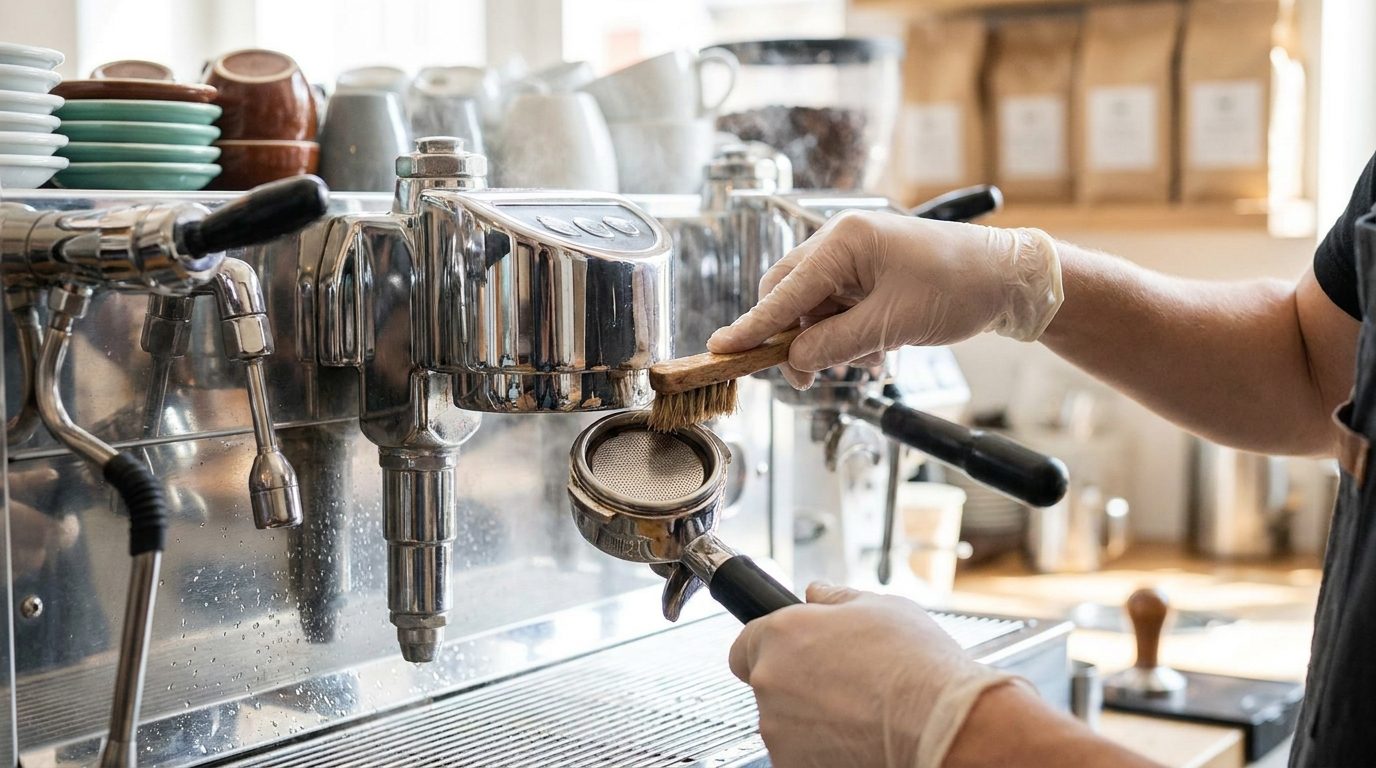
A commercial espresso machine needs three layers of cleaning: a daily close-down (backflush the groups with detergent, brush the group heads, soak baskets and portafilters, purge and wipe the steam wands, empty and rinse the knock box), a weekly deep clean (shower screens off, gaskets inspected, grinder burrs and hopper degreased, drip tray and drain line flushed), and a periodic service cycle (gasket and screen replacement, water filter change, descaling where your water demands it). Skip the daily layer and the weekly one stops working; skip the water layer and the machine fails early regardless of how clean the group heads look.
This is the routine, in the order a cafe actually performs it, with the reasons behind each step so your team can be trained rather than just instructed.
Why cleaning is an extraction issue, not a hygiene issue
Coffee oils oxidise. A film of rancid oil in the group head, dispersion screen or filter basket does not simply sit there — it dissolves into every shot passing through it, and tastes ashy and sour in a way no grind adjustment fixes. Baristas chase the grinder for days before someone pulls the shower screen and finds the cause.
Milk behaves worse. Protein and sugar bake onto a hot steam wand within seconds, and inside an unpurged wand tip milk residue is drawn back into the steam path as the boiler cools. That residue is why some cafes cannot get stable microfoam by mid-afternoon, and it is why the wand should be purged and wiped after every single jug, not at the end of the shift.
The third failure mode is mechanical. Group gaskets and the three-way discharge path are designed to be flushed. When they are not, grounds compact where the seals move, the group leaks around the portafilter, and a five-minute weekly task becomes an unplanned closure.
The daily routine: open, service, close
Opening. Flush each group for a few seconds to clear anything that sat in the line overnight. Purge each steam wand before the first jug — condensate collects in the wand while the boiler comes up to pressure. Wipe down the drip tray and check the water supply is open before the first order lands.
During service. After every milk jug: purge the wand, wipe it with a dedicated damp cloth kept only for that purpose, purge again. Between shots, flush the group briefly and wipe the basket rim so the gasket seats cleanly. Keep the knock box emptied rather than packed — a compacted box is where baristas start knocking pucks against the drip tray. A drawer-style unit such as the Stainless Steel Knock Box Drawer keeps the knocking bar at a fixed height.
Closing. This is the part that matters. Remove the baskets, fit a blind filter to each group and backflush with an espresso machine detergent at the dose its manufacturer specifies. Backflush, pause, repeat, then repeat with plain water until no foam or colour returns. Brush the group head while flushing so loosened residue leaves the machine. Soak portafilters — metal body only, handles out of the water — plus baskets and shower screens in warm detergent, then rinse and dry.
Milk equipment gets the same discipline. Rinse every jug immediately after use rather than stacking them; dried milk in the pouring spout is a hygiene finding waiting to happen. A dedicated purging jug such as the Milk Frothing Pitcher (450ml/15oz) keeps service jugs out of the drip tray. Countertop frothers used for back-bar drinks — the Smith And Nobel Milk Flother and the Kogan Milk Flother among them — should be emptied, rinsed and dried the moment the last drink goes out.
Maintenance schedule at a glance
| Task | Frequency | Why it matters | Sign you left it too long |
|---|---|---|---|
| Purge and wipe steam wands | Every jug | Stops milk baking into the tip and being drawn back into the wand | Wand spits; foam turns coarse and short-lived |
| Group flush and basket wipe | Between shots | Clears grounds so the gasket seals cleanly | Water sprays past the portafilter rim |
| Detergent backflush, brush groups | Daily, at close | Removes oil from the group, screen and discharge valve | Bitter, ashy shots that grind changes cannot fix |
| Soak portafilters, baskets, screens | Daily, at close | Oil films re-contaminate every shot | Dark stained baskets; slow, uneven flow |
| Empty and wash knock box, drip tray, drain | Daily | Prevents drain odour and fly attraction | Standing water and sour smell at the bench |
| Remove and inspect shower screens and gaskets | Weekly | Catches hardening seals before they leak | Portafilter sits loose or over-rotated |
| Degrease grinder hopper, brush burr chamber | Weekly | Rancid oil in the chamber flavours fresh coffee | Stale aroma when the hopper is opened |
| Replace group gaskets and shower screens | When hardened or leaking | Restores seal and even dispersion | Leaks that reappear days after cleaning |
| Check or replace water filtration media | On the filter's service interval | Controls scale before it reaches the boiler | Slower fill, noisier heating, temperature drift |
| Technician service and internal inspection | Periodically, per machine | Valves, pumps and safety components need eyes on them | Repeat faults nobody can pin down |
Water and scale: the failure that is never on the cleaning rota
Nothing on a bench cleaning list protects a boiler. Scale forms from dissolved minerals in the supply water, and Sri Lanka's groundwater is frequently hard — many cafes outside the mains network are drawing from a well or a tank fed by one. Scale plates onto the heating element and the boiler wall, insulating it so the machine works harder for the same temperature, and it narrows the small internal passages that control flow. The symptoms arrive gradually: longer recovery between drinks, temperature drift across a busy hour, then a fault.
Treat water as equipment. Establish what your supply is like before you commission the machine, fit filtration or softening sized to your daily volume, and log filter changes on the same calendar as the group gaskets. On tank water, sediment pre-filtration matters as much as hardness treatment.
Do not forget the grinder
The grinder is the dirtiest device on the bench and the least frequently cleaned. Oil accumulates in the burr chamber and the exit chute, then contaminates fresh beans. Weekly: empty and wash the hopper, dry it fully, brush the burr chamber and chute, and vacuum out fines. Burrs also wear — when the same dose starts producing a different shot time with no other change, worn burrs are a stronger suspect than the beans.
Low-use grinders hold stale oil longer, so back-bar units need the same treatment. The S+N Coffee Grinder and similar machines in the coffee grinders range belong on the same weekly rota as the main grinder.
How to choose the cleaning kit you actually need
Work through this before you write the rota:
- A detergent made for espresso machines, used at the stated dose. Household cleaners are not a substitute and can damage seals.
- A blind filter that fits your portafilter — sizing is by group standard, so check the basket you have before buying.
- A group brush with a heat-tolerant head, plus a separate brush for the grinder chamber.
- Dedicated cloths, colour-coded: one for steam wands, one for the bench, never interchanged.
- A knock box positioned at knocking height, not a bin under the bench.
- A soaking container deep enough for the portafilter body but not the handles.
- A tamper and distribution tool that match your basket diameter — 58mm tools fit 58mm baskets and nothing else, so measure first.
- A bottomless portafilter for diagnostics, such as the 58mm Bottomless Portafilter, 2 Ears with Double Cup Filter Basket, which shows channelling and basket wear that a spouted portafilter hides.
Frequently asked questions
How often should you backflush a commercial espresso machine? Flush the groups with water between shots and backflush with detergent once a day at close for most cafes. High-volume sites often backflush with detergent at the end of each shift instead. The rule is simple: detergent backflushing belongs to a fixed close-down step so it is never left to memory.
Can I clean an espresso machine without chemicals? Water flushing removes loose grounds but not the oil film, which is what taints extraction. A purpose-made espresso machine detergent is the only reliable way to strip the group, screen and discharge valve. Rinse until no foam or colour returns so no residue reaches the next shot.
Why does my espresso taste bitter even after adjusting the grinder? Suspect residue before recipe. Rancid oil in the shower screen, basket or grinder chute produces a persistent ashy bitterness that no grind or dose change removes. Pull the screen, soak the baskets, brush the grinder chamber, then retaste before touching the grinder setting again.
How do I stop my steam wand from blocking? Purge before and after every jug and wipe immediately with a dedicated damp cloth, while the residue is still soft. Soak the tip periodically in a milk-line cleaning solution. A wand that spits or steams unevenly usually has hardened milk inside the tip holes rather than a boiler fault.
Does hard water really damage a coffee machine? Yes. Dissolved minerals deposit as scale on the heating element and inside narrow flow passages, causing slower recovery, temperature drift and eventual failure. Filtration or softening sized to your daily volume, with a logged replacement interval, is cheaper than the boiler work that follows neglect.
Setting your cafe up to keep the routine
A cleaning schedule survives staff turnover only when the tools live at the bench and every task has an owner on the rota. Build the kit once and the daily close-down becomes a predictable, teachable routine rather than an argument.
Browse the coffee machine cleaning and maintenance accessories at Trendy Zone Lanka to assemble that kit, and see the commercial espresso machine range if you are also planning a machine upgrade. If you are still deciding which machine class fits your site, start with our coffee machines buyer's guide for Sri Lanka, and for a home setup that borrows the same discipline see the home espresso setup guide.
Share:
Milk frothing pitcher size guide: choosing the right jug for latte art
Home espresso machine setup: what you actually need to buy first