
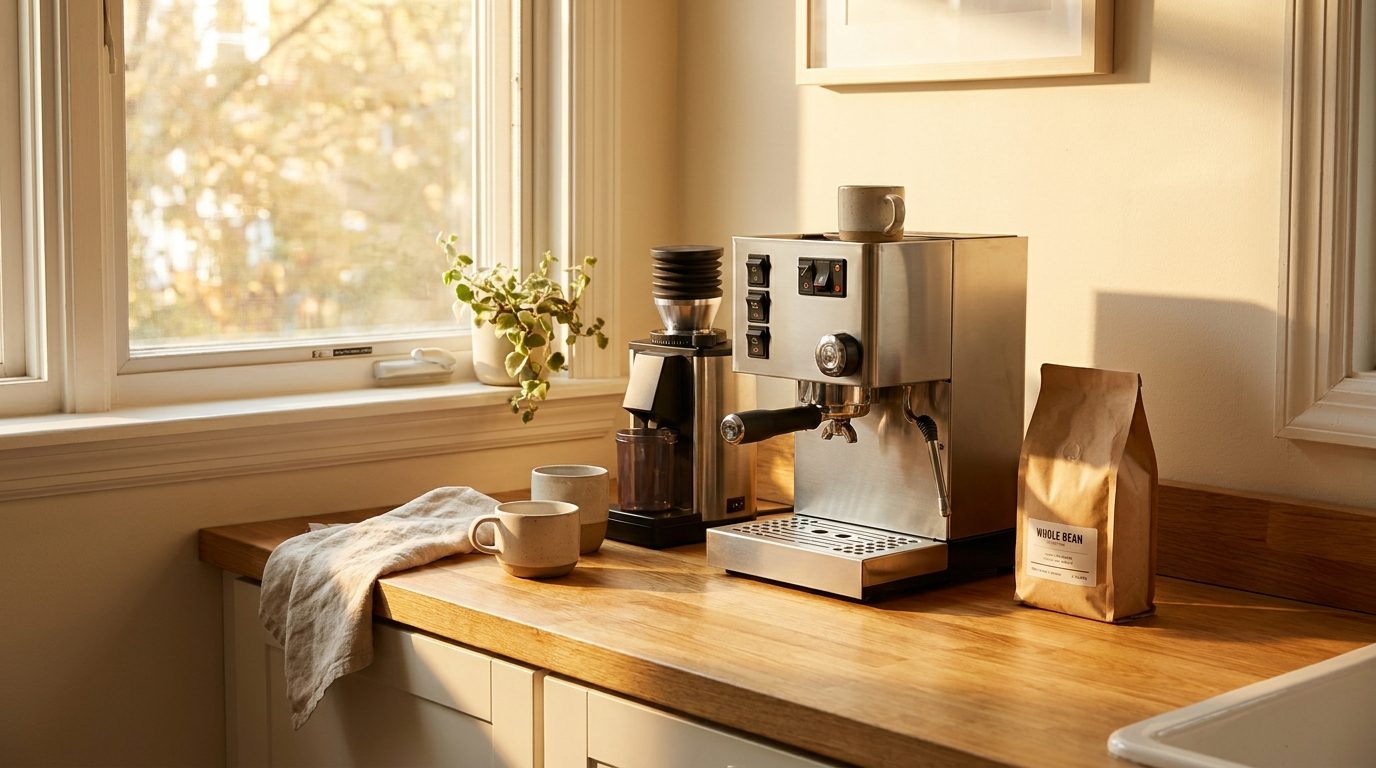
A home espresso machine setup is four parts, not one: a pump espresso machine with a portafilter, a grinder you can adjust in fine steps, a tamper and scale matched to your basket, and water that will not scale the boiler. Most disappointing home setups fail on the second and fourth of those, not the first — a good machine fed by a coarse, inconsistent grinder and hard tap water will never produce a repeatable shot.
This guide walks through the decisions in the order you should make them, for a kitchen in Colombo, Wattala or anywhere else in Sri Lanka where humidity and water hardness both work against you.
Start with the shot you want to make
Be honest about the drink. If your household drinks milk-based coffee — flat whites, cappuccinos, iced lattes — you need a usable steam wand and enough recovery to steam a jug after pulling a shot. If you drink espresso and long black, steam performance barely matters and the money belongs in the grinder. If nobody wants to spend four minutes on a coffee before work, a capsule machine is the honest answer.
That single decision eliminates most of the catalogue before you compare anything.
Machine types for home use
| Type | How it works | Best for | Trade-off |
|---|---|---|---|
| Pump machine, pressurised basket | Basket has a restrictor that builds pressure regardless of grind | First espresso machine; pre-ground or supermarket coffee | Forgiving but caps quality; crema is generated mechanically |
| Pump machine, non-pressurised basket | Pressure comes from your grind, dose and tamp | Learning real espresso; single-origin beans | Demands a proper burr grinder or every shot gushes |
| Machine with integrated grinder | Grinder, dose and tamp built into one footprint | Small kitchens; one-appliance setups | Grinder quality is fixed; a fault takes both functions offline |
| Bean-to-cup / fully automatic | Grinds, doses, brews and often froths at a button | Households wanting speed and consistency | Least control over extraction; more internal parts to clean |
| Capsule machine | Sealed capsule, fixed dose and pressure | Offices, guest rooms, low-volume households | No control at all; ongoing capsule dependency |
| Manual / vintage-style lever or steam unit | Manual or steam-driven extraction | Enthusiasts who enjoy the process | Steepest learning curve; least consistent shot to shot |
A note on the "bar" figure in machine names. A Sokany 5Bar Coffee Machine and a Sokany 15 Bar Espresso Coffee Machine are quoting the pump's rated maximum pressure, not the pressure applied to your coffee during extraction. Espresso is conventionally brewed at around nine bar; a higher rated pump gives headroom, not better coffee. Use the figure to distinguish pump machines from steam-pressure novelty units, and then ignore it.
Choosing the machine body
For a first proper setup, a compact pump machine with a standard portafilter is the most useful starting point. Something in the class of the Delonghi Stilosa Espresso Machine gives you a real portafilter, a manual steam wand and a small footprint, which is often the deciding factor in a Sri Lankan kitchen where bench space is contested. A slimmer body such as the Delonghi Dedica Pump (Arte) Espresso Machine suits a narrow counter where depth is available but width is not.
If you want the grinder solved in the same purchase, machines with a built-in grinder such as the Smith+Nobel 15 Bar Espresso Machine with Grinder collapse three devices into one bench position. The trade-off is real: you cannot upgrade the grinder independently, and a service visit takes your whole coffee capability with it.
For households that want the machine to do more of the work, look at the Sokany 1350w Multifunctional Espresso Machine. Compare the full home and domestic coffee machine range side by side before committing, because footprint and water tank access differ more than the headlines suggest.
The grinder decides your ceiling
Espresso is the most grind-sensitive brewing method there is. Extraction is controlled by particle size: a burr grinder produces consistent particles, a blade grinder produces gravel and dust in the same batch. With inconsistent grounds, water channels through the fast paths and under-extracts the rest — sour and thin, whatever you do at the machine.
Buy a burr grinder with fine adjustment steps. A stepped domestic grinder such as the De'Longhi KG200 Coffee Grinder is a reasonable entry point for filter and pressurised-basket espresso; for a non-pressurised basket, prioritise the finest adjustment range you can get. Compare the coffee grinder range against the basket type your machine uses, because that pairing — not the machine badge — decides whether you can dial a shot in.
Grind fresh, and grind only what you are about to brew. In a humid climate, pre-ground coffee sitting in an open container goes flat within days.
Water, scale and Sri Lankan conditions
Two local realities shape a home setup here.
Water hardness. Groundwater in much of Sri Lanka carries a high mineral load, and homes on well or tank supply are especially exposed. Those minerals plate out as scale in the boiler and the narrow flow paths, and the machine turns slower, noisier and less stable long before it fails. Use filtered water in the tank and descale on a schedule rather than on symptoms. Avoid distilled water — machines rely on some mineral content for taste and level sensing.
Humidity. Ambient moisture makes beans and ground coffee behave differently week to week. Store beans in an airtight container away from the stove, buy in quantities you will finish within a few weeks, and expect to adjust your grind slightly as the weather changes. A shot that ran perfectly last month and gushes today is usually humidity and bean age, not a machine fault.
Setting up the bench
Plan the physical space before delivery day:
- Clearance above the machine for the water tank lid or the bean hopper — the most common installation surprise is a cupboard that blocks refilling.
- A dedicated socket on a circuit that is not shared with another heating appliance.
- A knock and rinse zone near the sink so grounds do not travel across the kitchen.
- Drainage or a drip tray you can empty easily, particularly for machines with a hot water outlet.
- Somewhere for the grinder that does not require moving it for every use.
Tools matter more than they look. A tamper that matches your basket diameter, a scale that reads to a tenth of a gram, and a milk jug sized to your usual cup will make more difference to your first month than any accessory. The 58mm Tamper fits 58mm baskets only — measure the basket you have, since many domestic machines use a smaller diameter. A Coffee Scale with Timer, Espresso Scale with Auto Tare turns dialling in from guesswork into a recorded process.
How to choose your home espresso setup
Work down this list in order:
- Drink type — milk-based drinks require usable steam; black coffee does not.
- Basket type — pressurised if you will use pre-ground or supermarket beans, non-pressurised only if you are buying a proper burr grinder.
- Grinder — budget for it in the same purchase, not "later". It is the ceiling on everything.
- Bench footprint — measure width, depth and the clearance above for the tank and hopper.
- Water plan — filtered water in the tank plus a descaling schedule, decided before first use.
- Volume per day — three or more milk drinks in a row means you need recovery time between steaming and brewing, which favours a larger machine.
- Tolerance for routine — a machine you must clean daily is only worth owning if you will clean it daily.
- Accessories from day one — tamper matched to basket, scale, jug, brush and a rinsing cloth.
Frequently asked questions
What do I need to set up espresso at home for the first time? A pump espresso machine with a portafilter, a burr grinder with fine adjustment, a tamper matched to the basket diameter, a scale, a milk jug if you drink milk-based coffee, and filtered water. Buy the grinder at the same time as the machine rather than postponing it.
Is 15 bar better than 5 bar for a home espresso machine? Not directly. The figure is the pump's rated maximum, while espresso is normally extracted at around nine bar. A higher rating indicates a pump machine rather than a steam-pressure unit, which is useful, but it says nothing about temperature stability, build or shot quality.
Do I need a separate grinder if my machine has one built in? No, and an integrated grinder saves bench space and a second purchase. The compromise is that you cannot improve the grinder independently, and any service on the machine removes both functions. Separate units cost more space but give more control and easier replacement.
Can I use tap water in a home espresso machine in Sri Lanka? Filter it first. Much of the local supply, particularly well and tank water, is hard enough to scale a boiler noticeably within months. Use filtered water in the tank and descale on a fixed schedule. Avoid distilled water, which lacks the minerals machines need for taste and level sensing.
Why does my espresso pour too fast and taste sour? Usually the grind is too coarse or the dose too low, so water finds fast channels and under-extracts. Grind finer, keep the dose consistent by weight, and distribute the grounds evenly before tamping. In humid weather you may need to adjust the grind more often than you expect.
Where to start
Decide the drink, then the basket type, then the grinder — and only then choose between the machine bodies that fit your bench. Compare the home espresso machines available in Sri Lanka with those criteria in hand, and add the tamper, scale and jug to the same order so your first week is not spent improvising.
For a broader view of the category, including commercial options if you are also equipping a small business, see our coffee machines buyer's guide for Sri Lanka. If you want to borrow the cleaning discipline that keeps cafe machines consistent, the commercial espresso machine maintenance schedule scales down neatly to a home bench.
Share:
How to clean a commercial espresso machine: a maintenance schedule that holds up in service
Why your ice machine is not making ice: water, scale, heat and airflow