
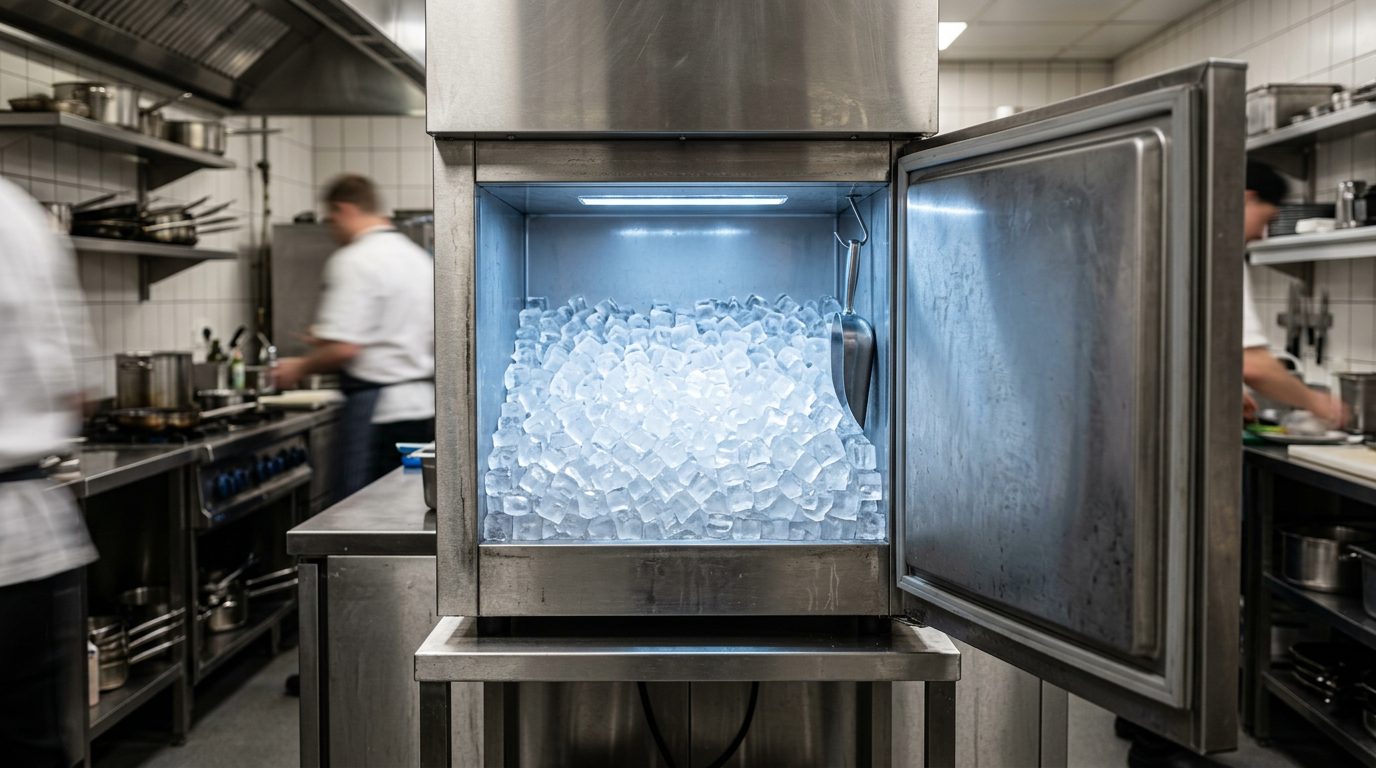
When an ice machine stops making ice, the cause is usually water or heat rather than a failed compressor. In order of likelihood: scale or sediment blocking the water distribution and float system, a clogged condenser or air filter starving the machine of airflow, an inlet water supply that has been shut off or throttled, an installation with too little clearance in a hot kitchen, or a machine that is simply overdue for its cleaning cycle. Work through those five before assuming the refrigeration circuit is at fault.
This guide covers water quality, scale, humidity and troubleshooting. If you are still deciding which machine to buy, the ice cube machine buying guide for Sri Lanka covers capacity classes, cube types and selection.
Troubleshoot in this order
1. Check the water first. Confirm the inlet valve is fully open and the line is not kinked. Low pressure produces thin, hollow or partial cubes before it produces none. Check the filter too — one left past its interval strangles flow before it stops filtering.
2. Check airflow. Most kitchen machines are air-cooled, rejecting heat into the room through a condenser. A condenser coated in grease and dust cannot do that, so cycles lengthen, output falls and the machine trips on high pressure. It is the most common preventable failure.
3. Check clearance and ambient conditions. A machine boxed into a corner recirculates its own hot exhaust. Daily output is rated under reference air and water temperatures, so a hot, humid, poorly ventilated kitchen always produces below that rating — and a boxed-in machine far below it.
4. Check the ice itself. Cloudy, soft, small or fused cubes are diagnostic — see the table below.
5. Check the bin. If ice is being made but the bin looks empty, look at melting and at the bin level sensor. A machine stopped by a sensor that thinks the bin is full behaves exactly like one that cannot make ice.
Symptom to cause: what the ice is telling you
| Symptom | Most likely cause | Check first |
|---|---|---|
| No ice at all, machine running | Water supply closed, blocked filter, failed inlet valve | Inlet valve, filter age, water pressure at the machine |
| No ice, machine not running | Bin full sensor, power, safety trip after overheating | Bin sensor, breaker, condenser cleanliness |
| Thin, hollow or partial cubes | Low water flow, scale in the distribution system | Filter, spray jets, water distributor for scale |
| Cloudy or white cubes | High mineral or sediment load in the feed water | Water treatment, sump cleanliness, purge cycle |
| Soft cubes that melt quickly | Short freeze cycle, poor airflow, high ambient heat | Condenser, clearance around the machine, ventilation |
| Cubes fused into a sheet | Incomplete harvest, scale on the evaporator | Cleaning cycle, evaporator surface, harvest timing |
| Slime or odour in the bin | Overdue sanitising, warm bin, contaminated air path | Sanitising schedule, bin drain, air filter |
| Output halved but ice looks fine | Dirty condenser, ambient heat, machine undersized for demand | Condenser, room temperature, actual peak demand |
Water quality is the whole problem
An ice machine is a water processing appliance that happens to use refrigeration: everything in the water either arrives in the ice or stays behind in the machine.
Hardness and scale. Dissolved calcium and magnesium deposit on the evaporator plate, the water distributor and the spray jets. Scale insulates the evaporator, so freeze cycles lengthen and cubes release badly; scale narrows the jets unevenly, so some cubes form thin. Groundwater across much of Sri Lanka is hard, and premises on well or tank supply are most exposed. Scale is not a fault but the predictable outcome of untreated water, which is why descaling is a scheduled task rather than a repair.
Sediment. Tank and well supplies carry particulates that settle in the sump and block jets. A sediment pre-filter ahead of the machine protects everything downstream.
Taste and odour. Ice absorbs whatever the water carries, plus odours from the air path and bin. Guests notice ice that tastes of chlorine before anything else on the table.
What to do. Establish what your supply is — mains, tank or well — before installing. Fit filtration matched to it, log the filter interval, and descale on schedule with a cleaner made for ice machines rather than improvising.
Heat, humidity and where the machine sits
Sri Lanka's humidity affects ice machines twice over. Warm, moist air raises the heat load the condenser must reject, so an air-cooled machine works harder for the same output; and humid air condensing on cold surfaces feeds microbial growth in the bin and air path, which is why sanitising intervals matter more here.
Placement rules:
- Keep the stated clearance on the ventilation faces; never push the machine flush to a wall or into a recess.
- Do not install beside the fryer, range or oven exhaust — rejected heat plus radiant heat is the fastest route to lost output.
- Give the drain a continuous fall to the gully; a flat or rising run backs water into the bin.
- Where the kitchen is hot and unventilated, site a workbench unit in a cooler service area rather than forcing a large machine into a hot corner.
Cleaning and sanitising schedule
- Daily: wipe external surfaces and the bin door seal; check that the bin is draining and that no water is standing.
- Weekly: empty the bin, wash and sanitise the interior, and store the scoop outside the bin rather than buried in the ice.
- Monthly: clean the condenser fins and wash any air filter — more often where fryers are nearby, since grease loading is the variable.
- Per the machine's interval: run a full descaling and sanitising cycle with a proper ice machine cleaner.
- Ongoing: replace filtration media on the interval it is rated for, logged rather than guessed.
Two habits cause most bin contamination: leaving the scoop in the ice, and using the bin to chill bottles.
Decision checklist before you call a technician
- Is the water supply valve fully open and the line unkinked?
- When was the water filter last changed, by date rather than memory?
- Is the condenser visibly clean, and has the air filter been washed this month?
- Does the machine have full clearance on all ventilation faces?
- Has the room got hotter — new equipment nearby, ventilation blocked, extract fan off?
- Is the bin sensor clear of ice build-up, and is the bin actually empty?
- When was the last full descale and sanitise cycle?
- Is the drain running freely with a continuous fall?
- Has demand grown since the machine was chosen?
- If all of that checks out, call a refrigeration technician rather than opening the sealed system.
Water, airflow, cleaning and placement are operator territory. The refrigeration circuit is not.
When the answer is capacity, not maintenance
Sometimes nothing is broken: the machine produces what it was built to produce and the business has outgrown it. Rated output is measured under reference conditions, so expect less in a hot kitchen with warm feed water.
If you run out by mid-service repeatedly, compare capacity classes instead of repairing. Workbench formats such as the Industrial 80Kg Ice Machine Workbench and the Industrial Stainless Steel Ice Cube Maker 30Kg suit bars and cafes where ice is used where it is made. Higher classes such as the Industrial Ice Cube Machine 150KG suit hotels and production kitchens drawing from a central bin, while a class like the Industrial Ice Cube Machine 45KG fits a single busy outlet. A Kogan 12kg Ice Cube Maker(Domestic) is a household device and should not be asked to carry service volume.
For shaved or crushed applications, the Industrial Multi-purpose Cube Ice Shaver Machines and the wider ice crushers and shavers range handle the conversion rather than running a cube machine harder.
Frequently asked questions
Why is my ice machine running but not making ice? Start with water: a closed or throttled inlet valve, a blocked filter or a scaled water distributor will stop ice formation while the machine keeps cycling. Then check the condenser and air filter, since restricted airflow lengthens cycles until production effectively stops. Only after those checks is a refrigeration fault likely.
How often should a commercial ice machine be cleaned? Wipe surfaces daily, sanitise the bin weekly, clean the condenser and air filter monthly, and run a full descaling and sanitising cycle on the interval the machine specifies. Kitchens with fryers nearby need more frequent condenser cleaning because grease loads the fins faster than dust alone.
Does hard water stop an ice machine from working? It does, gradually. Scale builds on the evaporator and inside the spray jets, lengthening freeze cycles and producing thin, cloudy or fused cubes before production drops. Filtration matched to your supply plus scheduled descaling prevents this. Sites on well or tank water should also fit a sediment pre-filter.
Why is my ice cloudy or melting too fast? Cloudy ice usually means a high mineral or sediment load in the feed water, or a sump that is overdue for cleaning. Fast-melting, soft cubes usually mean a shortened freeze cycle caused by poor airflow, high ambient temperature or a dirty condenser rather than a water problem.
Can I put an ice machine next to the cooker or fryer? Avoid it. Air-cooled machines reject heat into the room, and placing one beside a heat source raises both the intake air temperature and the condenser load, cutting output and shortening component life. Site it in a cooler, ventilated area with full clearance on the ventilation faces.
Keeping ice supply reliable
Ice failures are usually scheduled failures that nobody scheduled. Put filter changes, condenser cleaning and the descale cycle on the same calendar as your refrigeration checks and output holds through the hot months.
If the machine is simply too small for the trade, compare capacity classes in the commercial ice cube machine range. For how ice, chillers and freezers work together across a service, see our restaurant cold chain guide for Sri Lanka and the commercial chillers and refrigerators range.
Share:
Home espresso machine setup: what you actually need to buy first
Types of commercial refrigerators and which one your kitchen needs