
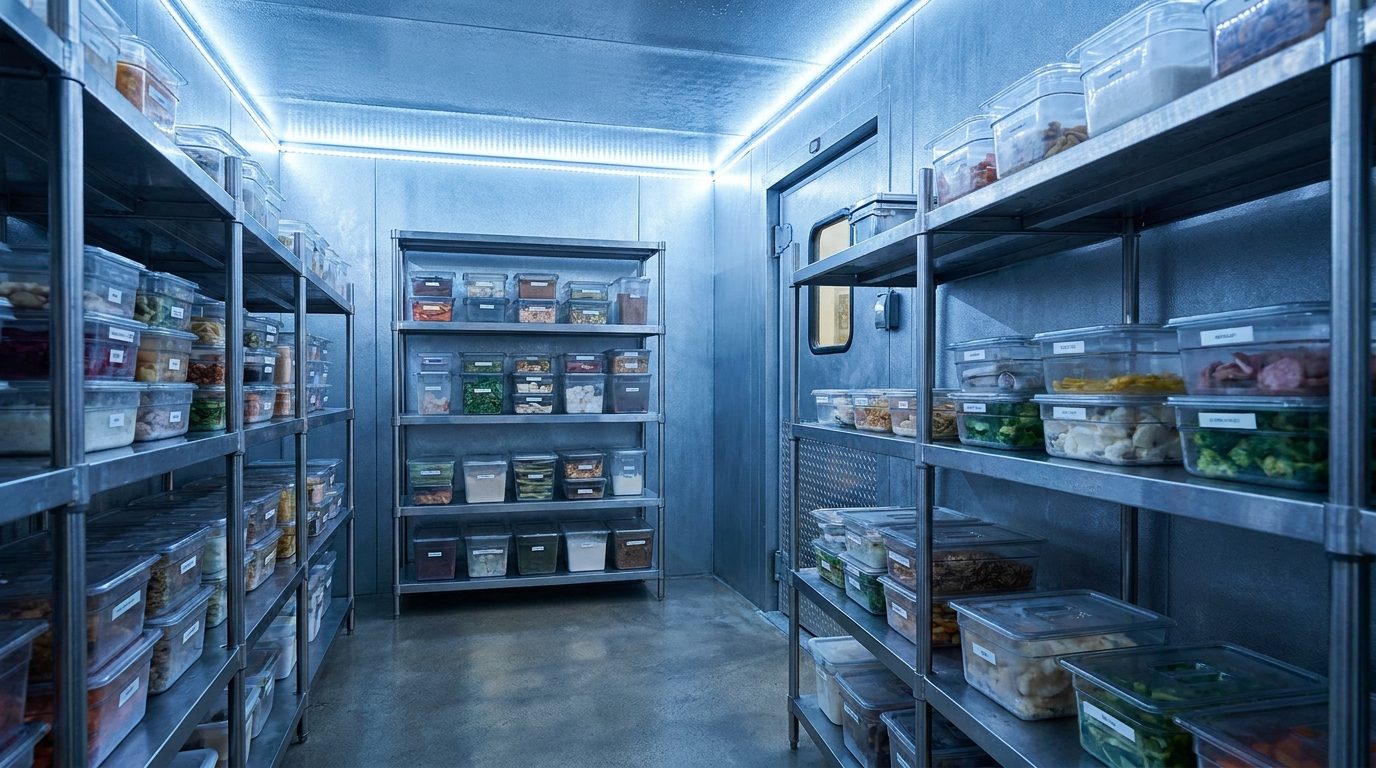
Cold storage for a restaurant is not one cabinet, it is a chain: product arrives cold, gets into refrigeration before it warms, is held at a stable temperature in a zone that matches how fast it moves, is cooled quickly after cooking, and is monitored at every step. The chain breaks at the joins — the loading area, the trolley waiting outside the walk-in, the tray of curry left to cool on the bench — far more often than it breaks inside a working cabinet.
This guide covers the operational side of cold storage: where the chain fails, how to design the flow so it does not, and what to monitor. If you are choosing between cabinet formats rather than planning the operation, start with our guide to the types of commercial refrigerators.
The chain, stage by stage
| Stage | Where it fails | Control | Equipment that supports it |
|---|---|---|---|
| Receiving | Product sits on the loading bay while paperwork is checked | Check temperature at the door, then put away immediately | Reserve upright chillers and freezers close to the delivery route |
| Bulk storage | Doors held open while staff search; cabinets overfilled | Labelled zones, stock rotation, airflow clearance | Multi-door upright chillers and freezers |
| Decanting and prep | Product left out during long prep sessions | Work in batches; return to cold between batches | Refrigerated prep benches and undercounter units |
| Station holding | Station cabinet used as bulk storage | Hold only the service's worth at the station | Undercounter chillers and freezers |
| Cooling after cooking | Hot food cooled slowly on the bench or in a storage freezer | Rapid pull-down as a defined process step | Blast freezer or blast chiller |
| Service and display | Product held warm-cold at the pass or counter | Time-limited display, restocked in small lots | Display and merchandising cabinets |
| Ice | Warm bin, contaminated scoop, ice used as a chilling method | Treat ice as a food item with its own hygiene routine | Ice machines with a cleaning schedule |
Receiving is the stage most kitchens skip
Chilled and frozen deliveries are most vulnerable in their first ten minutes on your premises. Product that travelled well can lose the whole benefit waiting at the back door for a signature.
Fix it with process, not equipment. Check temperature at the door before signing. Name a person responsible for putting cold deliveries away first, before dry goods. Keep the route to the reserve cabinets short and unobstructed, and where it is not, use a trolley so the transfer takes one trip rather than five armfuls — the trolleys range exists for exactly this.
Position reserve refrigeration accordingly: a multi-door cabinet such as the Up Right Chiller 02 Big Doors (High Quality) near the delivery route does more for the chain than a larger cabinet at the far end of the kitchen.
Zone storage by how fast product moves
The most common cold-storage design error is treating all refrigeration as interchangeable. It is not — it is a hierarchy:
Reserve. Deliveries and bulk stock, opened a few times a day. Bulk frozen belongs here, in an upright such as the Industrial Up-Right Freezer 02 Big Doors(MQ), whose door stays shut for hours.
Working store. Prepped mise en place and part-used stock, opened many times a shift. This is where an Industrial Under Counter Chiller 380L(with back splash) earns its place.
Station holding. Only what the station will use this service. An Industrial Undercounter Freezer 2 Door 300L with Backsplash at the fryer or grill keeps the reserve freezer shut for the whole service — worth more than its own capacity suggests.
Assembly. Cold prep lines where product goes from cabinet to plate. An Industrial Chillering Working Bench 490L puts storage and work surface in one position.
Every item moved down this hierarchy reduces door openings on the cabinet above it. That is the whole logic of zoning, and it matters more in a hot kitchen, because every opening admits warm, moist air the cabinet then has to remove.
Cooling cooked food is a process, not a wait
Cooked food passes back down through the temperature range where bacterial growth is fastest, and how long it spends there is the largest food-safety variable in most kitchens. Leaving a full gastronorm of rice or curry on the bench to "cool down" is slow at the centre of the pan, and slower still in a humid kitchen.
Two practical rules. First, reduce the depth of the load: shallow pans cool far faster than deep ones, and dividing a batch costs nothing. Second, use equipment designed for pull-down. A unit such as the Industrial Blast Freezer 05 Shelves (Linkrich) is built to absorb a hot load; a storage freezer is not, and loading hot pans into one raises the temperature of everything inside.
In any batch production — cook-chill, bakery, catering, banqueting — this stage is where a cold chain either works or is fictional.
Monitoring, labelling and the daily routine
Cold storage is a records discipline as much as an equipment one.
- Temperature checks at fixed points in the day, written down, for every cabinet. A cabinet drifting for a week stays invisible until someone reads the trend.
- Date and batch labelling on everything decanted from original packaging. Rotation is impossible without it.
- First in, first out, enforced by shelf layout rather than by memory.
- Door discipline as an explicit rule during service, not a hope.
- Loading limits. Airflow needs space; a cabinet packed to the roof holds temperature unevenly, and the warm spot is never where you expect.
- Cleaning and condenser checks on schedule. Where fryers and grills run, condensers load with grease and the cabinet quietly loses capacity.
Humidity, condensation and defrost
Sri Lanka's humidity has direct operational effects on refrigeration. Warm, moist air entering a cabinet condenses and freezes on the evaporator, so the unit spends more of its cycle defrosting and less cooling. Condensation on surfaces, seals and glass fronts is common in poorly ventilated rooms, and gaskets that stay damp degrade faster.
Practical responses: ventilate the kitchen so the air cabinets breathe is as dry as possible; inspect gaskets weekly and replace hardened or torn ones; keep clearance around condensers; and avoid siting refrigeration beside dishwash areas where steam is continuous.
Ice belongs in the same conversation. A machine and bin in a humid room grow biofilm faster, so bin sanitising is a weekly item, not an annual one. If ice is central to your service, plan the ice cube machine capacity with the same care as your chillers, and see our guide to ice machine water quality and troubleshooting.
Power interruptions and recovery
If your site experiences supply interruptions, decide in advance what happens. Keep doors shut throughout — an unopened cabinet holds temperature far longer. Know which cabinets carry the highest-risk stock and prioritise them if you have backup capacity. When supply returns, record temperatures before assuming the load is sound, and apply a written discard rule.
Cold chain checklist
- Is there a named person responsible for putting cold deliveries away first?
- Is delivery temperature checked and recorded at the door?
- Is the route from delivery to reserve refrigeration short, clear and trolley-friendly?
- Are cabinets zoned as reserve, working store, station and assembly, with stock in the right one?
- Does every station hold enough locally to avoid trips to the reserve during service?
- Is there a defined rapid-cooling step for every cooked item that will be held?
- Are pans shallow enough to cool at the centre in reasonable time?
- Are temperatures logged at fixed times, and does anyone review the trend?
- Is everything date and batch labelled, with rotation enforced by shelf layout?
- Are gaskets, condensers and drains inspected on a written schedule?
- Is there a written plan for a power interruption, including what gets discarded?
- Is ice treated as a food item with its own cleaning routine?
Frequently asked questions
What cold storage does a restaurant need? At minimum: reserve refrigeration for deliveries and bulk stock, a working store for prepped items, undercounter cabinets at each station so staff do not walk during service, and a rapid-cooling method for cooked food that will be held. Frozen capacity is the most commonly under-specified part.
How do you keep the cold chain unbroken in a hot climate? Shorten every gap. Check and put away deliveries immediately, zone storage so busy cabinets are small and reserve cabinets stay shut, cool cooked food in shallow pans using equipment built for pull-down, and keep the kitchen ventilated so cabinets are not fighting warm, humid air.
Why does my commercial fridge ice up or sweat in humid weather? Warm, moist air entering the cabinet condenses on the cold evaporator and freezes there, so the unit spends more time defrosting and less time cooling. Reduce door openings, check that gaskets seal cleanly, keep clearance around the condenser, and avoid siting cabinets beside dishwash steam.
How should a restaurant cool cooked food safely? Treat cooling as a defined process step. Divide batches into shallow pans so the centre is not insulated by depth, then move them through the critical temperature range quickly using a blast chiller or blast freezer. Do not load hot pans into a storage freezer holding other stock.
What happens to stored food during a power interruption? Keep every door closed, since an unopened cabinet holds temperature far longer than one that is checked repeatedly. Record temperatures when supply returns and apply a written rule about what is kept and what is discarded, decided in advance rather than in the middle of a service.
Building the cold side
A cold chain fails at the joins, so specify equipment around the flow of product: reserve near receiving, working store near prep, station cabinets at each section, and a defined pull-down step for anything cooked and held.
Compare formats for those roles in the commercial chillers and refrigerators range, and read the types of commercial refrigerators guide for cabinet-by-cabinet detail. If you are equipping a hotel or banqueting operation, our hotel equipment guide for Sri Lanka covers how those requirements stack up.
Share:
Types of commercial refrigerators and which one your kitchen needs
Soft Serve vs Batch Freezer: Which Ice Cream Machine Suits Your Shop