
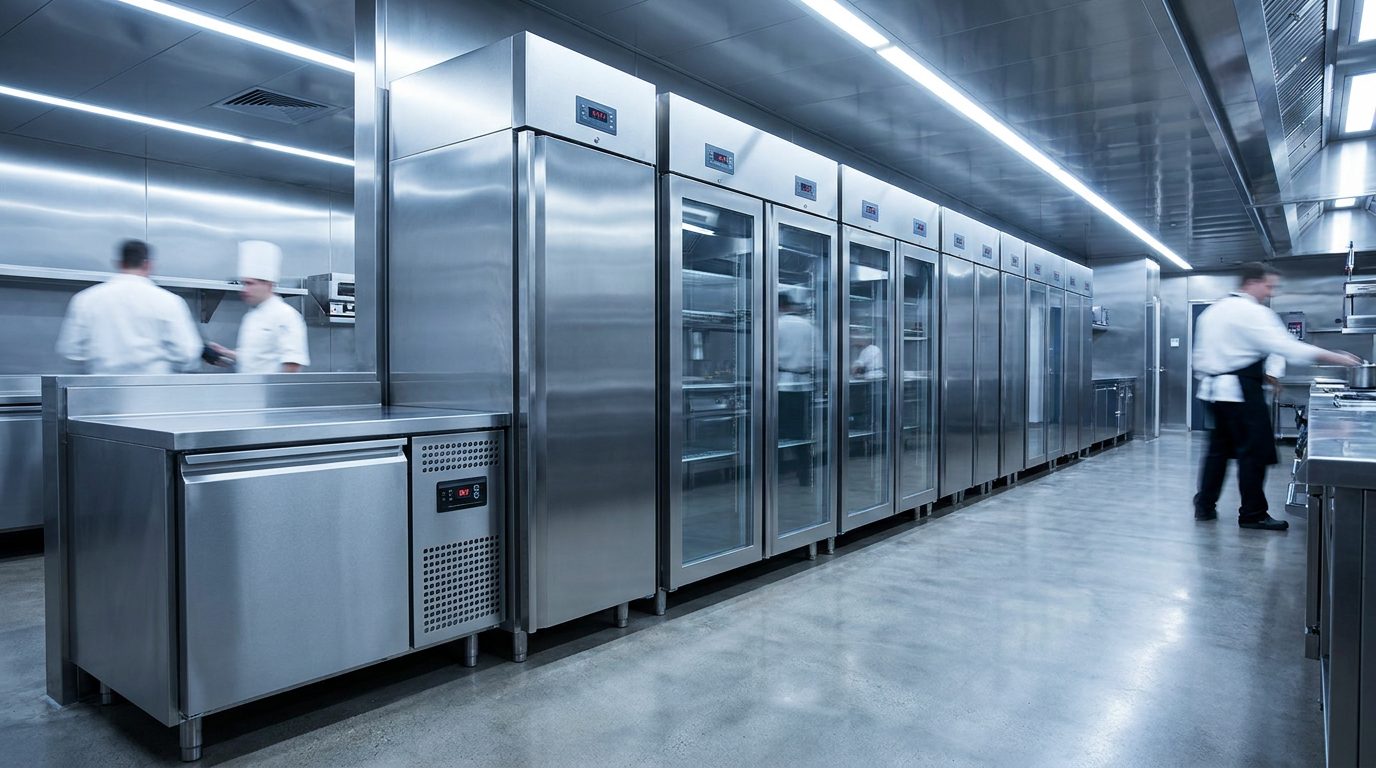
Commercial refrigeration divides into a handful of distinct types: upright reach-in chillers and freezers for bulk storage, undercounter units for point-of-use storage, refrigerated prep benches that combine storage with a work surface, blast freezers for rapid temperature pull-down, glass-door display units for merchandising, and specialist cabinets such as patisserie showcases and wine coolers. Each solves a different problem, and most kitchens need three or four of them rather than more of one.
This guide explains what each type is for, how to read door counts and litre ratings, and how to match the mix to your service. If you are planning the whole cold side rather than choosing one cabinet, our restaurant cold chain guide covers the operational layer.
The main types at a glance
| Type | What it is | Best for | Watch out for |
|---|---|---|---|
| Upright reach-in chiller (solid door) | Full-height cabinet, insulated solid doors | Bulk chilled storage: prep, dairy, produce | Floor area; needs a clear condenser path |
| Upright display chiller (glass door) | Full-height cabinet with glazed doors | Grab-and-go, front of house, bar stock | Glass loses more heat; higher load per opening |
| Undercounter chiller | Low-height cabinet under the bench | Point-of-use stock at the station | Limited volume; not a replacement for bulk storage |
| Refrigerated prep bench | Chilled cabinet with a working top | Cold prep, sandwich and salad lines, pizza make-up | Top surface is a work zone, not extra shelving |
| Upright freezer | Full-height frozen storage | Frozen bulk, protein reserves | Defrost management and door discipline |
| Undercounter freezer | Frozen storage under the bench | Fast-moving frozen items at the station | Small volume, opened frequently |
| Blast freezer / blast chiller | Rapid pull-down through the critical range | Cooked food cooling, bakery and pastry work | It is a process machine, not storage |
| Display showcase | Glazed merchandising cabinet | Cakes, patisserie, deli, prepared items | Designed to sell, not to hold long-term stock |
| Wine and bottle cooler | Controlled cabinet for bottles | Bars, restaurants, retail bottle display | Sized in bottles or litres, not in GN pans |
Solid door or glass door
Solid doors insulate better, cost less to run and hide untidy shelving. Glass doors sell. The decision is a front-of-house versus back-of-house one: anything a customer sees should be glazed, anything only your team sees should be solid.
Where visibility matters — bar back, grab-and-go, a self-service beverage point — units such as the Up Right Chiller 02 Glass Doors, or a single glass door cabinet where the frontage is narrow, let staff and customers find stock without holding a door open while they search. That last point is the operational argument for glass, not just the marketing one: a glazed door reduces search time at the door, which is when the cabinet loses most of its cold air.
For back-of-house bulk storage, solid-door upright cabinets are the workhorse, and the choice there comes down to door count and build rather than visibility.
Upright, undercounter or prep bench
These three are not competing options — they are three positions in a workflow.
Upright cabinets are your reserve. They hold the day's stock, deliveries and prepped mise en place. Door count is the practical sizing unit: a single-door cabinet suits a small kitchen or a satellite station, while three- and four-door formats such as the Up Right Chiller 04 Doors belong in kitchens where several sections draw from one cold store.
Undercounter cabinets are point-of-use. They exist so that a chef does not walk across the kitchen mid-service. An Industrial Undercounter Chiller 2 Door 250L with Backsplash, or a larger 380-litre version of the same format, fits into a run of benching and keeps the station self-sufficient for the service.
Refrigerated prep benches merge the two: chilled storage below, a work surface above. The Industrial Chillering Working Bench 490L is the type used on sandwich, salad and pizza make-up lines, where the food being assembled comes straight from the cabinet under the hands doing the assembling. The discipline to enforce is that the top is a work surface, not a shelf — stacked boxes on a prep bench block the airflow the cabinet depends on.
Chiller, freezer or blast freezer
A chiller holds food cold. A freezer holds it frozen. A blast freezer or blast chiller does neither — it moves food quickly through the temperature range where bacterial growth is fastest, and then hands it over to storage.
That distinction gets ignored constantly. Putting a tray of hot rice or a hot curry into a standard upright freezer raises the internal temperature for everything already in the cabinet, forces the compressor to run continuously, and still cools the centre of the tray slowly. A dedicated unit such as the Industrial Blast Freezer 05 Shelves (Linkrich) exists to absorb that load in a controlled way, which is why hotel kitchens, bakeries and any operation doing cook-chill production treat it as production equipment rather than storage.
For frozen storage itself, match format to how often the door opens. Bulk reserve belongs in an upright such as the Industrial Up-Right Freezer 04 Big Doors(HQ), while fast-moving items belong in an undercounter freezer at the station so the bulk cabinet stays closed.
Display and specialist refrigeration
Display cabinets are sales equipment with a refrigeration circuit attached. A glazed patisserie unit such as the Industrial Cake Display Showcase - 900MM Square is specified by frontage and shelf presentation as much as by capacity — it has to sit where customers queue, at a height where the product is at eye level.
Specialist bottle refrigeration is its own category. Wine cabinets and the units in the bottle coolers range are built around bottle racking and controlled holding rather than GN-pan storage, so do not substitute a general chiller for one in a bar where presentation matters.
How to read the numbers
Three figures appear in commercial refrigeration listings, and they answer different questions:
- Door count tells you the footprint and how many people can work from the cabinet at once. Two doors is not simply twice one door in practice — it is the difference between one section and two sections sharing.
- Litre capacity tells you gross internal volume, before shelving and airflow clearance. Never plan to fill the stated volume; leave circulation space or the cabinet will not hold temperature evenly.
- Frontage in millimetres applies to display and warmer-style units and tells you how much counter or queue line the cabinet occupies.
Match these to real demand: count what actually needs chilling at your busiest service, not what fits on a shelf.
How to choose your refrigeration mix
Work through this in order:
- Map the workflow. List each station and what it must reach without walking. Those needs become undercounter or prep-bench cabinets.
- Size the reserve. Total the deliveries and prep that must be held between deliveries. That becomes upright chiller and freezer capacity.
- Separate chilled from frozen honestly. Under-buying freezer space is the most common planning error, and freezer space is the hardest to add later.
- Decide if you cook to chill. If you batch cook and cool, budget for blast freezing rather than overloading storage cabinets.
- Choose door type by who sees it. Glazed for customer-facing, solid for back-of-house.
- Check the physical route. Doorway widths, corridor turns and floor level matter more than the specification sheet; a cabinet that cannot reach the kitchen is not a cabinet.
- Plan condenser access and clearance. Every cabinet rejects heat and needs air and service access. Boxed-in units fail early.
- Account for the room. In a hot, humid kitchen, cabinets work harder and door openings cost more. Build in headroom rather than buying to the exact number.
- Set the door discipline before delivery. Any refrigeration plan is only as good as how often and how long doors are held open during service.
Frequently asked questions
What are the main types of commercial refrigerators? Upright reach-in chillers and freezers for bulk storage, undercounter cabinets for point-of-use stock, refrigerated prep benches that combine storage with a work top, blast freezers for rapid cooling, glass-door display chillers for merchandising, and specialist cabinets such as patisserie showcases and wine or bottle coolers.
What is the difference between a chiller and a freezer in a commercial kitchen? A chiller holds food above freezing for short-term storage and daily use, while a freezer holds it frozen for longer reserve storage. They are separate cabinets because the temperatures, defrost behaviour and door-opening patterns differ. Using one for the other's job compromises both food safety and running cost.
Do I need a blast freezer or is a normal freezer enough? If you cook in batches and cool food for later service, a blast freezer is a process requirement, not a luxury. Standard freezers are designed to hold already-cold product; loading them with hot food raises the temperature of everything inside and cools the centre of the load slowly.
Should I buy a glass door or solid door commercial fridge? Solid doors insulate better and suit back-of-house bulk storage. Glass doors let customers and staff see stock without holding the door open to search, which makes them right for front-of-house, bar back and grab-and-go positions. Decide by who looks at the cabinet.
How much refrigeration capacity does a restaurant need? Size it from demand rather than from catalogue volume: count what must be held between deliveries, add the mise en place your stations need on hand, then leave circulation space inside every cabinet. Under-buying freezer capacity is the most common mistake, because adding it later usually means re-planning the kitchen.
Choosing the cabinets
Refrigeration is bought once and lived with daily, so specify it against the workflow rather than the floor plan. Compare formats side by side in the commercial chillers and refrigerators range, and if ice is part of the same service plan, see the commercial ice cube machine range as well.
For the operational side — receiving, holding, monitoring and moving product through the day — read the restaurant cold chain guide for Sri Lanka. For the wider kitchen build, our commercial kitchen equipment guide sets refrigeration in the context of the rest of the specification.
Share:
Why your ice machine is not making ice: water, scale, heat and airflow
Cold storage for restaurants: running a cold chain that holds in a tropical climate