
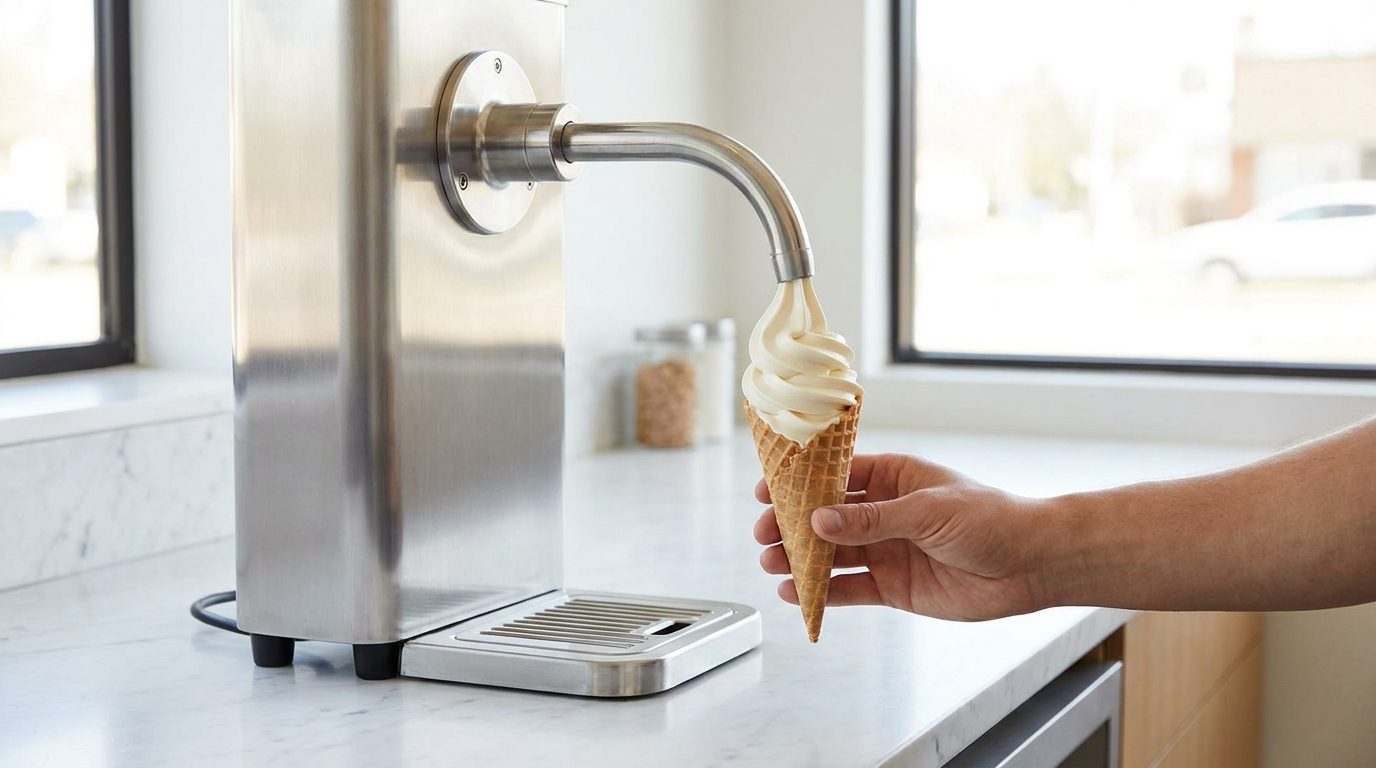
A soft serve machine freezes mix continuously and dispenses it straight into the cone at serving temperature, so you get a cone in seconds but only the flavours loaded in the cylinders. A batch freezer (usually sold as a hard ice cream machine) churns one batch at a time, which you then harden and scoop from a display — slower to produce, but it gives you dense scooping ice cream and an unlimited flavour list. The choice is a service-model decision, not a quality ranking.
How a soft serve machine works
Inside a soft serve machine, liquid mix sits in a hopper and feeds by gravity or pump into a refrigerated cylinder. A rotating dasher scrapes frozen mix off the cylinder wall while whipping air into it. That air — overrun — is what makes soft serve light and why it leaves the nozzle already soft enough to eat. Nothing is stored frozen solid; the machine holds the product in a servable state all day and refreezes as you draw.
The practical consequences are worth understanding before you buy:
- Throughput is about recovery, not volume. After a rush the cylinder needs time to pull the fresh mix back down to draw temperature. A machine that recovers slowly will give you soft, runny cones during your busiest twenty minutes.
- Flavours are fixed by cylinder count. A three-nozzle layout is the common café configuration: two flavour cylinders plus a centre draw that combines them. To change flavour you drain, clean and reload.
- Daily cleaning is non-negotiable. Dairy mix sits in the hopper and cylinder, so the machine has to be stripped and sanitised on a set schedule. Budget the labour, not just the purchase.
In the ice cream machines range, the counter-top Industrial Soft Ice Cream Machine (3 nozzle) suits a café that already has bench space it can give up, while the Industrial Soft Ice Cream Machine Stand Type - 3 Nozzle is the floor-standing version for a dedicated dessert counter where the machine is the service point.
How a batch freezer (hard ice cream machine) works
A batch freezer takes a measured quantity of mix, freezes and churns it under a fixed cycle, then discharges a batch that is still soft enough to pan. That pan goes into a hardening freezer, and the finished ice cream is scooped from a display cabinet. You are making a product, not dispensing one.
That extra step is exactly what buys you flexibility. Because the machine only shapes the batch, you decide the recipe every time — king coconut, treacle, wood apple, jackfruit, seasonal mango — and you can run a small trial batch without committing a whole cylinder. Overrun is lower, so the ice cream eats denser and holds its shape on a scoop.
The trade-off is equipment count. A batch freezer alone is not a service system; you also need cold storage for hardening and a display cabinet for the counter. The Gadali Industrial Hard Ice Cream Machine is the bench-mounted option where you already have a production table, and the Gadali Industrial Hard Ice Cream Machine With Stand puts the same job on its own frame in a production room.
Soft serve vs batch freezer compared
| Factor | Soft serve machine | Batch freezer (hard ice cream) |
|---|---|---|
| What it produces | Dispensed product, ready to eat at the nozzle | Batches of scooping ice cream needing hardening |
| Texture | Light, high overrun, served soft | Dense, lower overrun, scoopable |
| Flavours available at once | Limited to cylinder count | As many as your display holds |
| Speed at the counter | Seconds per serve, no scooping skill needed | Scooping speed, plus queue at the display |
| Staff skill required | Low for service, moderate for cleaning | Recipe and production skill needed |
| Extra equipment needed | Mix storage under refrigeration | Hardening freezer plus display cabinet |
| Flavour changes | Drain, clean, reload the cylinder | Next batch, same day |
| Best for | Kiosks, cinemas, quick-service counters, hotel dessert stations | Gelato bars, bakeries, brands selling tubs |
| Waste risk | Mix left in the hopper at close | Unsold pans hold for days in the freezer |
Where fried ice cream and gelato display fit
Two adjacent formats often get grouped into the same decision.
A fried ice cream (rolled ice cream) machine is a chilled flat pan, not a freezer barrel. You pour liquid base onto the cold plate, chop in fruit or biscuit in front of the customer, spread it thin and roll it up with a spatula. It is theatre-led service: slower per serve than soft serve, but the preparation itself draws a queue, which is why it works in food courts and event stalls. Trendy Zone lists two pan sizes — the Industrial Fried Ice Cream Machine 360mm and the larger Industrial Fried Ice Cream Machine 500mm — and the larger plate matters mainly if you want two servers working the same machine.
Gelato display cabinets are the counter half of the batch-freezer route. Pan count sets your menu: the Industrial Gelato Ice Cream Display 4 Pans Table Top suits a café adding four flavours to an existing counter, while the Industrial Gelato Ice Cream Display - 10 Pans is a destination unit for a dedicated parlour. Both sit alongside the wider display cabinets and food display equipment range.
How to choose: a decision checklist
Work through these in order. Most bad ice cream purchases come from answering the last question first.
- Define the serve. Cone-and-go at a kiosk points to soft serve. Scoops, tubs and signature flavours point to a batch freezer.
- Count your peak, not your day. The number that matters is servings in your busiest hour. Soft serve is judged on recovery during that hour; batch production is judged on how many pans you can freeze the night before.
- Decide who makes the product. A batch freezer needs someone who can hold a recipe consistent. If your counter is run by rotating part-time staff, soft serve is the lower-risk system.
- Check the cold chain you already own. Batch production only works if you have hardening and display capacity. Audit your existing commercial chillers and freezers before adding a batch freezer, not after.
- Confirm the power supply and the position. Confirm single or three-phase requirements and clearance for the condenser with the supplier for the exact model; refrigeration equipment fails early when it is boxed into a hot corner with no airflow.
- Cost the cleaning. Ask how long a full strip-down takes and who does it at closing. A machine that gets cleaned late is a machine that gets replaced early.
- Plan the flavour list. Two fixed flavours all season, or a rotating board? That single answer usually settles the machine type on its own.
Running an ice cream counter in a Sri Lankan climate
Ambient heat and humidity change the maths. Condensers work harder in an unventilated Colombo shopfront, so give the machine breathing room and keep it away from ovens, fryers and direct sun through glass. Serving windows shorten too: soft serve drawn into a warm cone collapses faster, and scooped ice cream softens on the counter if the display lid is left open between customers.
Power interruptions deserve a plan. Soft serve mix that has warmed in a hopper should not simply be refrozen and sold, and a display of hardened ice cream that has softened and refrozen will show ice crystals. Decide in advance what your staff discard and what they keep.
Finally, ice quality is part of the same cold-chain conversation for any dessert counter also serving cold drinks — the same maintenance discipline applies, as covered in the ice cube machine buying guide for Sri Lanka.
Frequently asked questions
Is soft serve or hard ice cream more profitable? Neither wins automatically. Soft serve has lower labour per serve and simpler staffing, but a fixed flavour list. Batch ice cream carries production labour and more equipment, yet supports premium positioning, tub sales and signature local flavours. Profit follows your location and volume more than the machine type.
Can one machine make both soft serve and hard ice cream? Not properly. The two machines freeze mix differently — one holds product servable in a cylinder, the other discharges a batch for hardening. Shops that sell both usually run a soft serve machine at the counter and a batch freezer in the back, feeding a display cabinet.
What equipment do I need besides the ice cream machine? Refrigerated storage for mix or base, a hardening freezer if you batch freeze, a display cabinet for scooping service, sanitising chemicals for daily cleaning, and pans or containers. Plan the counter layout before ordering, because the display usually needs more space than the machine.
How many flavours can a three-nozzle soft serve machine serve? Two, plus the combination draw from the centre nozzle. Adding a third true flavour means a second machine or a mid-service change-over, which requires draining, cleaning and reloading the cylinder.
Does a fried ice cream machine replace a soft serve machine? No. It serves a different purpose — made-to-order rolled ice cream with visible preparation. It is slower per customer, so it works best where the preparation is part of the attraction rather than where you need to clear a long queue quickly.
Where to start
If you are still weighing formats, compare the soft serve, hard ice cream, gelato display and rolled ice cream options side by side in the ice cream machines collection, then sanity-check the cold storage and counter equipment that has to sit around it. For a wider view of how a dessert counter fits into a full kitchen build, the commercial kitchen equipment guide for Sri Lanka covers the surrounding decisions. Trendy Zone Lanka's team can confirm the electrical requirements and footprint for any specific model before you commit counter space.
Share:
Cold storage for restaurants: running a cold chain that holds in a tropical climate
How to Choose a Bottle Cooler for a Shop or Café