
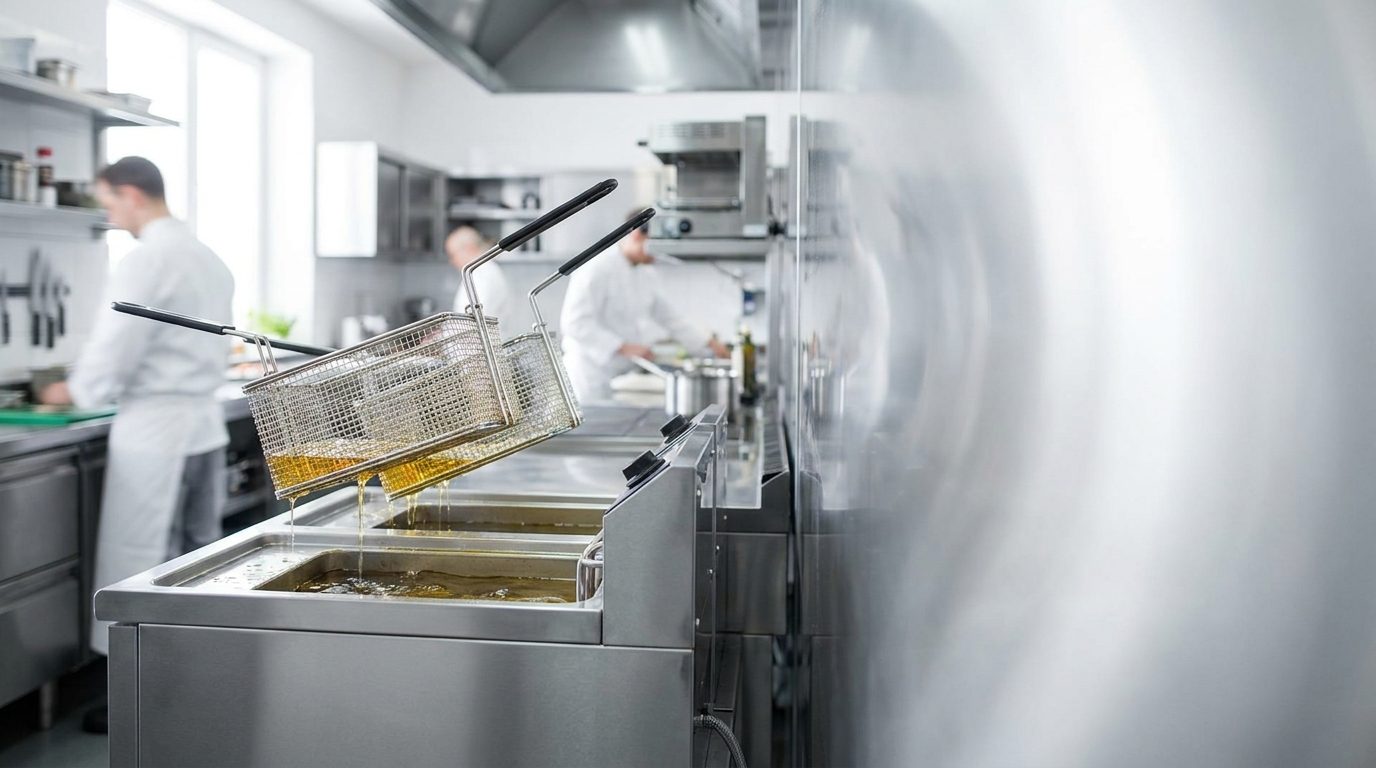
Size your fryer against peak covers per hour, not against your daily total. Work out how many fried portions leave the pass in your busiest hour, how heavy each portion is, and how long each item spends in the oil — then choose a tank that can carry that load without the oil temperature collapsing. Most kitchens that complain about "slow" fryers do not have a weak fryer; they have a fryer that is one size too small for their peak.
Start with peak covers per hour, not daily totals
A restaurant serving 300 covers a day may push 120 of them through a two-hour dinner window. The fryer has to survive that window, not the daily average. Three numbers set your requirement:
- Fried portions in the peak hour. Count every item that touches oil — chips, devilled cuttlefish, rolls, cutlets, chicken, fritters, samosas. A single plate can contain two fried components.
- Weight per portion. A portion of chips is heavier and wetter than a fish cutlet. Weight and moisture, not piece count, drive the temperature drop.
- Cook time per item. A 3-minute item lets you turn eight baskets an hour per basket position. A 7-minute item lets you turn four or five.
Multiply portions by cook time and you get basket-minutes required per hour. Compare that to basket-minutes available — number of basket positions multiplied by 60, minus recovery time between drops. When required basket-minutes approach available basket-minutes, you are already too small.
What tank litres actually tell you
Tank capacity in litres is the headline number on almost every commercial fryer, and it is a useful proxy — but it is a proxy for thermal mass, not for output. A larger volume of oil holds more heat, so when cold, wet food goes in, the temperature falls less and climbs back faster. That is the whole reason bigger tanks fry faster, not the fact that they physically hold more baskets.
Two practical consequences:
- Never fill a basket to the point where the oil stops bubbling vigorously. A limp, quiet drop means the oil has fallen out of frying range and the food is absorbing oil instead of expelling moisture. The result is greasy product and faster oil breakdown.
- Two smaller tanks often beat one large one. Splitting fish and chips across separate tanks protects flavour and lets you idle one tank in the quiet hours. Double-tank units such as the Industrial Electric Deep Fryer 13L Double exist for exactly this reason.
A fryer sizing ladder by service type
The table below maps typical service patterns to the tank class that generally suits them. Treat it as a starting point to test against your own peak-hour count, not as a rule.
| Service pattern | Typical peak fried load | Tank class that usually fits | Configuration notes |
|---|---|---|---|
| Home kitchen, small takeaway counter | A few portions at a time, intermittent | Small single tank (around 6–7 L) | One basket, bench-top, single flavour profile |
| Café, bakery snack counter, food cart | Steady trickle plus short rushes | Single 10–14 L tank | Bench-top; consider a second unit before a bigger one |
| Casual restaurant with a fried section | Continuous drops through a 2-hour peak | Twin 10–14 L tanks | Separate tanks for fish and chips; independent controls |
| Busy restaurant, hotel coffee shop | Multiple fried items on most plates | 20–25 L class, or twin large tanks | Floor-standing; dedicated extraction over the fry line |
| High-volume canteen, banquet, QSR-style output | Sustained batch frying all service | 40 L class and above | Cabinet-mounted, larger oil charge, longer recovery headroom |
Trendy Zone Lanka's commercial fryer range is built around this ladder. At the entry end sits the Industrial 6L Electric Deep fryer for counters and light snack work. In the middle, the A-Star 20L Double Industrial Electric Deep Fryer gives two independent 20-litre-class tanks for split menus. At the top, the Industrial Gas Fryer 25L and the cabinet-mounted Industrial Gas Fryer with Cabinet - 48L are built for sustained batch output rather than à la carte trickle.
Single tank, double tank or split pot?
Single tank is right when you fry one family of products — a chip shop, a doughnut counter, a bakery snack line. It is simplest to clean and holds one oil charge.
Double tank matters as soon as two fried items must not share flavour. Fish and seafood transfer strongly into oil; anything fried afterwards carries that flavour. Twin units such as the Industrial Large Tank 14L + 14L Gas Deep Fryer let you keep one tank for fish and one for chips, and shut one down when demand drops.
Split-pot behaviour — running one large tank with two baskets — is a compromise. You get flexible basket positions and one oil charge to manage, but no flavour separation and no ability to idle half the capacity.
A quieter benefit of double tanks: oil economics. Running two 14-litre tanks and changing them on separate cycles usually costs less oil over a month than running one oversized tank that must be dumped whole every time the fish oil turns. Oil discipline deserves its own planning session, but the sizing decision is where it starts.
Recovery time: the number behind "how fast can I re-fire?"
Recovery is how long the fryer takes to return to setpoint after a basket drop. It is a function of burner or element power relative to oil volume, plus how much cold food you dropped. You will rarely find a published recovery figure you can trust across brands, so judge it operationally:
- Drop a full basket of your heaviest item and watch the thermostat or the surface behaviour. If it takes longer than the cook time itself to climb back, the second consecutive basket will fry poorly.
- If your peak requires back-to-back drops with no gap, you need either more tank volume or more tanks — extra baskets in the same oil do not help.
- Frozen product is the harshest test. If you fry mostly from frozen, size up a step from what fresh product would suggest.
How to choose: a fryer sizing checklist
Work through these in order before you shortlist a model.
- [ ] Count fried portions in your busiest hour, not per day, and list them by item.
- [ ] Note the heaviest and wettest item on that list — that item sets the load your fryer must absorb.
- [ ] Decide whether flavour separation is required. If yes, you need two tanks, not one bigger one.
- [ ] Check the available line space in millimetres, including clearance for basket handles and for lifting the oil tank out to clean.
- [ ] Confirm your energy source and supply before you fall in love with a model — see the gas versus electric trade-offs in the commercial fryer buying guide.
- [ ] Plan the extraction above the fry line at the same time as the fryer; a correctly sized fryer under weak extraction is still an unpleasant kitchen.
- [ ] Allow headroom for growth. Menus add fried items; they rarely remove them.
- [ ] Confirm how you will filter, store and dispose of oil — a bigger tank means a bigger oil handling problem.
Frequently asked questions
How many litres should a restaurant deep fryer be? There is no single answer, because litres describe thermal mass rather than output. A café snack counter is usually well served by a 10–14 litre class tank, a busy restaurant fry section by twin tanks or a 20–25 litre unit, and sustained batch operations by 40 litres and up. Size against peak-hour fried portions.
Is it better to buy one big fryer or two smaller ones? Two smaller fryers are usually more flexible. You get flavour separation between fish and chips, you can idle one tank in quiet periods, and you keep frying if one unit is down for cleaning or service. One large tank makes sense only when you fry a single product family in high volume.
What happens if my deep fryer is too small? The oil temperature collapses on each drop, so food sits in sub-frying-temperature oil and absorbs it. You get pale, greasy product, longer ticket times, and oil that degrades noticeably faster because more moisture and food particles enter per litre of oil.
Do gas fryers recover faster than electric ones? Not automatically. Recovery depends on input power relative to oil volume and on how the heat reaches the oil. Electric fryers place elements directly in the oil, which transfers heat efficiently; gas fryers usually offer higher raw input. Compare like-for-like tank sizes rather than assuming one fuel wins.
Can I use a home deep fryer in a small restaurant? It is a poor economy. Domestic units are built for intermittent use, have smaller oil volumes and lighter thermostats, and will not hold temperature through consecutive drops. If you are frying for paying customers every service, start at the entry level of the commercial range.
Where to go next
Once you know your peak-hour load and whether you need one tank or two, compare the options in Trendy Zone Lanka's commercial fryer collection and check how the fry station sits within the wider commercial kitchen equipment line-up. If the fryer is part of a full build, the commercial kitchen equipment guide for Sri Lanka covers how the fry section fits alongside cooking, prep and cold storage.
Share:
Stand Mixer vs Dough Mixer: Sri Lanka Buying Guide
Gas or electric deep fryer: which is better for a commercial kitchen?