
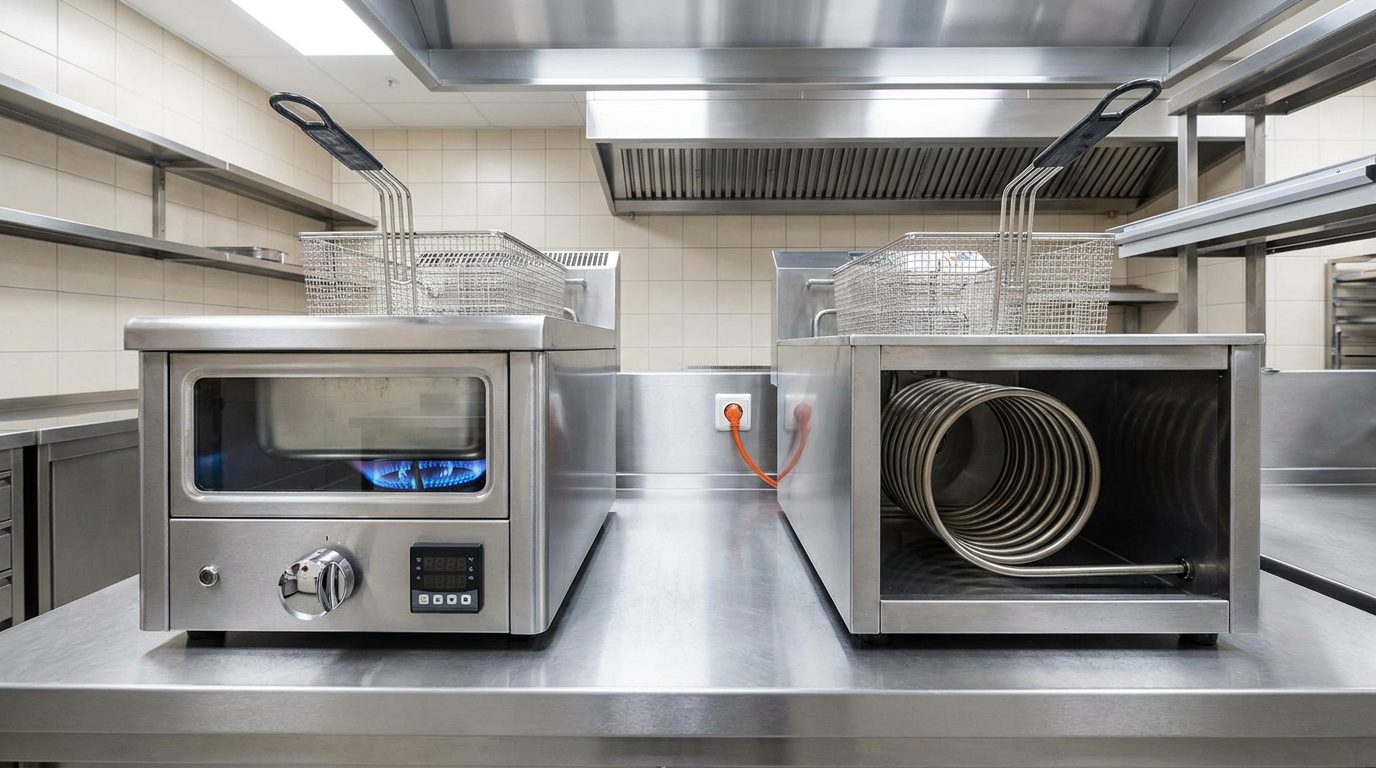
Neither fuel is better in the abstract — the right choice is set by your site. Electric fryers suit bench-top positions, small footprints and kitchens where running a gas line to the fry station is impractical; gas fryers suit high-volume, floor-standing fry lines where you already have LPG on site and want cheaper heat per hour. Decide by utility supply, position on the line and volume, in that order.
How gas and electric fryers heat oil differently
The mechanical difference explains almost every trade-off that follows.
An electric fryer puts its elements directly in the oil. Heat transfers straight from metal to oil with very little loss, which is why electric units heat up briskly and hold a setpoint tightly. Most designs let you swing the element assembly up so the tank can be lifted out and washed — a genuine advantage during a nightly clean.
A gas fryer burns LPG in tubes or a burner chamber under and through the tank, and the heat passes through the tank wall or tube wall into the oil. Some energy leaves with the flue gases, so thermal efficiency per unit of fuel is lower — but gas is usually cheaper per unit of delivered heat, and a gas burner can put a large amount of raw input into a big tank without needing a heavy electrical supply.
That is the core of it: electric transfers heat more efficiently; gas usually delivers cheaper heat and scales to larger tanks without an electrical upgrade.
Gas vs electric commercial fryer: side-by-side comparison
| Factor | Electric fryer | Gas fryer |
|---|---|---|
| Heat transfer | Elements immersed in the oil — very direct | Through tank or tube walls; some heat lost to flue |
| Typical position | Bench-top or floor-standing; flexible | Usually floor-standing on the cook line |
| Installation | Needs adequate electrical supply and circuit capacity | Needs an LPG connection, regulator and safe gas routing |
| Temperature control | Thermostats and touch controls hold setpoint tightly | Good control, generally with a coarser feel |
| Cleaning | Elements usually lift clear so the tank comes out | Fixed tubes or heated base; more careful cleaning around them |
| Suits | Cafés, bakeries, small kitchens, secondary fry stations | Busy fry lines, canteens, banquet and high-volume batch frying |
| Scaling up | Larger tanks demand a serious electrical supply | Large tanks scale readily on LPG |
| Portability | Easy to relocate within the kitchen | Effectively fixed once plumbed |
Where gas wins in a Sri Lankan kitchen
You already run LPG. If cookers, burners and shawarma units are on gas, adding a gas fryer means one more branch off an existing system rather than a new electrical circuit. Kitchens built around the commercial gas burner range usually find gas the path of least resistance.
You need a big oil charge. Larger tanks need serious heat input. The Industrial Large Tank 14L Gas Deep Fryer and the twin-tank formats above it are typical of a gas fry line built for sustained output rather than occasional drops.
Gas is not only for large tanks, either. Compact units such as the Industrial 7L Gas Deep fryer suit a small gas-fed cook line where a socket is scarce but LPG is already there — you can see both formats side by side across the gas and electric fryer range.
Grid interruptions matter. Where power supply is unreliable, a gas fry station keeps producing during an outage as long as ignition and ventilation are handled. That single factor decides the question in plenty of Sri Lankan kitchens.
You want a combined cook block. Units such as the Industrial 12L Gas Deep Fryer And Full Flat Gas Griddle Plate put frying and griddle work into one gas-fed footprint, which is efficient use of a short line.
Where electric wins
Space and position. A bench-top electric unit can sit anywhere there is a socket and clearance — a bakery snack counter, a hotel coffee shop, a service bar. The Industrial 12L Electric Deep fryer is the classic form for that job.
Tight temperature control. Products with a narrow frying window — battered seafood, doughnuts, delicate fritters — benefit from an immersed element and a responsive thermostat. Electric units generally give the more consistent hand.
Cleaning speed. Lift the element assembly, lift the tank, wash it. Over a year of nightly cleans that difference is real, and clean tanks mean longer oil life.
No gas on site. Rented premises, food courts, mall units and shared kitchens often will not allow an LPG line at the fry station. Electric units such as the Marchef 14L Industrial Electric Fryer exist precisely for those sites.
Installation, power and ventilation realities
Whichever fuel you choose, sort out three things before installation day, not after.
Electrical capacity. A commercial electric fryer is a substantial load, and two of them plus a water boiler on one circuit is how kitchens trip breakers mid-service. Have your electrician confirm the circuit and socket arrangement for the specific unit's rating before you commit to an electric fry line.
Gas routing and shut-off. A gas fryer needs a properly made connection, an accessible shut-off, and no flexible hose running where staff walk or where hot oil can drip. Have this done by a competent gas fitter.
Extraction. Frying generates hot, greasy vapour regardless of fuel. Gas adds combustion products, which raises the ventilation requirement further. Plan the canopy and extract alongside the fryer — the exhaust fan range is part of the same decision, not an afterthought.
How to choose: a decision checklist
- [ ] Is LPG already at the fry position? If yes, gas is an easy win. If it would need a new run, price the work into the comparison.
- [ ] What is your spare electrical capacity? Confirm it with an electrician before shortlisting electric units above bench-top size.
- [ ] Bench-top or floor-standing? Bench-top strongly favours electric; a dedicated floor position opens gas up.
- [ ] How many hours a day is the fryer at temperature? Long hot-holding hours tilt the running-cost argument toward gas.
- [ ] How narrow is your frying window? Delicate, batter-heavy products favour electric control.
- [ ] Who cleans it and how fast? If the tank must be stripped nightly by a small team, electric is kinder.
- [ ] What happens in a power cut? If service must continue, gas removes that risk.
- [ ] Are you sizing correctly first? Fuel is the second decision — settle tank size and tank count first, using the commercial fryer buying guide.
A common and sensible outcome is a mixed line: a gas fryer as the workhorse, plus a small electric unit for a second product or for quiet-period service.
Frequently asked questions
Is a gas or electric deep fryer cheaper to run? Gas is usually cheaper per unit of delivered heat, which is why high-volume fry lines lean that way. Electric fryers convert energy to oil heat more efficiently but pay more per unit of energy. Compare your actual LPG and electricity tariffs against your daily hours at temperature rather than assuming.
Which heats up faster, gas or electric? Electric fryers often reach setpoint quickly because the elements sit in the oil. Gas fryers can match or beat that when the burner input is large relative to tank volume. Compare like-for-like tank sizes; a small electric unit and a large gas unit are not a fair comparison.
Can I put a gas deep fryer anywhere in my kitchen? No. It needs a safe gas connection, an accessible shut-off, clearance from combustible surfaces and extraction above it. Site the gas fryer where the canopy and gas line already are, and have a competent fitter make the connection.
Do electric fryers give more consistent results? Generally yes, for products with a narrow temperature window. Immersed elements and modern thermostats hold a tighter band, which matters for battered seafood, doughnuts and delicate fritters. For robust items like chips, the difference is much smaller.
Should a small café choose gas or electric? Electric, in most cases. A bench-top electric fryer needs no gas work, moves if the layout changes, and strips down quickly for cleaning. Move to gas when volume rises to the point where a dedicated floor-standing fry station is justified.
Can I run gas and electric fryers side by side? Yes, and many kitchens do. A gas unit handles the peak load while a smaller electric unit covers a second product or off-peak service, which also keeps the two oil charges separate.
Choosing your fryer
Settle the tank size and tank count first, then let your site decide the fuel. Compare both fuels in Trendy Zone Lanka's commercial fryer collection, and if the fryer is one part of a wider fit-out, plan it alongside the rest of your commercial kitchen equipment so gas, power and extraction are all designed once rather than three times.
Share:
What size deep fryer do I need for a restaurant?
How often to change deep fryer oil in a commercial kitchen