
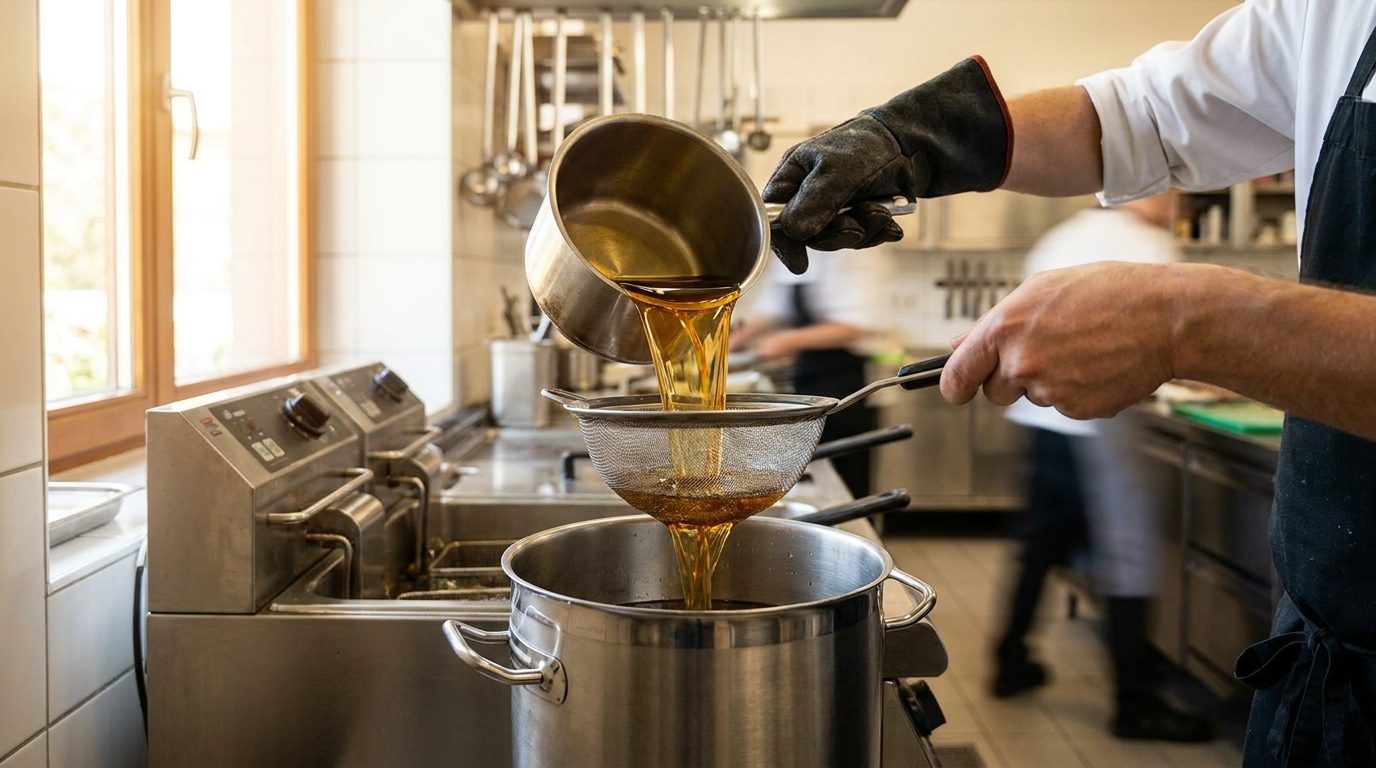
Change frying oil when its condition says so, not on a fixed calendar. In practice most commercial kitchens discard oil somewhere between every one and every five days, and the spread is that wide because the driver is throughput and product type, not time. A busy fish and chips line may dump daily; a bakery frying a few trays of doughnuts a day, with proper filtering, will get far longer from the same oil. Judge by colour, smoke, foam, smell and how the food comes out.
What actually degrades frying oil
Oil does not simply "get dirty". Three chemical processes run in parallel, and each is accelerated by something you control.
Hydrolysis. Water from the food splits the oil's fatty acids. Every wet product — cut potato, marinated chicken, battered seafood, anything straight from a wash — adds water. This is why draining and drying product before it hits the oil is the single cheapest oil-saving habit in the kitchen.
Oxidation. Oxygen at the surface attacks hot oil. Larger exposed surface areas, longer hours at temperature and vigorous agitation all speed this up. Oil held at frying temperature through a dead afternoon degrades for no revenue at all.
Thermal breakdown and polymerisation. Sustained high heat, especially above your working setpoint, breaks oil down and eventually forms the sticky varnish you see on tank walls and basket hooks. Loose crumbs and batter fragments left in the oil carbonise and accelerate everything else.
Salt, copper and brass contact, and detergent residue left after cleaning also shorten oil life. Salt the food after it leaves the fryer, never over the tank.
Signs your frying oil is finished
| Indicator | What you observe | What it means |
|---|---|---|
| Colour | Oil has darkened well past its fresh shade and stains a white cloth | Advanced breakdown; product will pick up colour before it is cooked |
| Smoke | Visible smoke at your normal working temperature, not just at the peak | Smoke point has dropped — the oil is degraded, not the thermostat |
| Foam | Fine, persistent foam that does not clear between drops | Surfactants from breakdown products; a strong discard signal |
| Smell | Acrid, fishy or "old fat" smell instead of a clean fried aroma | Flavour will transfer to product; discard |
| Viscosity | Oil looks thick and coats the basket, drains slowly | Polymerisation is under way |
| Product behaviour | Food browns too fast outside while under-cooked inside; greasy mouthfeel | Oil is finished regardless of how it looks |
If two or more of these appear together, change the oil. Do not try to rescue it by topping up with fresh oil — fresh oil added to badly degraded oil degrades quickly in turn.
A realistic oil change pattern by operation type
The table below describes typical patterns, not guarantees. Your own log will beat any general table within a fortnight.
| Operation | Frying pattern | Typical oil life with filtering | Biggest degradation driver |
|---|---|---|---|
| Bakery or café snack counter | Light, intermittent drops | Longest | Long idle hours at temperature |
| Restaurant fry section, mixed menu | Steady service peaks | Medium | Mixed products in one tank |
| Fish and seafood specialist | Heavy, wet, high-protein loads | Shortest | Moisture and protein carry-over |
| Chip and fritter volume kitchen | Continuous batch frying | Short to medium | Crumb and starch load |
| Banquet and event catering | Intense bursts, then idle days | Medium, if oil is cooled and covered | Oxidation between events |
The pattern to notice: wet, floury, high-protein products shorten oil life the most; long idle hours at temperature shorten it silently.
The daily and weekly oil routine
A disciplined routine typically extends oil life more than any single equipment upgrade.
Every service - Skim floating debris between rushes with a fine skimmer. Crumbs left in oil carbonise within minutes. - Shake off ice and excess batter before the drop; drain wet product properly. - Never salt or season over the tank.
Daily - Filter the oil once it has cooled to a safe handling temperature but is still fluid. Filtering removes the particles that drive breakdown; skipping it wastes oil faster than anything else on this list. - Wipe the tank walls and the element or tube surfaces while they are still slightly warm, before varnish sets. - Record the oil's condition in a simple log: date, colour, foam, action taken. Two weeks of that log tells you your real change interval.
Weekly - Boil out the tank with an appropriate cleaner, then rinse thoroughly and dry completely. Detergent residue and water both attack the next oil charge. - Check basket mesh and hooks for baked-on carbon; scrub or replace. - Inspect the thermostat behaviour: if the oil overshoots your setpoint, every subsequent oil charge will die early.
Turn the fryer down or off during dead hours. Many kitchens hold full frying temperature for hours with no orders. Idling at a lower holding temperature, or shutting a second tank down entirely, is free oil life.
Equipment choices that protect your oil
Some of your oil cost is decided when you buy the fryer, not when you clean it.
Cool zone design. A tank where debris settles into a cooler region below the heat source keeps crumbs out of the hottest oil. This is one reason bench-top designs where the elements lift clear — like the Industrial Electric Deep Fryer 13L — are easy to keep clean: the tank comes out and gets washed properly.
Accurate, responsive control. Overshoot kills oil. Units with precise controls, such as the Industrial Electric Deep Fryer 10L Double (High Quality Touch), let you hold a lower idle temperature between rushes rather than sitting at full frying heat all afternoon.
Separate tanks for separate products. Twin-tank formats stop fish flavour and protein load contaminating a chip tank, so each charge is discarded on its own schedule instead of both being dumped together. The double-basket and twin-tank options across the commercial fryer collection exist mainly for this reason.
Right-sized tanks. An oversized tank running half-loaded means more oil oxidising per portion sold; an undersized tank means every drop crashes the temperature and drives moisture in. Smaller units like the A-Star 10L Industrial Electric Deep Fryer or the Marchef 6L Industrial Electric Fryer can be the cheaper choice per portion at low volume, simply because you are not holding and discarding oil you never used.
Closed frying systems. Pressure frying, as in the Industrial Electric Pressure Fryer 15L, cooks in a sealed chamber at lower oil temperatures for a given result, which changes the degradation profile compared with open frying — worth understanding if fried chicken is a core product.
How to choose with oil economics in mind
- [ ] Calculate your oil cost per portion, not per drum. That number, not the drum price, tells you whether a change is expensive.
- [ ] Count your idle hours at temperature in a normal week. If the fryer is hot with no orders for hours, fix that before anything else.
- [ ] Decide whether one oil charge serves all products. If not, budget for two tanks rather than accepting contaminated oil.
- [ ] Check how easily the model can be stripped and filtered — can the tank come out, do the elements lift, is the drain accessible?
- [ ] Confirm the control resolution: can you set a lower idle temperature, or is it full heat or off?
- [ ] Match tank size to actual peak load, so oil turns over at a healthy rate instead of ageing in place.
- [ ] Plan filtering equipment and safe oil handling at purchase time, including how hot oil will be moved, stored and disposed of.
- [ ] Keep an oil log from day one. It converts opinion into a schedule.
Frequently asked questions
How often should you change deep fryer oil in a restaurant? Judge by condition. High-volume fry lines handling wet or battered product often discard daily; mixed restaurant sections commonly run two to four days with daily filtering; light bakery and café use can run considerably longer. Dark colour, persistent foam, smoke at working temperature or off smells mean change it now.
Can you filter deep fryer oil instead of changing it? Filtering removes suspended particles, which slows degradation significantly, but it does not reverse chemical breakdown. Filter daily to extend life, and still discard once the oil shows foaming, smoke at working temperature or a dark, viscous appearance.
Why does my frying oil go dark so fast? The usual causes are wet or floury product entering the oil, crumbs left to carbonise, salting over the tank, holding the fryer at full temperature through idle hours, and an overshooting thermostat. Fix the routine first; it is almost always cheaper than changing equipment.
Is it safe to top up old oil with fresh oil? Topping up to replace oil carried out on food is normal practice. Using fresh oil to disguise a degraded charge is not — the fresh oil breaks down rapidly in contact with the old, and the food quality does not recover.
Does frying temperature affect how long oil lasts? Strongly. Every degree above your working setpoint accelerates breakdown, and sustained overshoot shortens oil life sharply. Verify your thermostat against a probe thermometer, and drop the temperature during quiet periods instead of holding full frying heat.
Next steps
Oil is a recurring cost that the equipment decision either helps or hurts. Compare filtering access, tank removal and control resolution across Trendy Zone Lanka's commercial fryers, size the tank properly using the commercial fryer buying guide for Sri Lanka, and plan the fry station's cleaning and extraction alongside the rest of your commercial kitchen equipment.
Share:
Gas or electric deep fryer: which is better for a commercial kitchen?
Planning bakery equipment for 500 loaves a day