
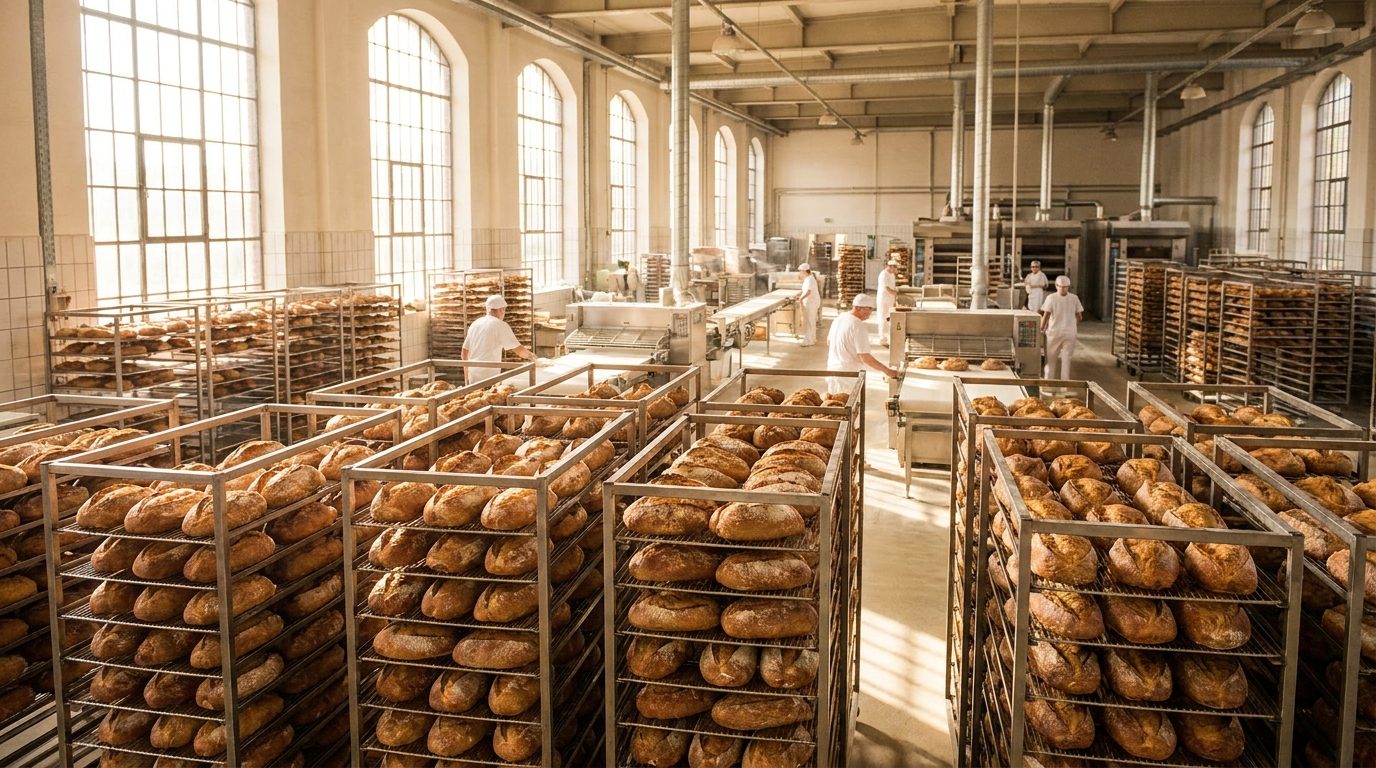
To plan bakery equipment for 500 loaves a day, work backwards from output to batches, then size every station to that batch rhythm. Five hundred loaves is not one decision — it is a mixer that can turn a dough batch in the time the oven takes to bake one, a prover that can hold the dough waiting for the oven, and an oven whose tray count and bake cycle multiply out to 500 within your production window. Your real capacity is set by the slowest station, so find that one first.
Work backwards from loaves per day to batches per hour
Start with three inputs you already know.
- Daily output target — 500 loaves.
- Production window — the hours between the first mix and the last loaf out. Six hours is a realistic single-shift window for a small bakery; larger operations run two shifts.
- Bake cycle — how long a loaf occupies the oven, plus loading and unloading time.
Divide output by the window: 500 loaves over six hours is roughly 84 loaves an hour. If a bake cycle occupies the oven for 30 minutes including load and unload, you need oven capacity for about 42 loaves per cycle. That single figure drives everything: tray count, tray size, deck count, mixer batch weight and prover capacity all follow from it.
Then check the same arithmetic against your peak day, not the average. A bakery that does 500 on a normal weekday and 750 before a holiday should be planned around the 750.
The five stations that set your ceiling
Every bakery is a chain of five stations, and the chain is only as fast as the slowest link.
- Mixing — batch size in litres of bowl volume and flour weight per batch, plus mixing time per batch.
- Dividing and shaping — how quickly bulk dough becomes uniform pieces.
- Proving — controlled space to hold dough while the oven works. This is where under-planning shows up first.
- Baking — tray or deck capacity multiplied by cycles per hour.
- Cooling, slicing, packing — the station that quietly caps a wholesale bakery.
Sketch your five stations with a capacity figure against each, in loaves per hour. The lowest number is your bakery's actual output, no matter what the other four can do. Trendy Zone Lanka's bakery equipment range covers all five stations, which makes it practical to balance them rather than over-buying one and starving another.
Mixing capacity: bowl litres versus flour weight
Mixer capacity is quoted in bowl litres, but bread production is planned in flour weight. The two are not interchangeable: a bowl rated in litres holds far less flour than its litre figure suggests once you account for water, dough expansion during mixing and the space the hook needs to work.
Two practical rules:
- Dough type changes usable capacity. Stiff bread dough loads a mixer far harder than a soft cake batter of the same volume. A spiral mixer is designed for bread dough; a planetary mixer is a general-purpose machine that handles batters, creams and lighter doughs well but is not the right tool for repeated heavy bread batches.
- Batch time must fit the oven rhythm. A mixer that produces a batch in twelve minutes but only enough dough for half an oven load will run continuously and still starve the oven.
For sustained bread work, heavy spiral machines like the 130 L Heavy Duty Spiral Mixer and the 64L Heavy Duty Spiral Stand Mixer are built to knead dense dough batch after batch. The difference between spiral and planetary designs, and when each is the right buy, is covered in stand mixer vs dough mixer.
Oven capacity: decks, trays and bake cycles
Oven capacity is the number most bakeries get wrong, because they compare oven size instead of calculating cycles.
| Oven type | How capacity is expressed | Bake rhythm | Best suited to |
|---|---|---|---|
| Single-deck | Trays per deck | One batch at a time; simple | Small bakery, café bake-off, pilot production |
| Multi-deck | Decks × trays per deck | Independent decks let you stagger products | Mixed product bakery: bread, buns, short goods |
| Convection | Layers of trays, forced air | Even, fast bake across all layers | Buns, pastries, cookies, high tray turnover |
| Rotary rack | Full racks per bake | Whole rack in and out; large single batches | Volume bread production, wholesale output |
Multiply honestly: trays per bake × loaves per tray × bakes per hour = loaves per hour. A 3-deck, 9-tray gas oven such as the Industrial Gas Oven 3 Deck 9 Trays gives you nine tray positions across three independently controlled decks — useful when different products need different temperatures. A rotary oven like the Indsutrial Rotary Diesel Oven-32 Trays is a different production model: a 32-tray rack goes in as one batch, which suits a bakery pushing a single product hard.
Also budget realistically for loading and unloading time. A rack oven is loaded once; a nine-tray deck oven is loaded nine times, and that labour sits inside your bake cycle. Compare the formats in the industrial oven range with that in mind.
Proving, dividing and finishing: the hidden bottlenecks
Bakeries almost always plan the mixer and the oven and then discover that the bottleneck is somewhere else.
Proving. Dough will not wait politely. If the oven is busy and there is nowhere controlled to hold proved dough, you either over-prove it or slow the mixer. A dedicated prover such as the Industrial Electric Dough Prover-16 Trays gives you a buffer between mixing and baking, which is what smooths a production line.
Dividing and shaping. Hand-dividing 500 loaves is slow and inconsistent, and inconsistent piece weight means inconsistent bake times. An Industrial Dough Divider/bread Cutter removes both problems at once.
Cooling and slicing. Loaves must cool before slicing or the crumb tears and the bag sweats. Cooling needs rack space and airflow, not machinery — but it needs planned space. Then an Industrial bread slicer determines how fast finished loaves become saleable, packed product. For a wholesale bakery this station, not the oven, is often the true daily limit.
Capacity planning checklist
- [ ] Write your daily target and your peak-day target separately, and plan around the peak.
- [ ] Fix the production window in hours, including cleaning down.
- [ ] Convert to loaves per hour, then to loaves per bake cycle.
- [ ] Calculate oven capacity as trays × loaves per tray × cycles per hour, including load and unload time.
- [ ] Size the mixer by flour weight per batch, not bowl litres, and check batch time against the bake cycle.
- [ ] Confirm your prover capacity can hold at least one full oven load waiting.
- [ ] Plan cooling rack space in square metres before you buy the slicer.
- [ ] Identify the slowest station and name it out loud — that is your bakery's capacity.
- [ ] Check utilities: gas, electrical supply and ventilation for the oven line, confirmed by your fitter.
- [ ] Leave space on the floor plan for the next machine, not just the current ones.
Frequently asked questions
What equipment do I need for a 500 loaf per day bakery? At minimum: a spiral mixer sized to your batch weight, a dough divider, a controlled prover, an oven with enough tray capacity to complete 500 loaves inside your production window, cooling rack space, and a bread slicer if you sell sliced. Balance them against each other rather than buying the biggest of each.
How many trays does my bakery oven need? Divide loaves per hour by bakes per hour to get loaves per bake, then divide by loaves per tray. A bakery producing about 84 loaves an hour on a 30-minute cycle needs roughly 42 loaves per bake — which the tray size and product footprint then convert into tray count.
Is a rotary oven better than a deck oven for a bakery? They solve different problems. A rotary rack oven loads a whole rack in one movement and suits high volumes of a single product. A deck oven bakes on stone-like surfaces with independent deck control, which suits mixed products and artisan crust. Volume and product mix decide, not price alone.
How big should my dough mixer be? Big enough that one batch fills a meaningful share of an oven load, and fast enough that batch time is shorter than the bake cycle. If the mixer produces less dough per cycle than the oven can bake, the mixer becomes your ceiling regardless of oven size.
What is usually the bottleneck in a small bakery? Proving and finishing, far more often than mixing or baking. Bakeries buy a good mixer and a good oven, then discover there is nowhere to hold proved dough and no space or labour to cool, slice and pack the output. Plan those two stations at the same time as the oven.
Building the line
Balance beats brute force: a bakery with a well-matched mixer, prover, oven and finishing station out-produces one with a large oven and nothing feeding it. Plan your five stations against the bakery equipment collection and the commercial bakery machine range, and if you are starting from an empty room, the bakery equipment setup guide for Sri Lanka covers the layout and utilities side of the same decision.
Share:
How often to change deep fryer oil in a commercial kitchen
How to choose a dough sheeter for your bakery