
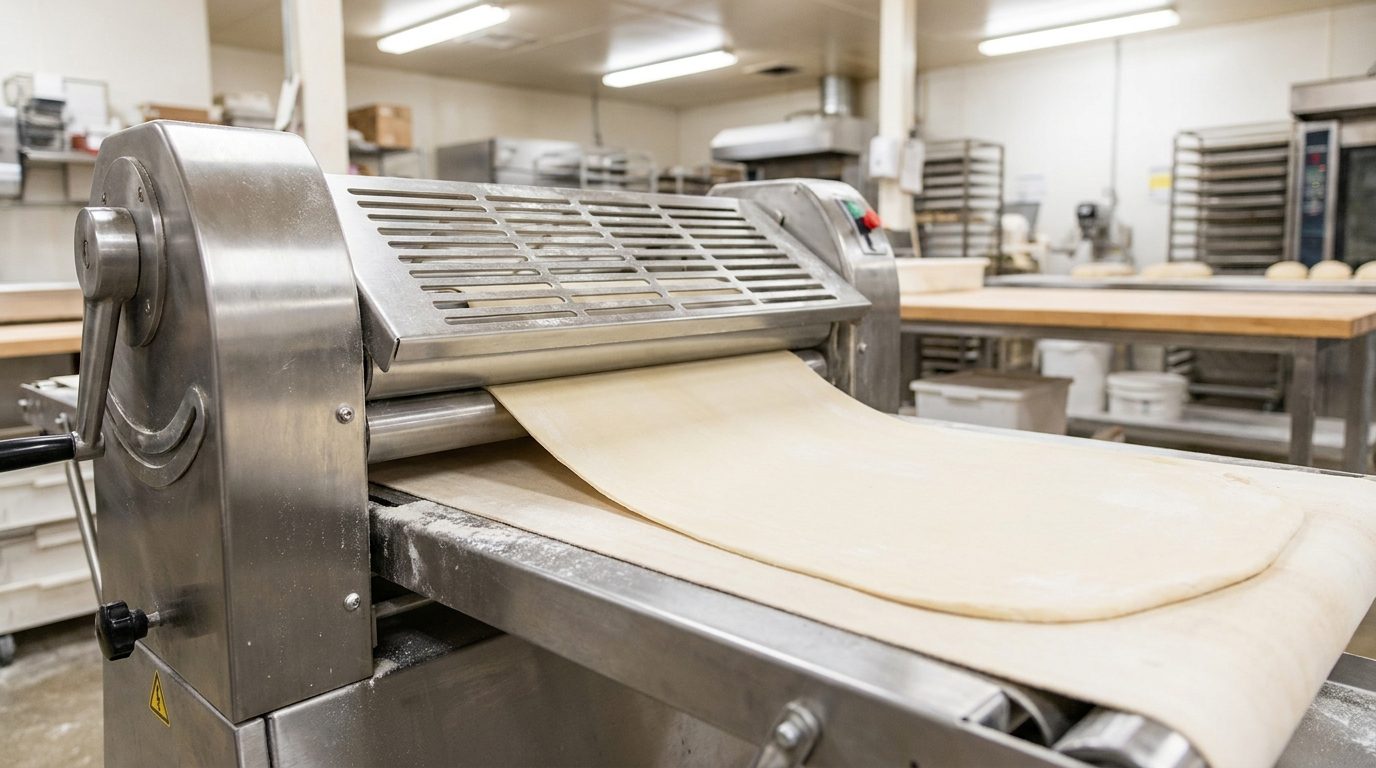
Choose a dough sheeter by starting with roller width: it must exceed the widest sheet your product needs, because a sheet wider than the rollers cannot be made in one pass. After that, check the gap adjustment range, the table length, and whether the machine is built for the dough you actually run. Roller width sets what you can make; the rest sets how fast and how consistently you make it.
What a dough sheeter actually does
A sheeter passes dough between two counter-rotating rollers set to a controlled gap, reducing thickness gradually rather than in one crushing pass. That gradual reduction matters more than most buyers expect.
Rolling dough by hand with a pin applies uneven pressure across the piece and works the gluten unevenly, which is why hand-rolled laminated pastry varies from batch to batch. A sheeter applies the same reduction across the full width, every pass. For laminated products — croissant, puff pastry, danish — that consistency is the difference between defined layers and a pastry that leaks butter in the oven.
Three things follow from the mechanics:
- Multiple gentle passes beat one aggressive pass. Squeezing a thick dough to final thickness in one go tears the gluten network and, in laminated dough, smears the butter layers into the paste.
- Dough temperature matters as much as the machine. Warm laminated dough smears no matter how good the sheeter is. Chilled dough sheets cleanly.
- The machine repeats what you tell it. A sheeter delivers consistency, not skill. Your lamination method still decides the product.
Roller width is the first number to fix
Roller width — usually quoted in millimetres — is the maximum width of dough the machine can take. Get this wrong and no other feature rescues it.
Work it out from your product, not from the machine:
- Take the widest finished sheet you need. For croissants, that is the width of the dough band before cutting triangles. For pizza, it is the largest base diameter you sell.
- Add trim allowance on both edges — sheeted dough is never perfectly straight-edged.
- Add headroom for products you have not launched yet. Bakeries add laminated lines; they rarely drop them.
The result is your minimum roller width. Buying narrow forces you into a second sheeting direction — turning the dough ninety degrees to widen it — which adds handling time and, in laminated dough, extra stress on the layers.
Trendy Zone Lanka publishes roller widths in the product titles themselves, so you can size directly against your requirement: the Industrial Pasta Sheeter Machine 180mm handles narrow bands, while the Industrial Pasta Sheeter Machine 240mm takes a wider sheet from the same style of machine.
Sheeter types and what they suit
| Type | How it works | Strengths | Typical use |
|---|---|---|---|
| Bench-top sheeter | Compact rollers on a work surface | Small footprint, easy to store, low commitment | Café kitchens, small pastry sections, pilot production |
| Floor-standing reversible sheeter | Long conveyor tables either side; dough passes back and forth | Handles large batches; controlled progressive reduction | Production bakeries, laminated pastry lines |
| Pizza dough sheeter (press-through rollers) | Dough ball fed through paired rollers into a round base | Fast, repeatable base sizing, minimal skill needed | Pizzerias, restaurants with a pizza section |
| Pasta sheeter | Narrow rollers, often with cutting attachments | Precise thin sheets; noodle cutting | Pasta production, thin pastry, roti-style sheets |
| Manual crank sheeter | Hand-driven rollers | No power needed; very low volume | Home and hobby use; not for continuous production |
For general bakery sheeting, the Industrial Dough Sheeter Machine is the workhorse format. For a pizza section, the Industrial pizza dough sheeter is a different tool entirely — it turns a dough ball into a consistent base in seconds, which matters far more than sheet width when every base must be the same diameter. Compare both formats in the dough sheeter range.
Gap range, table length and build
Gap adjustment range. The machine must open wide enough to accept your thickest starting block and close tight enough for your thinnest product. Filo-thin work and a thick laminated block are opposite ends of that range; check both against the machine's stated adjustment, not just the thin end.
Table length. On a reversible sheeter, the tables carry the dough sheet as it lengthens. Short tables mean the sheet runs off the end and stretches under its own weight, which distorts the piece. As a rule, if your finished sheet regularly exceeds the table, you need a longer machine or a second pair of hands.
Belt and roller condition. Belts should track straight and be cleanable; rollers should have a scraper to stop dough wrapping. These are the parts that decide day-to-day frustration.
Footprint and access. A floor-standing reversible sheeter needs clear space on both sides throughout its travel, not just its own machine footprint. Measure the working envelope, not the machine.
Power and position. Fix the electrical supply and position with the rest of your bakery line so the sheeter sits between the mixer and the prover, not across the room from both.
Matching the sheeter to your product
Croissant and laminated pastry. You need width for the dough band, a wide gap range for the initial block, gentle progressive reduction, and dough that is properly chilled. This is the most demanding use case and it justifies a proper reversible machine.
Pizza. Base consistency beats sheet width. A pizza dough sheeter with paired rollers gives you the same base diameter and thickness every time, which is what makes bake times predictable across a busy pizza service.
Pasta and noodles. Narrow, precise, repeatable thin sheets, often with a cutting head. Roller width in the product title tells you the sheet width directly.
Roti, paratha and flatbread. High piece counts of a consistent thickness. Consistency of thickness matters more than maximum width, since pieces are individually portioned.
Bread and buns. A sheeter is not the primary tool here — a dough divider does more for bread throughput. Sheeters earn their place where the product is rolled, layered or cut from a sheet.
How to choose: a dough sheeter checklist
- [ ] Measure the widest sheet you make today, add trim allowance, add growth headroom — that is your minimum roller width.
- [ ] Check the thickest starting block and the thinnest finished sheet, and confirm both sit inside the gap range.
- [ ] Decide bench-top or floor-standing by batch size and by whether the machine has a permanent home.
- [ ] Measure the working envelope, including table travel on both sides, not just the machine footprint.
- [ ] Confirm the machine matches your dough type — laminated, pizza, pasta and flatbread are different jobs.
- [ ] Check how the machine is cleaned: scrapers, removable guards, belt access.
- [ ] Check who will operate it and whether the controls suit that level of experience.
- [ ] Plan where it sits in the workflow, between mixing and proving, and confirm the power point is there.
- [ ] Sanity-check the sheeter against your overall production plan so it is not faster or slower than the stations around it.
Frequently asked questions
What size dough sheeter do I need? Size it by roller width. Take the widest sheet your product requires, add trim allowance on both edges, then add headroom for products you intend to add. The machine's roller width must exceed that figure, because you cannot produce a sheet wider than the rollers in a single pass.
What is the difference between a dough sheeter and a pizza dough sheeter? A general dough sheeter reduces a dough block into a long sheet through repeated passes, which suits laminated pastry and cut products. A pizza dough sheeter presses a dough ball through paired rollers into a round base of fixed diameter and thickness — faster and more repeatable for pizza, but not a sheeting machine for pastry.
Can I use a dough sheeter for croissants and puff pastry? Yes, and that is where a sheeter pays for itself. Consistent, even reduction protects the butter layers far better than a rolling pin. Keep the dough properly chilled and reduce in several gentle passes rather than forcing it to final thickness at once.
Is a bench-top dough sheeter enough for a small bakery? Often yes. If your batches are small, your widest product fits the roller width, and floor space is tight, a bench-top machine gives you the consistency benefit without the footprint. Move to a floor-standing reversible machine when batch size, sheet length or product range outgrows it.
How do I stop dough sticking or tearing in the sheeter? Reduce thickness gradually, keep the dough chilled and correctly rested, dust lightly rather than heavily, and keep the roller scrapers clean. Tearing is usually a sign of too large a reduction per pass or dough that has not rested enough after mixing.
Where to start
Fix your roller width first, then match the machine type to the dough you actually run. Compare the options in Trendy Zone Lanka's dough sheeter collection, see how the sheeter sits alongside mixing, proving and baking in the bakery equipment range and the commercial bakery machine range, and if you are equipping a bakery from scratch, start with the bakery equipment setup guide for Sri Lanka.
Share:
Planning bakery equipment for 500 loaves a day
Spiral Mixer vs Planetary Mixer: Which Belongs in Your Bakery