
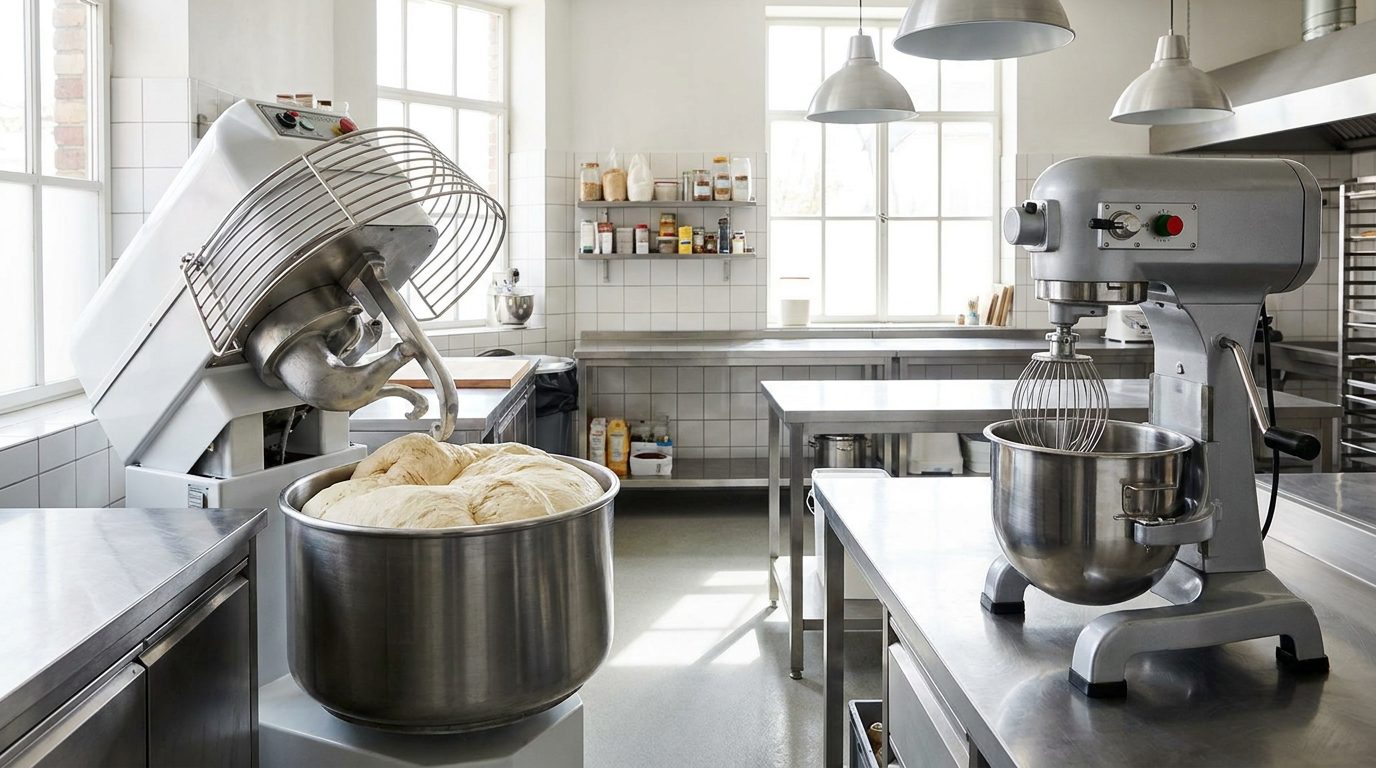
A spiral mixer is built for one job — developing bread dough — and it does that job with less friction heat and less strain on the machine than any planetary of equivalent size. A planetary mixer is a general-purpose machine: change the tool and it whips cream, creams butter and sugar, mixes cake batter, and handles light dough. Most working bakeries in Sri Lanka eventually own both, because they are not competing designs; they solve different halves of the production day.
This guide explains the mechanical difference, what it means for gluten and dough temperature, and how to decide which machine to buy first. If you are comparing a domestic stand mixer against a commercial dough mixer rather than comparing two commercial machines, start with our guide on stand mixers versus dough mixers instead.
How a spiral mixer works
A spiral mixer has a fixed, spiral-shaped hook mounted off-centre, plus a bowl that rotates on its own drive. The hook stays in one place; the bowl brings the dough to it. A stationary centre bar or breaker bar splits the dough mass on each pass, so the dough is folded and stretched rather than dragged around the bowl.
Three consequences follow from that geometry:
- Lower friction heat. The dough is worked by stretching, not by being churned against a bowl wall. Dough temperature climbs more slowly, which matters enormously in a tropical bakery where your flour, water and room are already warm.
- Efficient gluten development. The repeated fold-and-stretch action builds the gluten network in less time than a hook orbiting through the same mass.
- Tolerance of stiff and high-hydration dough. Bread, bun, pizza and roti-type doughs, wet ciabatta-style doughs, and stiff bun doughs are all within a spiral's normal working range.
What a spiral mixer cannot do is whip, aerate or cream. There is no whisk attachment and no paddle. It is a bread machine.
How a planetary mixer works
A planetary mixer holds the bowl still and moves a single agitator on a planetary path — the tool spins on its own axis while orbiting the bowl, so it eventually reaches every point of the bowl interior. The agitator is interchangeable: a dough hook, a flat beater or paddle, and a wire whisk are the standard three.
That interchangeability is the whole argument for a planetary. One machine covers cake batter, buttercream, meringue, choux paste, biscuit dough, samosa and roti dough, mashed fillings and cream fillings. In a bakery selling cakes, short eats and pastry alongside bread, the planetary is the machine that runs most hours of the day.
The trade-off is dough handling. A planetary hook drives through the dough mass rather than folding it, which puts more load on the gearbox, generates more friction heat, and takes longer to reach full gluten development. Manufacturers publish a maximum dough ratio for exactly this reason, and running heavy bread dough at the machine's absolute limit, batch after batch, is the single most common cause of premature gearbox wear.
Spiral vs planetary at a glance
| Factor | Spiral mixer | Planetary mixer |
|---|---|---|
| Bowl | Rotates, driven | Fixed |
| Tool | One fixed spiral hook | Interchangeable hook, beater, whisk |
| Best for | Bread, bun, pizza and pastry base dough | Cake batter, cream, icing, light dough |
| Gluten development | Fast and even | Slower, more mechanical work needed |
| Friction heat in dough | Lower | Higher |
| Heavy dough duty cycle | Designed for continuous bread batches | Limited by published dough ratio |
| Versatility | Single purpose | Multi purpose |
| Typical first purchase for | Bread-led bakery | Cake, pastry and short-eats-led bakery |
| Minimum viable batch | Larger — small batches ride above the hook | Smaller — tool reaches lower bowl volume |
Dough temperature: the reason bread bakers choose spiral
Final dough temperature drives fermentation speed, and fermentation speed drives flavour, crumb and shelf life. In a Sri Lankan bakery the ambient temperature and the flour are both working against you before you switch anything on, so every degree the mixer adds is a degree you have to remove somewhere else — usually with chilled water or ice, which costs money and complicates the recipe.
Because a spiral mixer develops the same dough in less time and with less churning, it typically finishes the mix at a lower temperature than a planetary doing the same work. If you are producing bread daily and fighting over-proofed dough by mid-morning, mixer choice is a real part of the fix, not a marginal one. Machines such as the 34L Spiral Stand Mixer and the larger 64L Heavy Duty Spiral Stand Mixer sit in the industrial dough mixer range for exactly this class of work, and a high-volume plant bakery would look at something in the 130 L Heavy Duty Spiral Mixer class.
Matching the machine to your product mix
Work backwards from what you actually sell, not from what you might sell one day.
Bread-led bakery. Buns, sandwich loaves, pizza bases, kimbula banis. A spiral is the primary machine; a small planetary handles fillings and icings.
Cake and pastry-led bakery. Butter cakes, gateaux, short eats, biscuits. A planetary is the primary machine. A 10L Planetary Stand Mixer suits a small pastry section, while an Industrial 20L Planetary Mixer covers a busier one.
Mixed retail bakery. Both, sized so the spiral covers your peak bread batch and the planetary covers your largest single cake or cream batch. Buying one oversized planetary to do both jobs is the compromise that most often disappoints.
Restaurant, hotel or café pastry section. Usually planetary only, because bread volume is low and the variety of preparations is high.
Sizing without guesswork
Bowl litres are not batch litres. Two rules keep you out of trouble:
- Respect the useful working range, not the nameplate. A bowl runs best somewhere in the middle of its range. Sizing so your standard batch fills the bowl completely leaves no room for the dough to climb and fold, and it loads the drive hardest exactly when you use it most.
- Check the minimum batch too. An oversized machine cannot mix small quantities properly — a small dough in a large spiral bowl simply rides under the hook without being worked, and a small volume in a large planetary bowl sits below the whisk. If you run frequent small specialty batches, a second small machine beats one large one.
Then size for your peak day, not your average day. Poya weekends, December and the wedding-season months are when a mixer that is one size too small turns into a bottleneck for every downstream station.
How to choose: a decision checklist
Work through these in order before you commit:
- What percentage of your output is yeast-raised bread dough? Above roughly half, buy the spiral first.
- How many different preparations does the machine need to cover? More than dough alone means a planetary belongs in the plan.
- What is your largest single batch, by dough weight, on your busiest day? Size the bowl around that batch sitting comfortably within its working range.
- What is your smallest routine batch? Confirm the machine can mix it properly.
- How many batches back to back? Continuous bread production is spiral territory; a planetary needs recovery time under heavy dough.
- Do you have three-phase power, and where will it sit? Confirm the supply and the footprint before ordering, including clearance to lift the bowl guard and remove the hook.
- Who cleans it, and how? Bowl removal, guard design and access under the head decide whether it gets cleaned properly at closing time.
- What is downstream? A bigger mixer only pays off if your dividing, proofing and oven capacity can absorb the batches it produces.
Frequently asked questions
Can a planetary mixer make bread dough?
Yes, within the manufacturer's stated dough ratio. It will take longer to develop gluten and will warm the dough more than a spiral. For occasional bread in a cake-led bakery that is perfectly workable. For daily bread production, a planetary run at its limit is being used outside its design intent.
Can a spiral mixer whip cream or mix cake batter?
No. The hook is fixed and cannot be changed for a whisk or beater, and the fold-and-stretch action does not aerate. A bakery that needs both jobs needs both machines.
Which should I buy first if I can only buy one?
Buy the machine that matches your highest-volume product. If bread and buns carry the business, buy the spiral. If cakes, cream and short eats carry it, buy the planetary — its versatility is worth more than its dough performance costs you.
Does a bigger bowl always mean more output?
No. Output is set by the whole line — mixing, dividing, proofing and baking. A mixer larger than your prover and oven can absorb produces dough that over-proofs while it waits. Match capacity across the line, then upgrade the true bottleneck.
Is a spiral mixer worth it for a small bakery?
If bread is your core product, yes — the gain in dough consistency and the reduction in mix time show up in every batch. If you produce a few dozen loaves a day alongside a wide pastry range, a well-sized planetary is usually the better first investment.
Where to go next
Compare the full industrial dough mixer range by bowl size against the batch weights you calculated above, then look at the wider commercial bakery machines that sit either side of the mixer in your workflow. If you are planning a bakery from scratch rather than replacing one machine, our bakery equipment setup guide and the full bakery equipment collection cover the complete line.
Share:
How to choose a dough sheeter for your bakery
Deck Oven vs Convection Oven vs Rotary Oven: Choosing a Bakery Oven