
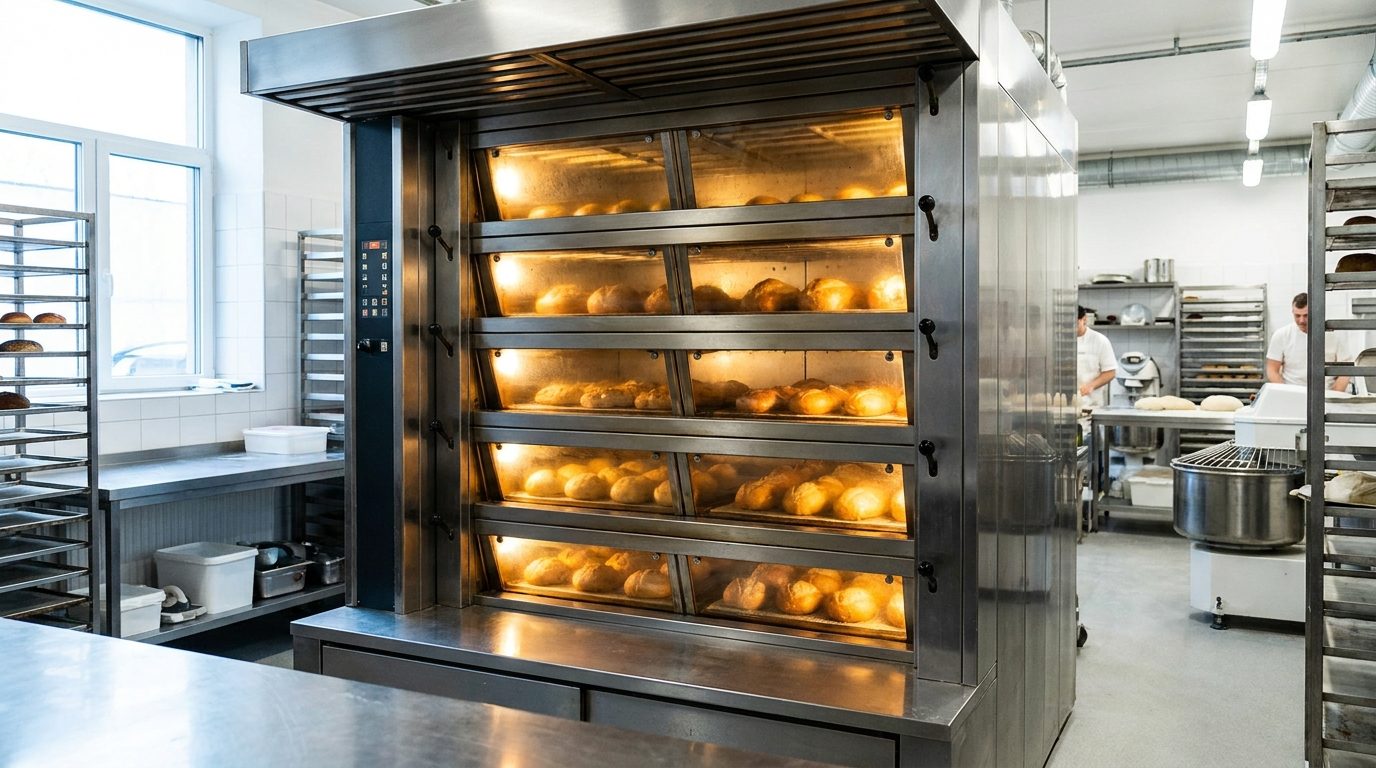
The difference between the three main bakery oven types is how heat reaches the product. A deck oven bakes mainly by conduction from a hot hearth plus radiant heat from the chamber, which is why it produces the bottom crust and oven spring that bread and pizza need. A convection oven bakes by moving hot air with a fan, which gives fast, even colour across many trays — ideal for pastry, biscuits and buns. A rotary rack oven is a convection oven with a rotating trolley inside, built for volume and for baking a full rack of trays evenly in one load.
Choose on product first, then on volume. This guide covers what each design does to dough, how deck and tray counts translate into real output, and the practical questions to settle before you commit to a configuration.
How a deck oven bakes
In a deck oven the product sits directly on a heated hearth or on a tray resting on it. Heat comes from below through the deck surface and from above by radiation from the chamber crown, with independent top and bottom heat control on most commercial models.
That combination is what bread needs. Direct bottom heat drives the initial burst of steam and gas expansion inside the loaf — oven spring — and sets a base crust that will not go pale or soft. Because the air in the chamber is comparatively still, the surface of the dough does not dry too early, so the loaf can expand before the crust sets.
Deck ovens are also thermally heavy. A well-built deck holds a large mass of heat, so it recovers a stable baking temperature after the door opens and a cold load goes in — worth more in practice than a headline maximum temperature.
Configurations are described by decks and trays: a single-deck, two-tray oven such as the Industrial Gas Oven 1 Deck 2 Tray suits a small retail bakery or a restaurant bread section, while the Industrial Gas Oven 2 Deck 4 Trays and the Industrial Gas Oven 3 Deck 9 Trays step up the number of independent chambers you can run at different temperatures at the same time. That independence matters: bread at one setting on the lower deck, buns at another above, without compromising either.
How a convection oven bakes
A convection oven circulates hot air with one or more fans. Heat transfer is faster and far more uniform across the chamber, so products on the top and bottom trays colour at a similar rate and you can load more trays into the same volume.
Convection suits anything where even surface colour and a shorter bake matter more than bottom crust and dramatic oven spring: biscuits, cookies, short eats, puff pastry, sponge sheets, savouries, roasted items. Because the moving air dries the product surface faster, most convection baking is done at a lower set temperature than the equivalent deck bake, and lean bread doughs benefit from steam injection to delay crust set.
The trade-offs are real. Moving air can distort delicate items, skin over thin batters, and pull moisture out of enriched dough on a long bake. Airflow also creates hot spots near the fan, so tray rotation mid-bake is common practice.
How a rotary rack oven bakes
A rotary rack oven is a convection chamber sized to take a whole loaded rack of trays, which rotates during the bake. Rotation cancels out the hot and cool zones a fixed convection chamber has, so every tray on the rack finishes at roughly the same point.
The operational advantage is loading. Your team loads a rack at the bench, wheels it in, and wheels it out at the end of the bake — one movement instead of handling dozens of individual trays at a hot oven mouth. For a bakery producing hundreds of units of the same product per bake, that is a labour and consistency gain that a bank of deck ovens cannot match. The costs are footprint, ceiling height, ventilation and a heavier utility connection, plus a rack loading system your trays and trolleys must actually fit.
Comparison table
| Deck oven | Convection oven | Rotary rack oven | |
|---|---|---|---|
| Primary heat transfer | Conduction from hearth plus radiant | Forced hot air | Forced hot air with rotating rack |
| Best products | Bread, buns, pizza, hearth-baked items | Biscuits, pastry, short eats, sponges | High-volume batches of one product |
| Bottom crust | Strongest | Moderate | Moderate |
| Evenness across trays | Depends on deck loading | Good, may need tray rotation | Highest |
| Independent zone control | Yes, per deck | Single chamber | Single chamber |
| Loading method | Tray by tray | Tray by tray | Whole rack at once |
| Recovery after door opening | Slower but very stable | Fast | Fast |
| Footprint per tray of output | Higher | Lower | Lowest at volume |
| Suits | Retail and mixed bakeries | Cafés, pastry sections, hotels | Wholesale and plant bakeries |
Gas or electric?
Both fuel types appear across deck and convection designs, and the choice is usually decided by the building rather than the baking.
Gas deck ovens dominate Sri Lankan bakery production for the same reasons gas dominates the rest of the commercial kitchen: the fuel is available, the burners are straightforward to service locally, and running a large thermal mass on gas avoids a heavy electrical upgrade. Electric models give closer temperature control and cleaner installation where a flue is difficult, which is why electric chambers such as the Industrial Electric Pizza Oven 1 Deck 2 Trays work well in enclosed café and in-mall kitchens. Either way, confirm the supply and the extraction path before ordering — those two things delay more bakery oven installations than anything else.
Sizing decks and trays to real output
Do the arithmetic before you shortlist, not after.
- Count units per tray for your highest-volume product, using your actual tray size and your actual spacing.
- Multiply by trays per bake for the configuration you are considering.
- Divide your daily target by that number to get bakes per day.
- Multiply bakes by cycle time — bake time plus loading, unloading and recovery — and check the total fits inside your production window.
If the oven has to run sixteen hours to hit your target, the configuration is too small. If it sits idle most of the day, you have bought heat you are paying to maintain. Plan the peak, not the mean: festival weeks and wedding season expose an undersized oven immediately.
The oven is also one station in a line. Read the industrial oven range alongside the mixing and proofing equipment in commercial bakery machines, because an oven larger than your mixer and prover can feed simply idles between loads.
How to choose: decision checklist
- What is your highest-volume product? Bread and pizza point to deck; pastry and biscuits point to convection.
- Do you bake two products at different temperatures at once? If yes, independent decks are worth more than raw tray count.
- Is your output one product in large batches, or many products in small batches? Large single-product batches justify a rack oven; variety favours decks.
- What tray size does your bakery standardise on? Confirm the oven takes it, and that your baking tray trolleys match — a mismatch here creates permanent handling friction.
- Where is the extraction going? Confirm the flue or hood route and ceiling height at survey stage.
- Gas or electric? Decide from the available supply, not from a brochure.
- How does the oven recover? For frequent small loads, recovery after door opening matters more than peak temperature.
- Can you service it locally? Burners, thermostats, elements and door seals are the parts that fail; local availability decides your downtime.
- What comes after the oven? Cooling and racking capacity must absorb every bake, or your finished goods queue on the bench.
Frequently asked questions
Is a deck oven or a convection oven better for bread?
A deck oven, in almost every case. The hot hearth gives the bottom heat that drives oven spring and sets a proper base crust, and the calmer chamber lets the loaf expand before the surface dries. A convection oven can bake bread, but enriched and lean doughs both benefit from steam and from gentler airflow.
Can one oven do both bread and pastry?
A multi-deck oven with independent chamber controls comes closest, since you can run bread on one deck and pastry on another. If pastry and biscuits are the majority of your output, a convection chamber plus a smaller deck for bread is usually the more efficient pair.
What does "3 deck 9 trays" actually mean?
Three separately controlled baking chambers stacked in one body, with capacity for nine trays in total across them. It tells you both your batch size and how many different bake settings you can run simultaneously — the second number is often the more useful one.
Do I need a pizza oven if I already have a deck oven?
For occasional pizza on a bakery menu, a deck oven handles it. For a pizza-led menu where turnaround time and stone-baked base character are the product, look at the dedicated commercial pizza oven range, which is designed around higher deck temperatures and rapid, repeated bakes.
How much extra space should I leave around the oven?
Enough to open the doors fully, stand clear of the door swing with a loaded tray, service the rear or side panel, and maintain the manufacturer's stated clearance to combustible surfaces. Plan the loading path from bench to oven as carefully as the oven position itself.
Where to go next
Match your product mix and daily target against the configurations in the industrial oven collection, then check the rest of the line in the bakery equipment range. If you are planning a complete build rather than replacing one oven, the bakery equipment setup guide and the broader commercial kitchen equipment guide cover the surrounding stations.
Share:
Spiral Mixer vs Planetary Mixer: Which Belongs in Your Bakery
Bakery Proofing and Cooling Equipment: Building a Workflow That Keeps Up