
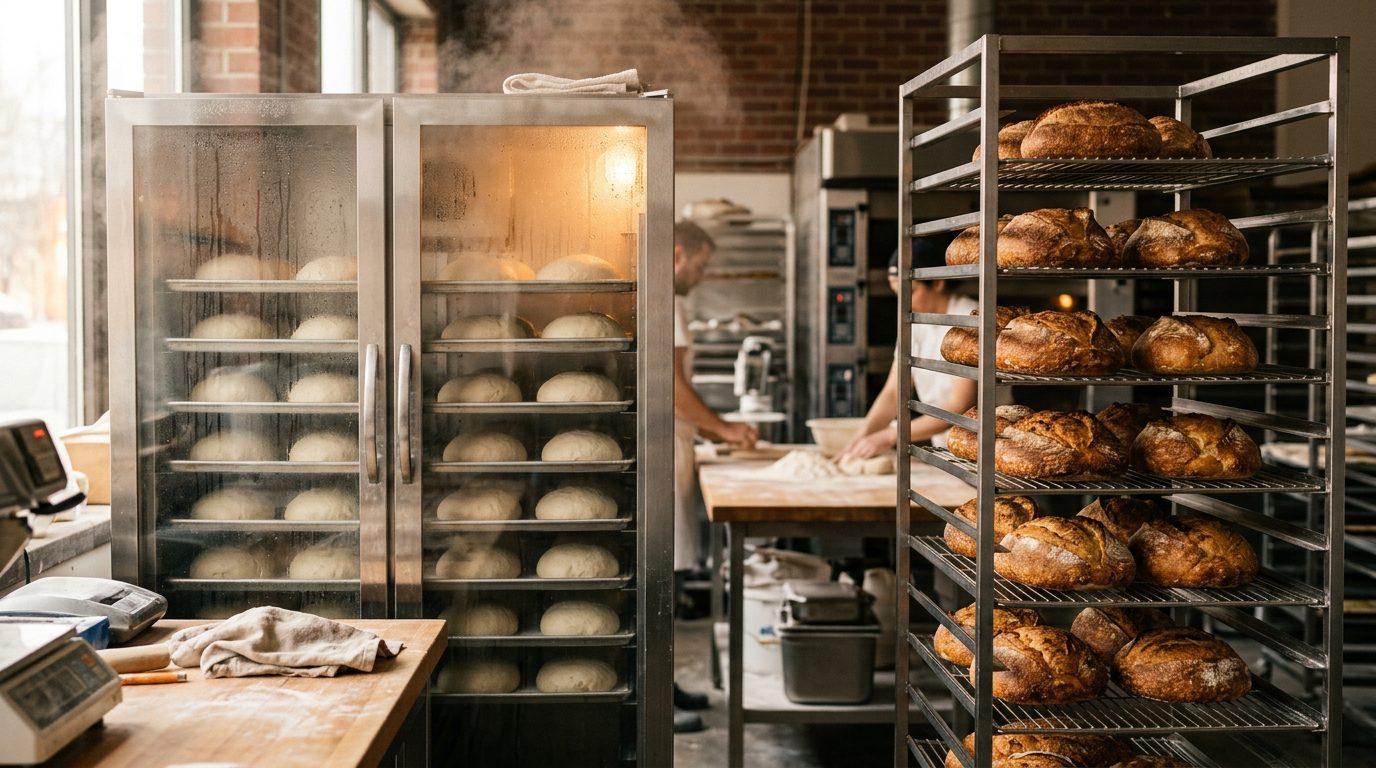
Most bakery bottlenecks are not in the mixer or the oven. They sit in the two stages either side of the bake: proofing, where dough needs controlled warmth and humidity for a fixed period you cannot rush, and cooling, where finished product needs airflow and time before it can be sliced or packed. Get proofing and cooling equipment sized correctly and the oven runs continuously; get it wrong and you are either waiting for dough or stacking hot bread on a bench.
This guide walks the line from mixed dough to packed product, explains what each stage physically needs, and gives you the questions to size it against your own daily output.
The stages between mixer and oven
Dough leaving the mixer is not ready to bake. Four things usually happen first, and each one needs space, equipment or both.
Bulk fermentation. The whole dough mass rests so that yeast activity and enzyme action develop flavour and extensibility. This needs covered containers and a controlled corner of the bakery, not a machine — but it does need floor space and a stable temperature.
Dividing and scaling. Every unit must come out at the same weight, or your bake times drift and your costing falls apart. Hand scaling is accurate but slow, and it is the first task a growing bakery should mechanise. A machine such as the Industrial Dough Divider/bread Cutter turns a bulk mass into consistent portions at a pace hand scaling cannot match, and consistency here is what makes everything downstream predictable.
Shaping and panning. Whether by hand or with a dough sheeter for laminated and pastry work, this stage sets the structure the final proof will inflate.
Final proof. The panned units rise to their finished volume before baking. This is the stage that most often controls your whole day's rhythm.
What a prover actually controls
A proving cabinet controls two variables: temperature and relative humidity. Temperature sets the speed of fermentation. Humidity stops the dough surface drying and forming a skin.
Skinning is the failure most small bakeries live with without recognising it. A dried surface cannot stretch, so the loaf's expansion in the oven is restrained, the crust tears in the wrong place, and the crumb finishes tighter than it should. Proving in the open air of a bakery — especially in a warm, breezy or air-conditioned room — makes skinning almost inevitable, and no amount of oven adjustment compensates for it.
A cabinet prover also gives you something the open bench cannot: repeatability. When the same recipe rises in the same conditions every day, your bake times stop being a judgement call. A tray-based cabinet such as the Industrial Electric Dough Prover-16 Trays is designed around exactly that — a known number of trays going in and coming out on a schedule you can staff against.
Larger bakeries add retarding: holding shaped dough cold to slow fermentation, so overnight dough is ready for an early bake without an overnight shift. Retarding needs purpose-built cold holding rather than a general-purpose chiller, though general commercial chillers and refrigerators remain essential for creams, fillings and laminated pastry with butter in it.
Stage-by-stage requirements
| Stage | What it needs | Equipment | Common failure if under-provisioned |
|---|---|---|---|
| Bulk fermentation | Stable temperature, covered vessels | Containers, bench space | Inconsistent dough day to day |
| Dividing and scaling | Speed and weight accuracy | Dough divider, scales | Uneven bake, unpredictable costing |
| Shaping | Even thickness, gentle handling | Sheeter, bench, moulder | Poor volume and shape |
| Final proof | Controlled warmth and humidity | Proving cabinet | Skinned dough, tight crumb, drifting timings |
| Baking | Stable, recoverable heat | Deck or convection oven | Pale bases, uneven colour |
| Cooling | Airflow on all sides, time | Tray trolleys, racking | Condensation, gummy slicing, mould |
| Slicing and packing | Fully cooled product | Bread slicer, packing bench | Crushed slices, short shelf life |
Cooling is not "leave it on the bench"
Hot bread is still finishing. Starch continues to set as the loaf cools, and the crumb keeps releasing moisture and steam. Two rules follow.
Air must reach every surface. A loaf sitting on a solid tray or stacked against another loaf traps steam underneath, which softens the base crust and creates a damp patch that stays damp. Cooling on open racks with clearance between trays is the whole technique. Vertical trolleys such as the Baking Tray Trolley 09 Layers (Aluminium) and the taller Baking Tray Trolley 15 Layers give you cooling capacity in a small footprint and, just as importantly, let you move a whole bake in one movement instead of tray by tray.
Slicing and packing must wait. Slicing warm bread drags and compresses the crumb, and it clogs the blades. Packing warm bread is worse: the residual steam condenses inside the bag, and that free water on the crust surface is the single most reliable way to shorten shelf life and invite mould. If your team is bagging warm loaves because the racks are full, the fix is more racking, not faster bagging. Once the product is genuinely at room temperature, an Industrial bread slicer gives you even slices at a pace that keeps up with a full bake.
Cakes and cream products add a third rule: they need cooling before decoration, and cold holding afterwards. Finished display stock belongs in display and showcase equipment rather than back on the production bench.
Sizing the workflow to your output
Work in units per hour, at your peak, at every stage. The line runs at the speed of its slowest station.
- Set your peak-hour target — the busiest hour of your busiest day, not the daily average.
- Calculate proving capacity in trays. Units per tray, times trays in the cabinet, divided by proof time in hours, gives units per hour. If that number is below your target, the prover is your ceiling regardless of oven size.
- Calculate oven throughput the same way, using bake time plus loading and recovery.
- Calculate cooling capacity. Cooling takes longer than baking for most products, so cooling racks usually need to hold more units than the oven bakes in one cycle — often several bakes' worth at once.
- Compare all three. Then buy the constraint, not the machine that is most appealing.
The frequent mistake is upgrading the oven while leaving proving and cooling untouched. The result is dough that over-proofs waiting for a bake slot and hot product with nowhere to go, which is a worse operation than before the upgrade. The commercial bakery machines range is best read as a line rather than a shopping list — mixing, ovens, dividing and slicing each sized to the same target.
How to choose: decision checklist
- What is your peak-hour unit target, by product? Every calculation depends on this number.
- How many trays do you need in proof at once, given your longest final proof time?
- Does your prover, oven and trolley all take the same tray size? Standardise on one tray dimension across the bakery before buying anything.
- Where will hot product cool, and is that space out of the traffic path and away from doors and fans that dry crust unevenly?
- How long does your product genuinely need to cool before slicing and packing? Time it once, honestly, and plan racking around the real number.
- Is dividing done by hand? If yes, work out the labour hours and weight variance it costs you before deciding it is fine.
- Do you need cold holding for fillings, creams or overnight dough, and is that separate from your finished-goods display?
- What is the movement path from mixer to bench to prover to oven to cooling to packing? Draw it. Every crossing point is a collision and a delay.
Frequently asked questions
Do I really need a proving cabinet in Sri Lanka's climate?
The ambient temperature will raise dough, but it will not control humidity or hold conditions steady through the day. Without a cabinet, your proof times move with the weather and the dough surface skins in moving air. A prover is what makes your schedule repeatable rather than reactive.
How long should bread cool before slicing?
Until the crumb is at room temperature throughout, not just to the touch on the outside. Large loaves take considerably longer than rolls. Slicing before then compresses the crumb and gums the blade; packing before then traps condensation in the bag.
Can I proof dough in the oven on a low setting?
It is a common improvisation and a poor one. There is no humidity control, the temperature is far above proving range at the lowest usable setting, and it occupies the oven you need for baking. It also makes it impossible to run proof and bake in parallel, which is the whole point of separate equipment.
What causes condensation inside bread packaging?
Packing before the product has fully cooled. Residual heat drives moisture out of the crumb, and it condenses on the inner surface of the bag. That surface water softens the crust and creates the conditions for mould. The fix is cooling capacity, not different packaging.
Which should I buy first, a prover or more cooling racks?
Measure both against your peak hour. If dough is waiting on the bench and rising unevenly, buy the prover. If baked product is stacked and being bagged warm, buy racking first — it is the cheaper fix and it has an immediate effect on shelf life.
Where to go next
Map your own line — divide, shape, proof, bake, cool, slice, pack — then match each stage against the commercial bakery machines collection and the wider bakery equipment range, including tray trolleys and racking. For a full build from scratch, the bakery equipment setup guide covers the surrounding stations and the commercial kitchen equipment guide covers the shared services around them.
Share:
Deck Oven vs Convection Oven vs Rotary Oven: Choosing a Bakery Oven
How to Start a Cafe in Sri Lanka: The Equipment Checklist