
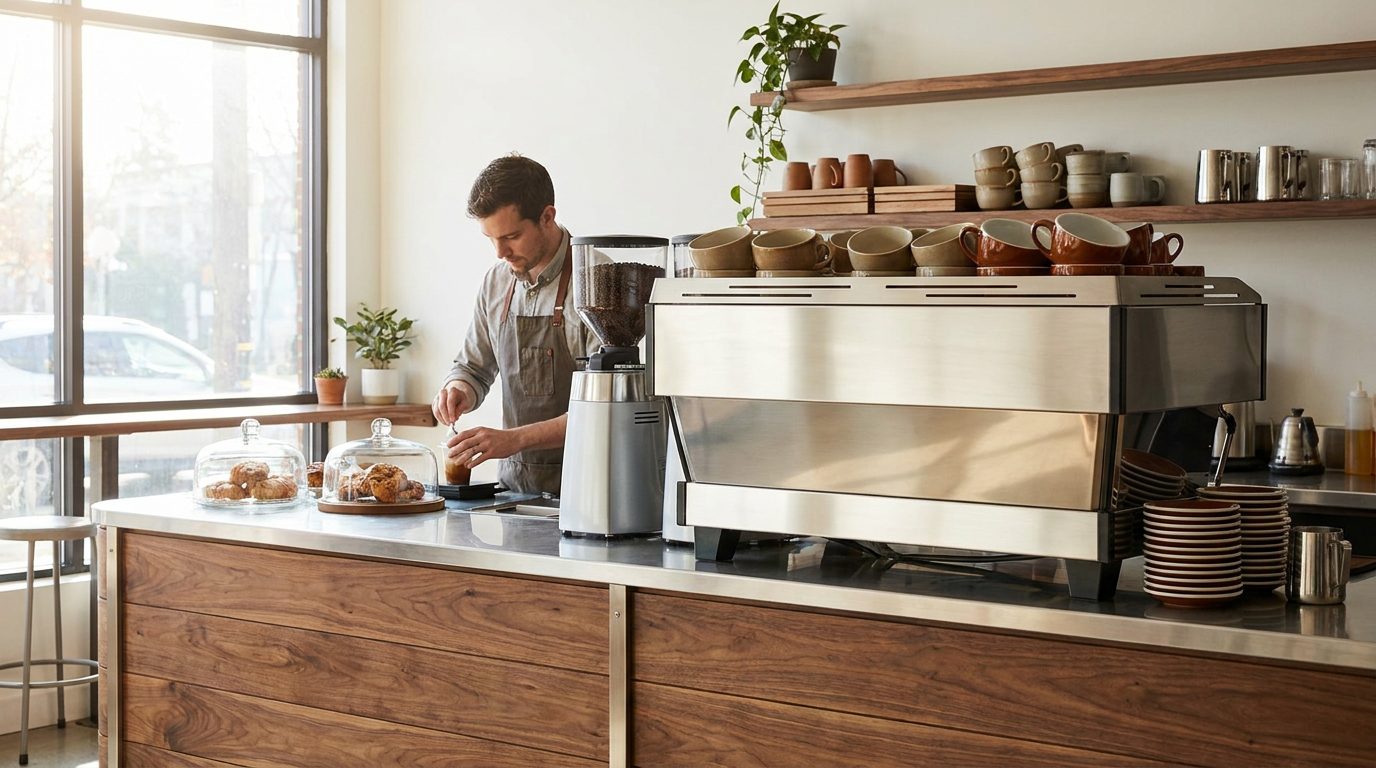
Every café equipment list comes down to five zones: the coffee bar, the cold chain, the food line, front-of-house service, and back-of-house washing and storage. The coffee bar decides your product quality and your queue speed, so it takes the largest share of attention and investment; the other four decide whether you can serve food profitably and keep the health and hygiene side of the operation defensible.
This checklist is written for an owner planning a real café in Colombo, Wattala or a regional town — sized around peak-hour demand rather than around a wish list. Work through the zones in order, because each one constrains the next.
Zone 1: the coffee bar
Four items set your quality ceiling. Nothing else on the list can compensate if these are wrong.
Espresso machine. The single largest decision. Group head count sets how many drinks you can build simultaneously; boiler design sets how well the machine holds temperature through a rush. A one-group machine suits a low-volume counter, a small office café or a kiosk; two groups are the standard for a café with a queue, because one barista can extract on one group while steaming milk for the next order. Work through the commercial espresso machine range against your peak hour before you shortlist on appearance. Models such as the G3028 Espresso Machine and the G3148 Espresso Machine sit in the semi-automatic commercial class most Sri Lankan cafés run.
Grinder. Buy it at the same time and with the same seriousness as the machine. Espresso quality is decided at the grinder more than anywhere else, because grind consistency controls extraction. An underspecified grinder paired with a good machine produces worse coffee than the reverse. A dedicated commercial unit such as the G9015A Coffee Grinder belongs on the bar; browse the full coffee grinder range if you plan to run separate grinders for espresso and filter.
Water. Sri Lankan supply hardness varies significantly by area, and scale is the leading cause of commercial espresso machine failure. Filtration and softening are not optional extras; they are part of the machine purchase. Budget for them at day one, not after the first breakdown.
Milk and cold storage under the counter. Your barista should never leave the bar for milk. An undercounter fridge in the bar run is a workflow decision, not a luxury.
Zone 2: barista tools
Small items, disproportionate effect on consistency. The working set is a tamper, a distribution tool, a bottomless or double-spout portafilter, milk pitchers in at least two sizes, a knock box, cleaning brushes and detergent, and a scale with a timer so shots are measured rather than guessed.
A tamping station such as the 58mm Espresso Tamping Station protects both your bar surface and your barista's wrist over a long shift. On milk, pitcher size matters more than most owners expect: a Milk Frothing Pitcher (450ml/15oz) is the everyday size for single and double drinks, and steaming a small volume in an oversized pitcher gives poor texture every time. The rest of the working kit is in barista tools and accessories.
Zone 3: cold chain
| Item | Why it is on the list | Sizing rule |
|---|---|---|
| Undercounter bar fridge | Milk within arm's reach of the group head | One day's milk at peak, plus a margin |
| Upright chiller | Bulk milk, dairy, prepped food | Your restock frequency times daily usage |
| Freezer | Frozen bases, ice cream, stock control | Slowest-turning items decide the size |
| Ice machine | Iced coffee, cold brew, cold drinks | Peak-day iced-drink count, not average |
| Cake and pastry display | Sells your food without a single word from staff | Match to your daily production or resupply |
Ice deserves specific attention in a Sri Lankan café. Iced drinks are a large share of sales for most of the year, and an undersized machine simply stops mid-afternoon on your busiest day. Size the ice cube machine on your peak day, and remember that a machine's daily production is spread across 24 hours while your demand is concentrated in a few. Storage bin capacity matters as much as production rate. The rest of your cold requirement sits in commercial chillers and refrigerators.
Zone 4: the food line
The food menu should be designed around the equipment you are willing to buy and the extraction you are able to install, in that order. A café that adds deep frying after signing the lease usually discovers the ventilation problem too late.
For a toastie, panini and sandwich menu, a contact grill such as the Industrial Panini Grill 425mm plus a small oven covers most of the card. Add a blender for smoothies and frappés, a juicer if fresh juice is on the menu, and a small prep fridge. Anything beyond that — full breakfast service, curries, fried items — is a commercial kitchen rather than a café food line, and should be planned as one.
Two rules hold generally:
- Every hot item you add extends peak-hour ticket time. If the item cannot be produced in under the time the coffee takes, it will slow the whole queue.
- Every cooking method you add changes your extraction requirement. Griddling, frying and open-flame cooking each demand different hood and make-up air provision.
Zone 5: front of house and back of house
Front of house: counter with a clear customer path, till and payment position, condiment and collection station away from the ordering point, cups and lids storage within reach of the bar, seating and menu boards.
Back of house: a three-compartment or double-bowl sink, a separate hand wash basin, dry storage racking, a bin and waste area, and a water heater. If you plan to serve on ceramic, a glass and crockery washer changes the labour maths quickly — hand washing crockery through a rush is a hidden staffing cost that most new cafés underestimate.
Sizing everything to peak hour
The number that drives the entire list is peak-hour drinks. Estimate it honestly.
- Seats plus takeaway. Estimate covers per hour at your busiest time, and add takeaway orders.
- Drinks per cover. Usually a little over one.
- Seconds per drink. Espresso extraction and milk steaming set the floor; a single barista on a two-group machine can sustain a working rhythm that a one-group machine cannot match.
- Compare. If your peak-hour drink count exceeds what one barista on your chosen machine can produce, you need more groups, more staff, or both. Machine capacity and staffing are one decision, not two.
Repeat that logic for ice, milk storage and the food line. Every zone should be sized against the same peak-hour number so no single station collapses the queue.
How to choose: buying order for a new cafe
When capital is staged, this sequence protects quality and cash at the same time.
- First: espresso machine and grinder, chosen together. They are the product. Choosing group count correctly at this stage is cheaper than replacing the machine in year two.
- Second: water treatment. Protects the machine you just bought.
- Third: undercounter refrigeration and the bar layout. Workflow at the bar decides sustainable service speed.
- Fourth: ice machine. Sized for the peak, not the average.
- Fifth: the food line, limited to what your extraction and your menu genuinely support.
- Sixth: display and front-of-house fittings, which drive add-on sales once traffic exists.
- Seventh: back-of-house upgrades such as a glass or crockery washer, once volume justifies the labour saving.
- Throughout: confirm power, water, drainage and extraction for every item before you order it. Single-phase versus three-phase, drain position and hood capacity are the constraints that force expensive rework.
Frequently asked questions
What equipment do I need to open a small cafe in Sri Lanka?
At minimum: a commercial espresso machine and grinder, water filtration, an undercounter fridge for milk, an ice machine, a display fridge or cabinet for food, sinks and a hand wash basin, dry storage, and the barista tool set. Anything hot beyond toasted items also requires extraction planned in advance.
Should I buy a one-group or two-group espresso machine?
Base it on peak-hour drinks, not total daily drinks. A one-group machine serves a low-volume counter or kiosk well. Once a queue forms, two groups let a barista extract and steam in parallel, which roughly transforms sustainable throughput rather than marginally improving it.
Do I need a commercial machine, or will a good home espresso machine do?
Domestic machines are built for a handful of drinks a day, with smaller boilers and lighter duty components. Under continuous service they lose temperature stability first and then fail early. Our coffee machine buyer's guide compares the classes in detail.
How much should I spend on the grinder relative to the machine?
Treat the grinder as a co-equal purchase, not an accessory. Grind consistency limits what any espresso machine can extract, so a serious grinder paired with a modest machine outperforms the reverse in the cup almost every time.
What is the most commonly underestimated item?
Ice capacity, followed by water treatment. Both are invisible until the day they fail, and both fail on your busiest day. Size ice for the peak day and treat filtration as part of the espresso machine purchase.
Do I need three-phase power?
It depends on the machine and the rest of the kitchen. Larger multi-group espresso machines and much commercial cooking equipment call for three-phase. Confirm the supply at the premises before signing the lease, because upgrading it afterwards is slow and expensive.
Where to go next
Start with the decision that everything else follows from — work through the commercial coffee machine collection against your peak-hour drink count, then build the cold chain, food line and back of house around it. For the wider kitchen side of a café that serves real food, the commercial kitchen equipment guide covers the stations and services this checklist only touches.
Share:
Bakery Proofing and Cooling Equipment: Building a Workflow That Keeps Up
1 Group vs 2 Group Espresso Machine: Group Heads Explained