
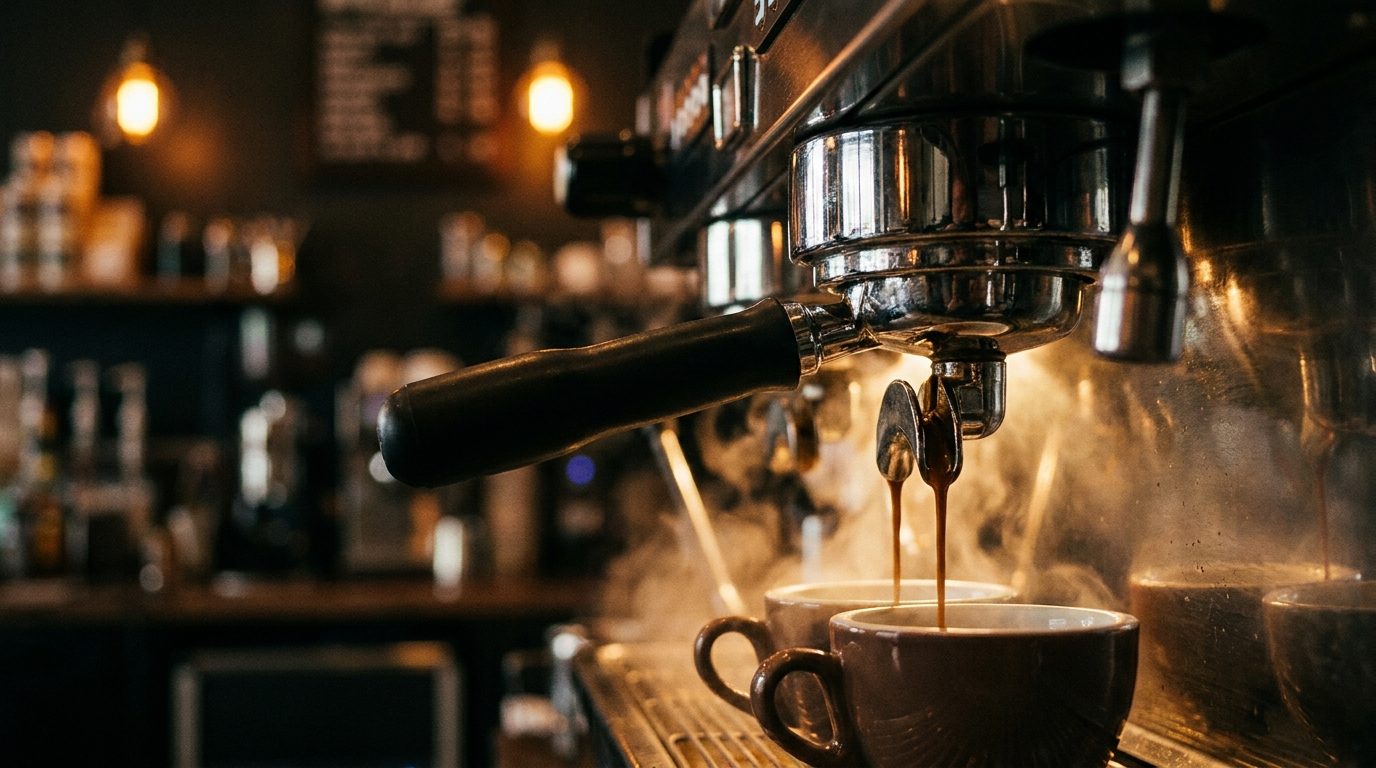
A group head is the assembly the portafilter locks into — the point where pressurised hot water meets the coffee bed. The number of groups on a machine tells you how many espressos can be extracted at the same time, and therefore how many drinks one or two baristas can build in parallel. A one-group machine suits a low-volume counter, an office or a kiosk. A two-group machine is the working standard for a café with a queue, because it lets a barista extract one drink while steaming milk for the next.
Group count is the headline, but it is not the whole decision. Boiler design, recovery under load and workflow around the machine matter just as much. Here is what actually happens inside the group, and how to match a configuration to your service.
What a group head does
When you lock in a portafilter and start the shot, the group must do four things at once: deliver water at a stable brew temperature, hold pressure against the resistance of the coffee bed for the full extraction, keep the coffee bed sealed at the gasket, and then release residual pressure through the drain so the puck can be knocked out cleanly.
The engineering challenge is temperature stability. Coffee extraction is sensitive to small temperature swings, and every shot pulls heat out of the group. How the group is heated determines how fast that heat is replaced.
- Thermosiphon groups circulate water continuously from the boiler through a heavy brass group body, using that mass to buffer temperature. It is slow to heat at start-up and slow to drift once there.
- Saturated groups make the group body part of the boiler itself, so it sits at boiler temperature permanently. Stability under back-to-back shots is excellent.
- Heated or semi-saturated groups use an element or a partial thermosiphon path to hold the group close to brew temperature with less mass.
For a busy café, temperature recovery between shots is the property that shows up in the cup. A group that drops temperature during a rush produces a different coffee at 8am than at 8.30am, and grinder adjustment does not reliably fix that.
Boiler configuration matters as much as group count
Group count sets parallelism. Boiler design sets endurance.
Single boiler. One boiler serves brewing and steam. You cannot brew and steam at full performance simultaneously, which is fine at home and limiting behind a counter.
Heat exchanger. A steam boiler with a tube passing through it heats incoming brew water on demand. You can brew and steam at the same time from one boiler. This is the most common commercial arrangement and it works well provided the machine is used steadily rather than left idle between long gaps.
Dual or multi boiler. Separate boilers for brew and steam, sometimes one per group, so brew temperature can be set independently of steam pressure. This gives the most control and the most consistent recovery under continuous load.
A two-group machine on an undersized boiler will disappoint during a rush more than a well-specified one-group machine handling a queue it was sized for. Read the boiler description before the group count when you compare models in the commercial espresso machine range.
Group count compared
| 1 group | 2 group | 3 group | |
|---|---|---|---|
| Shots in parallel | One | Two | Three |
| Typical setting | Kiosk, office, small counter, restaurant service bar | Café with a queue, hotel bar, bakery café | High-volume café, hotel breakfast service, campus outlet |
| Baristas it supports | One, working sequentially | One comfortably, two at pace | Two or more |
| Counter width needed | Smallest | Moderate | Largest |
| Utility demand | Lowest | Higher | Highest |
| Effect of a rush | Queue builds quickly | Absorbs peaks | Absorbs sustained peaks |
| Main risk | Outgrowing it within a year | Over-buying for genuinely low volume | Idle capacity and wasted counter space |
The peak-hour calculation
Work from the busiest hour of your busiest day, not from daily totals — the daily total never tells you whether the queue moves.
- Count peak-hour drinks. Covers per hour plus takeaway, times drinks per cover.
- Estimate the working cycle per drink. Grind and dose, tamp, lock in, extract, steam milk, pour, serve, purge and clean the group. In practice a milk drink occupies a barista far longer than the extraction time alone.
- Identify the constraint. On a one-group machine, the group itself blocks: nothing else can extract while a shot runs. On a two-group machine, the constraint moves to the barista and the steam wand, which is where you want it — you can add a second person, but you cannot add a second group.
- Add headroom. Weekends, holidays and the first month of a new outlet all run above your model. If your calculation lands close to the ceiling of a one-group machine, buy two groups.
The reason two groups transform throughput rather than merely doubling it is workflow overlap. A barista locks in the first shot, moves to steaming milk while it extracts, pours, then starts the next shot on the second group without waiting for the first group to clear and cool. The machine stops being the bottleneck.
Semi-automatic, volumetric or fully automatic?
Group count is separate from how the group is controlled.
Semi-automatic machines start and stop the pump manually or with a single button, leaving shot volume to the barista and the scale. They give the most control and the lowest complexity to service, which is why they dominate specialty cafés. Machines across the semi-automatic coffee machine range and commercial models such as the G3211 Espresso Machine and the G3812C Espresso Machine sit in this category.
Volumetric machines dose a programmed volume per button, which improves consistency between staff and speeds up service where training time is limited.
Fully automatic and bean-to-cup machines grind, dose, tamp and extract in one cycle. They remove barista skill from the equation, which is exactly right for an office, a hotel breakfast buffet or a self-service point, and exactly wrong for a café selling coffee as its product. See the fully automatic coffee machine range if unattended service is your use case.
Portafilters, baskets and the 58mm standard
Most commercial group heads use a 58mm portafilter, which is why commercial accessories, tampers, distributors and baskets are built around that dimension. Standardising on it means your tools, spare baskets and cleaning kit stay compatible when you change or add machines.
Two portafilters are worth owning beyond the ones supplied. A 58mm Double Spouts Portafilter, 2 Ears with Double Cup Filter Basket is the workhorse for split shots and service speed. A 58mm Bottomless Portafilter, 2 Ears with Double Cup Filter Basket exposes the underside of the puck during extraction, so channelling, uneven tamping and distribution faults become visible instead of theoretical — it is the single most useful training tool on a bar. The supporting kit sits in barista tools and accessories.
How to choose: decision checklist
- What is your peak-hour drink count, with headroom? This is the primary input; everything else is secondary.
- How many people work the bar at peak? One barista and three groups is wasted capacity. Two baristas and one group is a queue.
- What proportion of your drinks contain milk? A milk-heavy menu loads the steam boiler harder than the groups, which pushes you toward a stronger steam system or a second wand.
- How long is your busy period? Short sharp peaks reward recovery speed; all-day steady trade rewards boiler capacity.
- How wide is the bar run? Measure the machine footprint, the grinder beside it, the knock box and the working space between them before ordering.
- What is the power supply and the water connection? Confirm the electrical supply, the plumbed feed and the drain position at the counter, not after installation.
- How hard is your water? Scale is the leading cause of commercial espresso machine failure. Filtration and softening belong in the purchase, not the maintenance budget.
- Who services it locally? Group gaskets, baskets and valves are consumables; plan for them.
- Have you specified the grinder to match? A machine can only extract what the grinder delivers, and grind consistency limits every group you buy.
Frequently asked questions
What is a group head on an espresso machine?
It is the assembly where the portafilter locks in and pressurised hot water is delivered through the coffee. It controls brew temperature stability, holds pressure through extraction, seals against the basket, and releases pressure afterwards. The number of group heads sets how many shots can run at once.
Is a 2 group espresso machine worth it for a small cafe?
Usually yes, if a queue forms at any point in the day. The second group lets a barista overlap extraction with milk steaming instead of working strictly in sequence, which is what keeps a queue moving. If service is genuinely spread thin across the day with no peaks, one group is sufficient.
Can one barista operate a 2 group machine?
Yes, and that is the most common arrangement. The second group exists to remove waiting time from a single barista's workflow as much as to allow two people to work side by side. Three groups, by contrast, generally need more than one person to be worth the counter space.
Does more groups mean better coffee?
No. Cup quality comes from the grinder, the coffee, water treatment, the barista and the machine's temperature stability. Group count is a throughput decision. A well-specified one-group machine on treated water with a good grinder beats a larger machine that is poorly maintained.
What size portafilter do commercial machines use?
58mm is the common commercial standard, which is why tampers, distributors, baskets and tamping mats are widely available in that size. Confirm your specific machine before buying accessories, and standardise across your bar so tools remain interchangeable.
Where to go next
Settle your peak-hour number first, then compare group count, boiler configuration and footprint across the commercial coffee machine collection. If you are still deciding between commercial and domestic classes, or between semi-automatic and bean-to-cup, our coffee machine buyer's guide for Sri Lanka covers that comparison in full.
Share:
How to Start a Cafe in Sri Lanka: The Equipment Checklist
Semi-automatic vs fully automatic coffee machine: which one fits your service?