
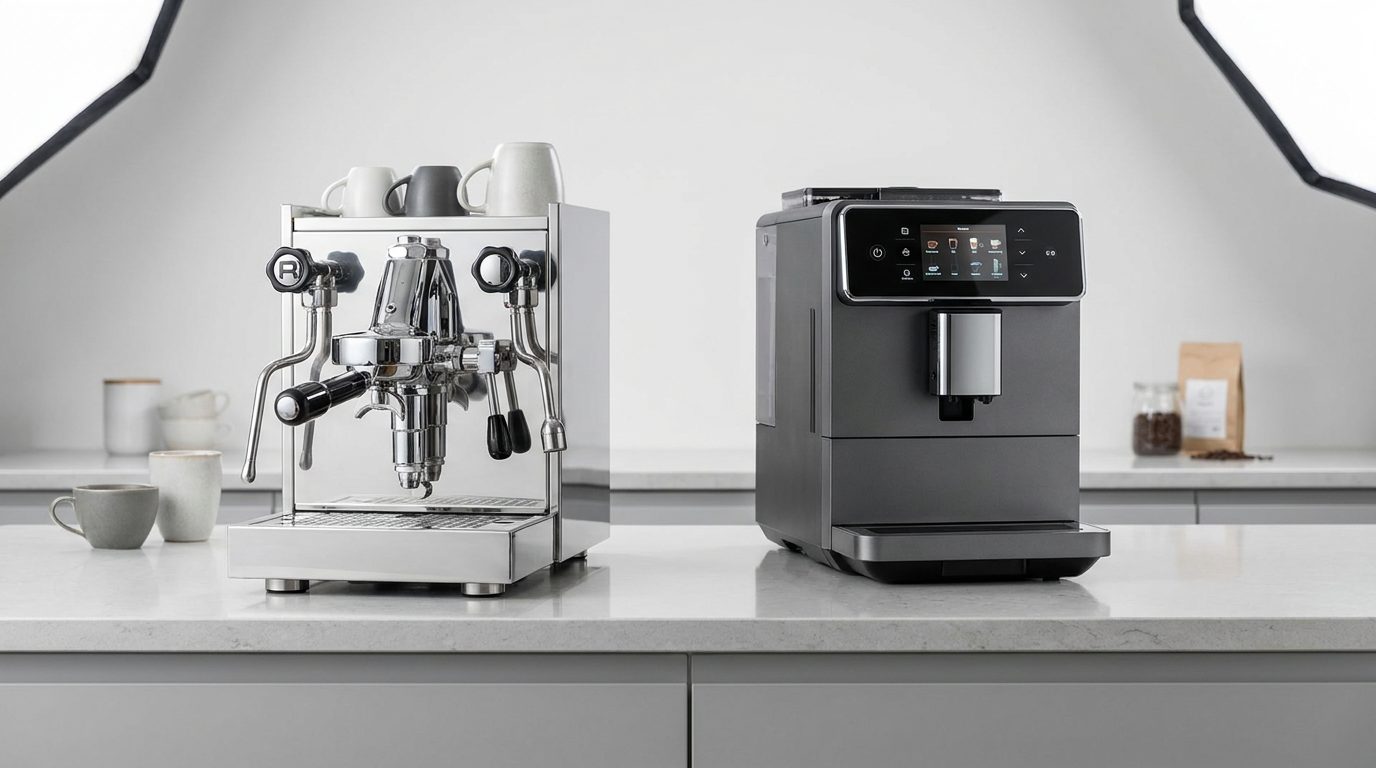
A semi-automatic machine leaves dose, tamp and shot timing in the barista's hands; a fully automatic (bean-to-cup) machine grinds, doses, tamps, brews and usually froths at one button press. Choose semi-automatic when espresso craft is part of what you sell and you have trained staff. Choose fully automatic when repeatable output without a barista matters more — offices, hotel breakfast lines, staff pantries and self-service counters.
Everything else in this comparison follows from that single difference: who controls the variables, the person or the machine.
What "semi-automatic" actually means
On a semi-automatic espresso machine, a pump delivers brew pressure, but the barista does the rest. They grind and dose into the portafilter, level and tamp the coffee bed, lock the portafilter into the group head, start the shot, and stop it when the volume or weight looks right. Steam is manual too: a wand, a jug, and the operator's judgement.
That is more work per drink, and it is also the point. Every espresso variable — grind size, dose, tamp consistency, extraction time — stays adjustable. When beans change, when humidity changes, when the roast ages a week in the hopper, the barista can dial the grinder in and hold the cup quality steady.
Two families of semi-automatic sit side by side in the range. Countertop machines aimed at home and small-office use, such as the Philips Semi Auto Coffee Machine, keep the format simple. Prosumer machines with an integrated grinder, such as Breville The Barista Express or the Delonghi La Specialista Prestigio Espresso Machine, fold grinding, dosing and tamping aids into one footprint, which suits a small café bar or an office where counter space is short. You can browse the whole range of semi-automatic espresso machines to see how those two families differ in layout.
What "fully automatic" (bean-to-cup) actually means
A fully automatic machine holds whole beans in a hopper, grinds to order, forms the puck inside a sealed brew unit, extracts, and ejects the spent puck into an internal waste bin. Milk drinks are handled by an automatic frother or a milk line drawn from a chilled jug. The user presses a picture of a drink; the machine does the sequence.
Nobody needs training beyond "press this and empty that". Machines such as the Jura Impressa J9.3 Industrial Fully Automatic Espresso Coffee Machine and the Magnifica Start Espresso Machine with Automatic sit in the fully automatic coffee machine range.
The trade-off is ceiling and flexibility. The machine's brew unit takes one puck geometry and one pressure profile, so the range of espresso you can pull is narrower than a skilled barista working a good grinder. And when something goes wrong, you cannot fix it on the fly with a grind adjustment; you work through the machine's own settings.
Semi-automatic vs fully automatic: side-by-side
| Factor | Semi-automatic | Fully automatic (bean-to-cup) |
|---|---|---|
| Who controls dose, tamp and shot | Barista | Machine |
| Barista training needed | Real training, plus dial-in practice | Minimal; refill and empty |
| Consistency across staff | Depends on the barista | Very consistent regardless of user |
| Ceiling on cup quality | High — limited by skill and grinder | Fixed by the brew unit's design |
| Milk texture for latte art | Manual steam wand; pourable microfoam possible | Usually automatic froth; art is limited |
| Speed for one skilled operator | Fast when two drinks overlap | Fast per drink, sequential |
| Separate grinder required | Yes, unless the model includes one | No — grinder is built in |
| Daily routine | Backflush, wand purge, basket and shower screen cleaning | Guided rinse and clean cycles, empty puck bin |
| Best fit | Cafés, restaurants, specialty counters | Offices, hotel breakfast, pantries, self-service |
Where each type wins in real service
A café selling coffee as the product. Semi-automatic, without much argument. Customers who choose a café for its coffee expect a barista to adjust to the beans in front of them, and latte art on the cup is part of the sale. Pair the machine with a grinder from the coffee grinder range rather than treating the grinder as an afterthought.
A restaurant serving coffee after dinner. Either can work. If your service peaks in one short after-dessert window and your waiters, not a barista, make the coffee, a fully automatic machine removes the weakest link. If a trained team is already behind the bar, semi-automatic is fine.
A hotel breakfast buffet. Fully automatic wins on guest self-service and on the fact that no staff member has to stand at the machine for two hours. It also survives the guest who has never touched an espresso machine.
An office pantry. Fully automatic, or capsule if volume is modest. The decision usually comes down to who is responsible for cleaning it.
A high-volume takeaway counter. A multi-group semi-automatic from the commercial espresso machine range usually beats a single bean-to-cup unit, because one barista can brew and steam in parallel instead of waiting out a sequential cycle.
Staffing is the real deciding factor
Machine choice is a staffing decision disguised as an equipment decision. A semi-automatic machine multiplies a trained barista and exposes an untrained one. A fully automatic machine flattens both.
Ask three questions before you look at any model. Who makes the coffee on a Tuesday afternoon when your best staff member is off? How often does that person change? Is anyone accountable for dialling in the grinder each morning? If the honest answers are "whoever is free", "often" and "nobody", buy fully automatic and put your effort into the beans instead.
Cleaning and daily routine
Both types need a routine; they need different ones.
Semi-automatic: purge and wipe the steam wand after every milk drink, knock out and rinse baskets, wipe the shower screen and gasket, backflush the group with the blind basket at close, and soak portafilters and baskets on a schedule. A knock box drawer at the barista's hip keeps the puck routine off the bin and off the floor.
Fully automatic: run the machine's own rinse and cleaning cycles when prompted, empty the puck bin and drip tray daily, clean the milk circuit every single day without exception, and keep the bean hopper free of stale coffee. Milk-line neglect is the most common cause of bad drinks and service calls on bean-to-cup machines.
Water quality matters for both. Sri Lanka's supply hardness varies by location, and scale is what kills boilers and heating elements.
How to choose: a decision checklist
- Is coffee quality part of your brand promise? Yes → semi-automatic.
- Will a trained barista be on shift every trading hour? No → fully automatic.
- Do you need latte art? Yes → semi-automatic with a manual steam wand.
- Is the machine unattended or self-service? Yes → fully automatic.
- Do drinks come in bursts of several at once? Yes → semi-automatic with enough groups, so brewing and steaming overlap.
- Do you have counter space and budget allocation for a separate grinder? No → a semi-automatic with an integrated grinder, such as the Smith+Nobel 15 Bar Espresso Machine with Grinder, or a bean-to-cup unit.
- Who is accountable for daily cleaning? Name the person before you buy either type.
- How many drinks at your busiest hour? Size the machine to the peak, not to the daily average.
For a wider view of the categories and how they sit together, read the coffee machine buyer's guide for Sri Lanka.
Frequently asked questions
Is a semi-automatic coffee machine hard to use? It takes practice, not talent. A new user can pull a drinkable shot on day one and a consistent one within a few weeks, provided the grinder is adjustable and someone shows them how to dial in. The skill is repeatability under pressure, which is exactly what training and a routine build.
Do fully automatic machines make worse coffee? Not worse — narrower. A bean-to-cup machine delivers a consistent cup that most drinkers are happy with, every time, from any user. It cannot chase the last stretch of quality the way a barista adjusting grind and dose can, and its milk texture rarely matches a hand-steamed jug.
Which is better for an office? Fully automatic, in most offices. Nobody in an office is dialling in a grinder, and staff turnover on the machine is constant. If the office is small and drink volume is low, a capsule machine may be enough.
Can one machine cover both a café counter and catering events? A compact semi-automatic can travel, but plan for power, water and a stable surface. For events where speed matters more than craft, a canister or bean-to-cup machine is easier to staff.
Do I still need a separate grinder with a semi-automatic machine? Yes, unless the model includes one. The grinder controls extraction more than the machine does, so pairing an entry-level grinder with a good espresso machine is the most common setup mistake.
Where to start
If espresso craft is central to your business, begin with the semi-automatic espresso machine collection and choose the grinder in the same breath. If the machine has to run itself, start with the fully automatic range. Trendy Zone Lanka lists both families, so compare the two side by side against your peak-hour drink count before you commit.
Share:
1 Group vs 2 Group Espresso Machine: Group Heads Explained
Flat burr vs conical burr grinder: what actually changes in the cup