
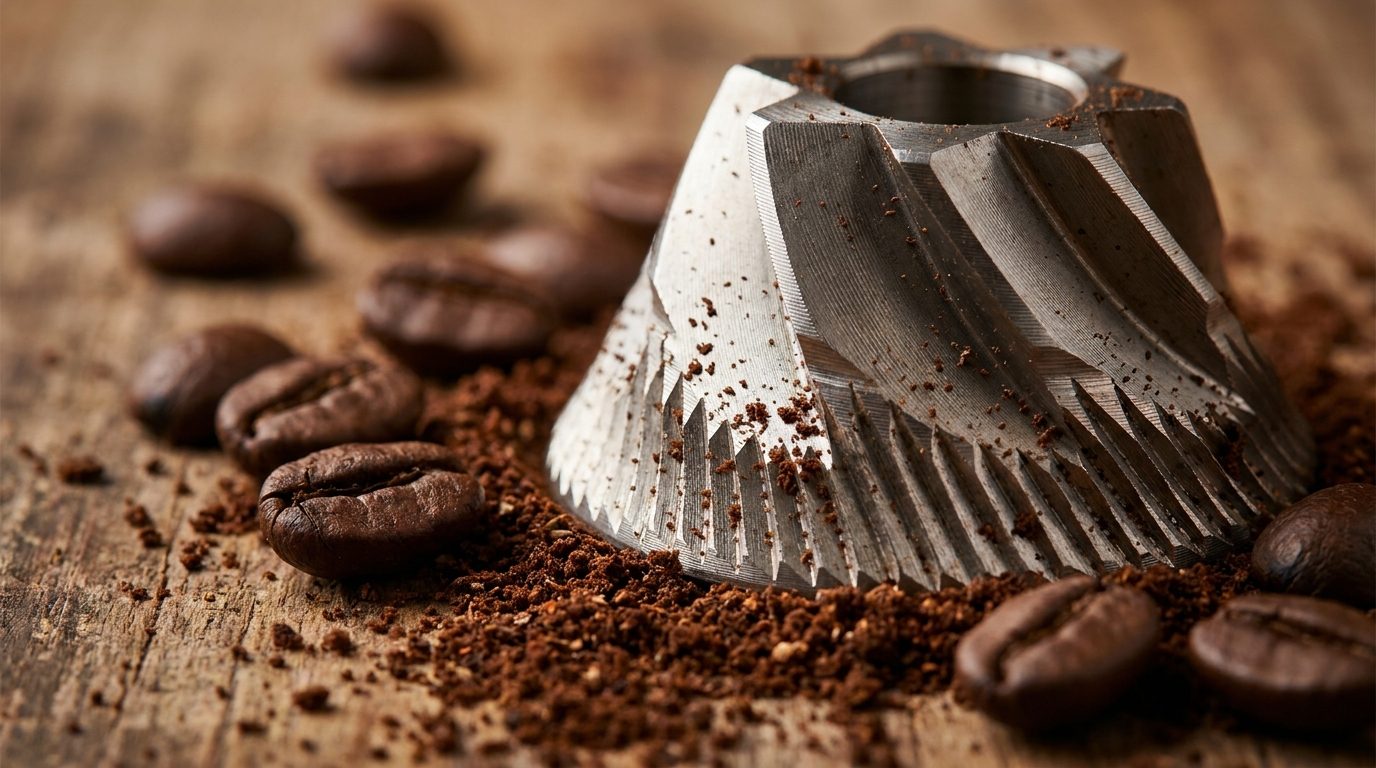
Flat burrs sit as two parallel rings and push coffee outward through a uniform gap; conical burrs sit as a cone inside a ring and let gravity pull coffee down through a narrowing gap. In practice, flat burrs are associated with a tighter particle spread and a clearer, more separated cup, while conical burrs are associated with a slightly wider spread, more body, and lower motor and heat demands. Both make excellent espresso. Burr size, alignment and adjustment quality matter more than geometry alone.
If you take one thing from this guide: your grinder limits your espresso more than your espresso machine does.
Why the grinder decides the shot
Espresso is a pressurised extraction through a compacted bed of coffee. Water follows the path of least resistance. If the grind contains too many oversized boulders alongside very fine dust, water carves channels, over-extracting the fines and leaving the boulders barely touched. The result tastes both bitter and sour at once, and no adjustment on the machine fixes it.
A burr grinder cuts coffee to a target size between two hard surfaces. A blade grinder — the type with a spinning propeller — smashes beans into whatever fragments happen to result, and it cannot produce an espresso-appropriate bed at all. For espresso, a burr grinder is not an upgrade, it is a requirement. Every grinder in the coffee grinder collection should be checked against its own listed specification for burr type before you buy for espresso use.
How flat burrs work
Two flat, ring-shaped cutting discs face each other. The motor spins one; the other stays fixed. Beans enter the centre, get broken by the coarse outer teeth, then travel outward across the flat cutting surface until they are small enough to escape the gap at the rim. Because every particle has to pass the same exit gap in the same plane, size distribution tends to be narrower.
What that buys you: clarity. Flavour separation on lighter roasts, a cleaner filter brew, and a shot where individual notes are easier to pick out. What it costs you: flat burrs generally need more motor torque, run warmer under sustained use, and are more sensitive to burr alignment — a slightly out-of-true flat set undoes the geometry's main advantage.
How conical burrs work
A cone-shaped inner burr rotates inside a matching outer ring. The gap narrows from top to bottom, so beans are pre-broken at the top and cut progressively finer as gravity pulls them down. Conical sets typically move more coffee per rotation at lower RPM, which means less heat and less motor strain for the same output.
What that buys you: body, sweetness and a forgiving margin for error, plus quieter running and less retained coffee in many designs. What it costs you: a slightly broader particle spread, which is why conical shots often taste rounder but less separated than flat-burr shots of the same coffee.
Flat vs conical: side-by-side
| Factor | Flat burrs | Conical burrs |
|---|---|---|
| Geometry | Two parallel rings, coffee exits at the rim | Cone inside a ring, coffee falls through |
| Particle spread | Generally narrower | Generally slightly wider |
| Typical cup character | Clarity, separation, defined acidity | Body, sweetness, forgiving |
| Motor and RPM demand | Higher torque, often higher heat | Lower demand, cooler running |
| Alignment sensitivity | High — alignment strongly affects results | Lower, self-centring by design |
| Retention between doses | Often higher without a purge routine | Often lower |
| Noise | Usually louder | Usually quieter |
| Suits | Specialty cafés, lighter roasts, espresso bars | Home espresso, dark roasts, mixed-duty use |
| Burr replacement | Rings replaced as a matched pair | Cone and ring replaced as a set |
Treat the "typical cup character" row as a tendency, not a law. A well-aligned conical grinder with large burrs will beat a small, misaligned flat set every time.
The specifications that matter more than geometry
Burr diameter. A larger burr set cuts each bean over a longer surface at a lower rotation speed. That means less heat, more even results and faster dosing. Between two grinders with the same burr shape, the larger set usually wins.
Burr material. Hardened steel burrs cut sharply and wear predictably; ceramic burrs stay sharp longer and run cooler but are more brittle if a stone gets through. Both are legitimate. What matters is that replacement burrs exist for the model you buy.
Adjustment type. Stepped adjustment moves in fixed clicks — quick, repeatable, and occasionally frustrating when the right setting falls between two steps. Stepless adjustment gives infinite fine control, which is what an espresso bar dialling in a new bag every few days actually wants. For filter and press grinding, stepped is entirely sufficient.
Retention and dosing. Coffee left inside the chute from the previous dose is stale by the time it reaches the next cup. Single-dose workflows and low-retention chutes suit cafés that rotate beans; hopper-fed doser grinders suit a single house blend at volume.
Duty rating. A grinder that will run through a morning rush needs a motor rated for that. Domestic-class grinders overheat when pushed through continuous back-to-back dosing.
Matching grinder to brew method
- Espresso: fine, uniform grind with tight adjustment steps. Non-negotiably a burr grinder, ideally stepless.
- Moka pot and Aeropress: fine-to-medium; a good domestic burr grinder is fine.
- Pour-over and drip: medium; consistency matters more than fineness, and clarity favours flat burrs.
- French press and cold brew: coarse; the grinder must produce coarse settings without excessive fines, or the brew turns muddy.
- Spiced and blended local coffee preparations: coarse-to-medium, where throughput and easy cleaning matter more than particle science.
Models such as the De'Longhi KG200 Coffee Grinder, the Anko Coffee Grinder, the S+N Coffee Grinder and the G9015A Coffee Grinder cover different points on that range; check each listing for the burr type, adjustment method and intended duty before choosing.
The integrated-grinder shortcut
Several espresso machines include a grinder in the same body. Breville The Barista Express and the Kogan Espresso Barista Coffee Machine with Grinder are examples from the semi-automatic espresso machine range.
The advantages are real: one footprint, one power point, grind-to-portafilter with no transfer step. The limitation is that you cannot upgrade the grinder independently, and if the grinder is the weak component, you are stuck with it. For a home setup or a small office, integrated is sensible. For a café bar, keep them separate — a busy counter often needs two grinders anyway, one for espresso and one for decaf or a second single origin. Multi-group machines in the commercial espresso machine collection are usually specified that way.
How to choose: decision checklist
- What do you brew most? Espresso demands the finest, most controllable adjustment; filter tolerates less.
- How many doses per hour at peak? Match the motor duty rating to your rush, not your average.
- One coffee or several? Rotating beans favours low retention and stepless adjustment.
- Who adjusts it? If nobody dials in daily, choose a grinder that holds its setting and is easy to reset.
- Can you get replacement burrs? Burrs are consumables. Confirm they are replaceable for the model.
- Do you have counter space and a spare power point? If not, an integrated grinder machine is the realistic answer.
- Is the cup character you want clarity or body? That is the point where flat versus conical genuinely decides it.
Pair whichever grinder you choose with proper preparation tools — a distributor, a tamper and a scale from the barista tools and accessories range — because an uneven puck wastes a good grind. For the wider category picture, see the coffee machine buyer's guide for Sri Lanka.
Frequently asked questions
Is a conical burr grinder better than a flat burr grinder? Neither is universally better. Conical burrs tend to give more body and forgiveness with less heat and noise; flat burrs tend to give more clarity and separation. Burr diameter, alignment quality and adjustment precision usually make a bigger difference to your cup than the geometry itself.
Can I use a blade grinder for espresso? No. A blade grinder produces a wide, uncontrolled mix of dust and boulders, so water channels through the puck instead of extracting evenly. It can work for French press in a pinch, but espresso needs a burr grinder with fine, repeatable adjustment.
How often should coffee grinder burrs be replaced? Burrs wear by weight of coffee ground, not by calendar age. A café grinder working through a rush every day will need burrs far sooner than a home grinder. Signs of wear include needing progressively finer settings for the same shot time, and a duller, flatter cup.
Does a bigger burr always mean a better grinder? Larger burrs generally cut more evenly and run cooler at a given output, so between comparable grinders the larger set usually performs better. But a large burr set in a poorly aligned housing with sloppy adjustment will still lose to a smaller, well-built grinder.
Do I need a separate grinder if my machine has one built in? Not for home or light office use. A busy café usually wants separate grinders, so you can run espresso and decaf side by side and upgrade the grinder without replacing the machine.
Where to start
Decide the brew method and the peak hourly dose count first, then shortlist from the coffee grinder range and read each listing's burr and adjustment specification against the criteria above. Trendy Zone Lanka lists grinders for home espresso, café counters and general kitchen use across Sri Lanka.
Share:
Semi-automatic vs fully automatic coffee machine: which one fits your service?
Barista tools list for beginners: what a new café bar actually needs