
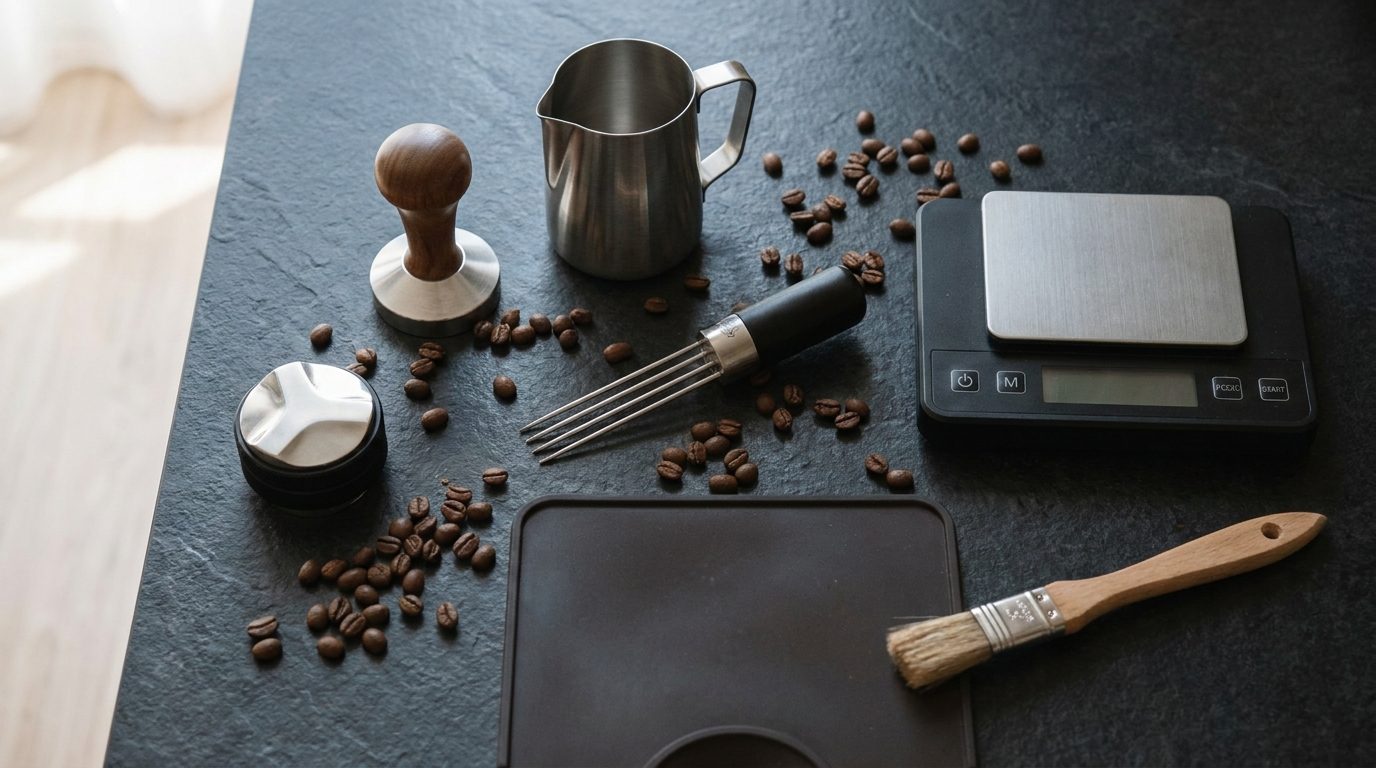
A beginner's barista kit comes down to eight items: a tamper, a distributor or levelling tool, a WDT needle tool, a scale with a timer, a knock box, a milk jug, a cleaning brush with detergent, and cloths dedicated to specific jobs. Everything else on the market is refinement. Buy the eight, learn them properly, and add later.
The mistake most new cafés make is not underbuying tools — it is buying a wall of accessories and never establishing a routine for any of them.
Match the size before you buy anything
Espresso accessories are sized to your portafilter. The commercial standard is 58 mm, and most of the barista tools and accessories in this range — tampers, distributors, WDT tools, portafilters — are 58 mm items. Compact domestic machines often use 51 mm or 54 mm baskets instead.
So the first step is not shopping. It is measuring the inside diameter of your filter basket, or checking your machine's specification, and writing that number down. A tamper that is 2 mm undersized leaves an unsealed ring of coffee around the edge, which is a permanent channelling problem no barista skill will fix.
Puck preparation: the tools that change the cup
These four do the real work.
Tamper. The tamper compresses the coffee bed into a level, uniform puck. Flat base, correct diameter, enough mass to feel stable in the hand. A 58mm Tamper is the standard fit for commercial group heads; a heavier tamper suits an operator who wants weight doing the work rather than the wrist. Consistency matters more than force — the same pressure every time beats a hard tamp.
Distributor. A distribution tool spins across the top of the dose and levels it to a set depth before tamping. A 58mm Coffee Distributor removes most of the variation between one staff member and another, which is exactly what a new team needs.
WDT tool. Grinders drop coffee in clumps, and a clump is a dense spot that water will avoid. A 58mm WDT Tool stirs fine needles through the dry dose to break clumps before levelling. It is the smallest tool in the kit with the largest effect on shot consistency.
Bottomless portafilter. A bottomless portafilter, sized to your group head, has no spouts, so you can watch the underside of the basket during extraction. Squirting jets and one-sided flow mean your prep is uneven. Use it as a training tool for the first months, then keep it for diagnosis.
Measuring: scale and timer
You cannot make a repeatable espresso without knowing the dose in and the yield out. A Coffee Scale with Timer, Espresso Scale with Auto Tare sits under the cup, tares automatically and times the shot at the same time.
Set a recipe and hold it: a fixed dose in grams, a target yield in grams, and a target time in seconds. When one of those three drifts, adjust the grinder — not the tamp, not the machine. Write the recipe on a card by the grinder so the person opening on Sunday brews the same coffee as the person who dialled it in on Friday.
Milk: jug shape and jug size
Steaming is where most new baristas lose drink quality. Two things help before technique does.
Jug size should match the drink. A jug that is too large gives the steam wand too much milk to move; a jug that is too small overflows once the milk expands. A Milk Frothing Pitcher (450ml/15oz) covers most single and double milk drinks on a café bar, and a second jug in a different size keeps you from re-steaming milk between orders. Never re-texture milk that has already been steamed — the proteins will not rebuild the foam.
Jug shape decides your pour. A tighter, more tapered spout gives more control for latte art; a wider spout pours faster for volume service.
Cleaning tools, which are not optional
A café bar accumulates coffee oils fast, and rancid oil is the single most common cause of a bitter cup in an otherwise well-run shop.
- Knock box. A Stainless Steel Knock Box Drawer gives the barista one movement to eject the puck, instead of a trip to the bin and coffee grounds across the floor.
- Group head brush. Used after every few shots to sweep the shower screen and gasket.
- Blind basket and espresso detergent. For the closing backflush on machines that support it.
- Colour-coded cloths. One for the steam wand only, one for the group and portafilter, one for the counter. Mixing them is a hygiene failure, not a shortcut.
- Soaking container. For baskets, portafilters and jug parts on a weekly cycle.
Tool priority table
| Tool | What it fixes | Buy when |
|---|---|---|
| Tamper (correct diameter) | Uneven, unsealed puck | Day one |
| Distributor / levelling tool | Barista-to-barista variation | Day one |
| WDT needle tool | Clumps and channelling | Day one |
| Scale with timer | Unrepeatable recipes | Day one |
| Milk jug (right size) | Poor texture, wasted milk | Day one |
| Knock box | Slow, messy puck disposal | Day one |
| Cleaning brush and detergent | Bitter, oily cups | Day one |
| Bottomless portafilter | Invisible prep faults | First month, for training |
| Tamping station | Wrist strain, angled tamps | When volume rises |
| Second milk jug | Re-steamed milk at peak | When milk drinks exceed a third of orders |
| Second grinder | Decaf and single-origin service | When you add a second bean |
A tamping station, like the bottomless portafilter, belongs in the second wave for most bars: it holds the portafilter square while you tamp, which matters most once one person is making hundreds of drinks a shift.
What is not on the list yet
Milk thermometers are useful for training and then get replaced by the hand-on-the-jug method. Puck screens, precision baskets and pressure gauges are real improvements, but only after your recipe, grinder and cleaning routine are stable — they solve problems a new bar does not have yet. Decorative latte art stencils sell drinks in photographs, not in a queue.
How to choose your first kit: checklist
- Measure your portafilter basket (58 mm, 54 mm or 51 mm) and buy only tools matching it.
- Count your peak-hour drinks. Over about 40 drinks an hour, a tamping station and a second milk jug stop being luxuries.
- Decide your milk drink mix. Mostly cappuccinos means jug size and steam routine matter more than puck tools.
- Check counter space before buying a scale, a distributor holder and a knock box that must all sit within reach of the group head.
- Choose one recipe card format and write the day's dose, yield and time on it.
- Confirm each tool is dishwasher-safe or hand-wash only, and set the cleaning cycle accordingly.
- Budget the grinder first. Tools refine a good grind; they cannot rescue a bad one — see the coffee grinder range.
If you are still choosing the machine itself, the commercial espresso machine collection is the place to start, and the coffee machine buyer's guide for Sri Lanka covers how the categories differ. Fitting out the rest of the shop is covered in the commercial kitchen equipment guide.
Frequently asked questions
What tools does a beginner barista need? A tamper of the correct diameter, a distribution tool, a WDT needle tool, a scale with a timer, a milk jug, a knock box, and dedicated cleaning brushes and cloths. Those items cover puck preparation, measurement, milk and hygiene — the four things that decide whether a shot is repeatable.
Is a 58 mm tamper standard? 58 mm is the common commercial group head and portafilter size, so most professional tamps, distributors and WDT tools are made to it. Compact home machines frequently use 51 mm or 54 mm baskets, so always measure your own basket rather than assuming.
Do I really need a coffee scale? Yes, if you want the same drink twice. Without weighing dose and yield you are guessing, and grind, humidity and bean age all shift during the week. A scale with a built-in timer lets you hold a fixed recipe and adjust the grinder when the shot time drifts.
What size milk pitcher should I buy first? Start with a mid-size jug that comfortably handles your most common milk drink, then add a second in a different size. Two sizes stop staff from over-filling for a single cappuccino or re-steaming leftover milk, which is where texture quality collapses.
What is a WDT tool for? It breaks up the clumps a grinder leaves in the dry dose. Clumps are dense spots that water flows around instead of through, causing channelling and uneven extraction. Stirring the dose with fine needles before levelling and tamping is a short step with a large effect on consistency.
Where to start
Measure your basket, then work down the priority table above using the barista tools and accessories collection. Buying the day-one essentials properly beats buying fifteen items you will never build a routine around.
Share:
Flat burr vs conical burr grinder: what actually changes in the cup
The best coffee machine for an office depends on headcount and who cleans it