
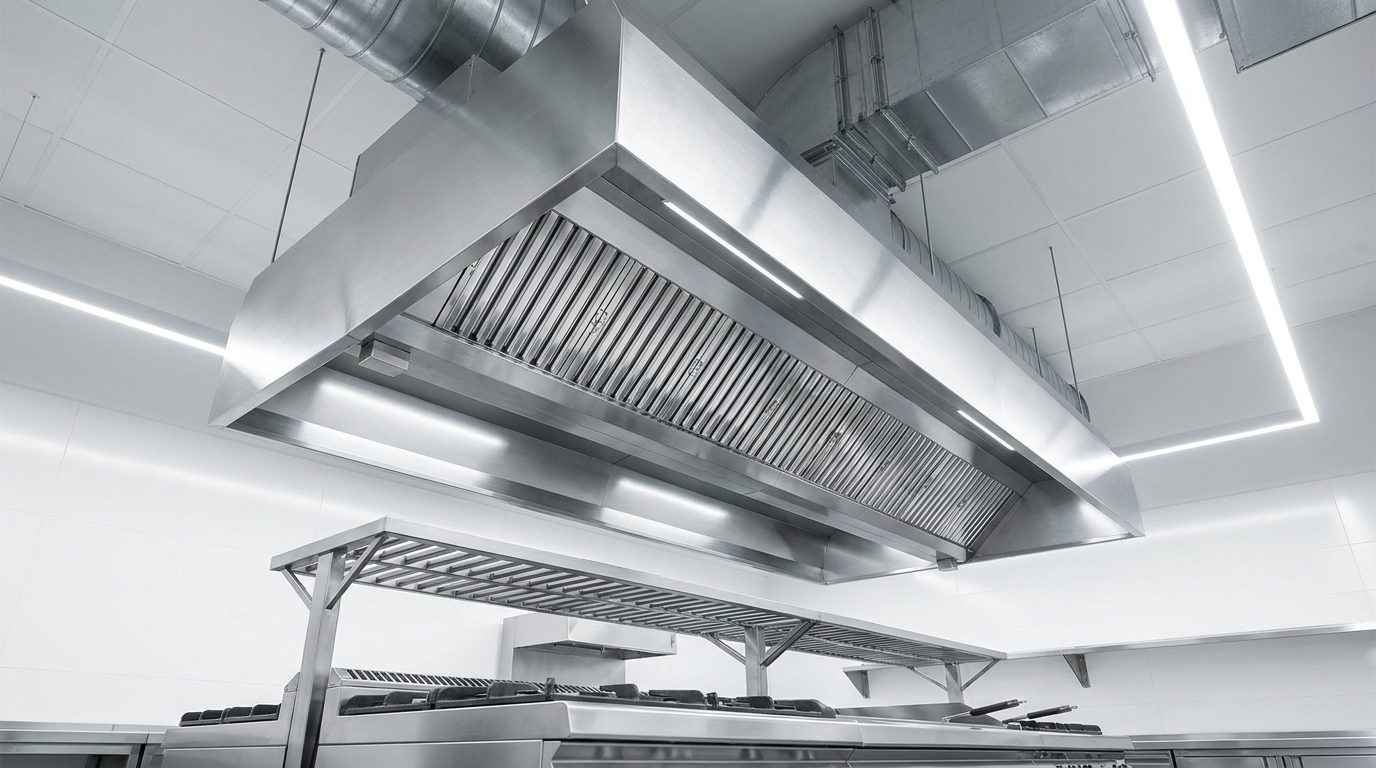
A restaurant kitchen needs two things from its ventilation: a canopy hood that captures heat, steam and grease at the source above the cook line, and enough replacement air coming in to make that extraction actually work. A wall-mounted exhaust fan is a supporting tool — excellent for prep rooms, dishwash areas and general air change, but not a substitute for a hood over burners, griddles and fryers.
Ventilation is also the one system that quietly determines whether your kitchen staff stay. In Sri Lanka's climate, an under-ventilated kitchen with an open flame line becomes unworkable by mid-service.
What kitchen ventilation has to achieve
Four separate jobs, and equipment that does one well may do another badly.
Capture contaminated air at the source. Grease aerosol, smoke and steam rise in a plume from the cooking surface. Catch it above the appliance and it never enters the room. Miss it and it travels across the kitchen, condenses on every surface, and settles on ceilings, light fittings and staff.
Remove heat. Gas burners and fryers dump enormous sensible heat into the room. Extraction is the primary way it leaves.
Control humidity. Steamers, boiling pans and dishwashers produce moisture that will condense on cool surfaces, corrode equipment and encourage mould if it is not removed.
Supply fresh air. Combustion appliances consume air, and staff need it. Extraction without supply is only half a ventilation system.
Canopy hood, wall exhaust fan or neither
| Method | How it works | Right for | Limits |
|---|---|---|---|
| Canopy hood with ducted extraction | Hood over the appliances captures the plume, grease filters strip aerosol, ducting discharges to atmosphere | Any cook line with burners, griddles, fryers or grills | Needs a viable duct route to outside; fixed position; must be cleaned on schedule |
| Wall or window exhaust fan | Draws room air directly through the wall to outside | Prep rooms, dishwash areas, dry stores, staff areas, light-cooking pantries | Pulls contaminated air across the room to reach the fan; cannot capture grease at source |
| Hood plus wall fan together | Hood handles the cook line; wall fan handles general room air change | Most real commercial kitchens | Requires the two to be balanced against a make-up air path, not simply both switched on |
| Recirculating or ductless | Filters air and returns it to the room | Very light duty only | Does not remove heat from the room; unsuitable for a commercial gas cook line |
For the cook line itself, the hood is not optional. A wall-mounted Industrial Exhaust Hood - Black 600mm suits a compact station — a single burner position, a pantry cook top, a small café line — where a full canopy would be oversized. Larger lines need a canopy sized to the equipment beneath.
For rooms rather than appliances, an Industrial Exhaust Fan 20 Inches or the smaller Industrial Exhaust Fan 16 Inches does the general air-change work. As a rule, a larger diameter fan moves a given volume of air at lower speed, which means less noise for the same effect — worth remembering in an open kitchen or a café where the fan is audible to guests.
Sizing extraction to the cook line, not the room
The most common sizing error is calculating extraction from the room's floor area. Room volume tells you about air change; it tells you nothing about the plume coming off a wok burner.
Extraction over a cook line is sized from two things: the face area of the hood, and the duty of the equipment underneath it.
- Light duty — ovens, steamers, boiling pans, rice steamers. Mostly heat and moisture, little grease.
- Medium duty — open ring ranges, griddles, pasta cookers. Heat plus moderate grease aerosol.
- Heavy duty — deep fryers, chargrills, high-pressure wok burners, rotisseries. Substantial grease and very high heat plumes.
The heaviest appliance under a hood governs the design. A single fryer or wok burner will drive the extraction requirement for the whole canopy, which is why the commercial gas burner range you choose and your commercial fryer selection should be settled before extraction is specified, not after. The commercial fryer buying guide covers what that station demands.
Three geometry rules matter as much as the fan rating:
- Overhang. The hood must extend beyond the appliance footprint on every open side, because the plume spreads as it rises. A hood cut flush to the equipment edge will spill.
- Height. Lower hoods capture better. Set the height for good capture while leaving safe head and working clearance for the tallest person on the line.
- Cross-draughts. An open door, a pedestal fan or a badly placed air conditioner will blow the plume straight out from under the hood. Capture fails long before the fan does.
Have the extraction volume calculated by someone competent against your actual equipment schedule, and confirm what your local authority requires regarding discharge position, grease management and ducting before installation.
Make-up air: the half everyone forgets
Air removed has to be replaced. If it is not, the kitchen goes into negative pressure and the symptoms are unmistakable: doors are hard to pull open or slam shut, the hood stops capturing even though the fan is running, gas burners perform poorly and flames lift, extract volume collapses, and air gets dragged in from wherever it can — usually the dining room, or worse, the drainage system.
Provide a deliberate supply path: a louvred opening, a supply fan, or a transfer route from an adjacent space, positioned so incoming air sweeps across the room toward the extract rather than short-circuiting straight into it. Air should enter behind or beside the staff and travel toward the cook line, not blow across the front of the hood.
Balance matters more than raw capacity. A modest extraction system with a proper supply path outperforms an oversized fan in a sealed room every time.
Grease filters, ducting and fire risk
Filters. Baffle filters are the commercial standard for grease-laden air. They force the airstream through direction changes so grease droplets strike the baffle surface, drain down and collect in a trough. Mesh filters clog faster, are harder to clean properly and hold more grease. Whichever you have, filters must be removable and washable, and they must actually be washed — a clogged filter both starves the extraction and holds fuel.
Ducting. Keep the run as short and straight as practical; every bend costs airflow. Build in accessible cleaning hatches at the outset, because a duct that cannot be cleaned will eventually have to be replaced. Discharge upward and away from windows, air intakes, walkways and neighbouring properties. Fit backdraft shutters or louvres — during monsoon, driving rain into an open discharge is a real problem, as are insects and rodents using the duct as an entrance. In humid conditions, condensation forms inside ducts and needs somewhere to drain that is not the ceiling of your kitchen.
Fire. Accumulated grease in a hood, filter or duct is the fuel path in most commercial kitchen fires. A written, dated cleaning schedule for filters, hood interior and ductwork is the control, and it needs to be at a frequency matched to your cooking duty — a heavy fry line needs it far more often than a bakery.
Note that ventilation and standby power are separate planning questions: generators cover supply interruptions, and are worth deciding early alongside your electrical load, but they play no part in the extraction calculation.
How to choose: decision checklist
- What is the heaviest-duty appliance on my cook line? That sets the extraction requirement.
- Is there a viable duct route to atmosphere from the position where I want the cook line?
- Does the hood overhang the appliance footprint on every open side?
- Is the hood height set for good capture while leaving safe working clearance?
- Where is make-up air entering, and does it sweep across the room toward the extract?
- Do I need separate general extraction for the dishwash and prep areas as well as the cook line?
- Is fan noise acceptable in an open kitchen or a café where guests can hear it?
- Are filters baffle type, removable and washable, and who washes them and how often?
- Does the ducting have accessible cleaning hatches, backdraft protection and a condensation drain?
- Is the discharge point clear of windows, air intakes, walkways and neighbours?
- Have I confirmed the ventilation and discharge requirements that apply to my premises locally?
Frequently asked questions
What size exhaust fan do I need for a restaurant kitchen? There is no single answer from floor area alone. Extraction over the cook line is sized from the hood face area and the duty of the equipment beneath it, while general room fans are sized on air changes for that space. Have the calculation done against your actual equipment schedule, and remember a larger, slower fan is quieter than a small fan working hard for the same volume.
Is a wall exhaust fan enough for a commercial kitchen? Not for a cook line. A wall fan only removes air that has already crossed the room, so grease, heat and steam travel past your staff and settle on every surface on the way. Wall fans are the right tool for prep rooms, dishwash areas, stores and staff spaces, working alongside a canopy hood over the cooking equipment.
Why is my kitchen extraction not pulling properly? Usually one of four things: clogged grease filters, no make-up air path so the room is in negative pressure, too many bends or too long a duct run, or a cross-draught blowing the plume out from under the hood. Check the filters first — it is the cheapest fix and the most common cause.
How often should kitchen hood filters be cleaned? Frequency follows cooking duty rather than the calendar. A heavy frying or grilling line loads filters far faster than a bakery or a steaming line. Set a written schedule, inspect weekly at minimum, and clean whenever grease is visible on the baffle surface rather than waiting for a scheduled date.
Do I need make-up air for a kitchen exhaust system? Yes. Any meaningful extraction rate has to be balanced by air coming in, whether through a louvred opening, a supply fan or a transfer path from an adjacent space. Without it the extraction rate collapses, doors become hard to open and burners run poorly — the fan will appear to be at fault when the real problem is a sealed room.
Where to start
Fix your cook line first, identify its heaviest-duty appliance, then specify capture at the source and a matching supply path. Compare hoods and general-purpose fans in the exhaust fans and kitchen extraction range, and set them against the rest of your specification using the commercial kitchen equipment guide for Sri Lanka and the full commercial kitchen equipment range. Ventilation is far cheaper to plan than to retrofit.
Share:
Commercial Gas Burner Types and How to Choose Between Them