
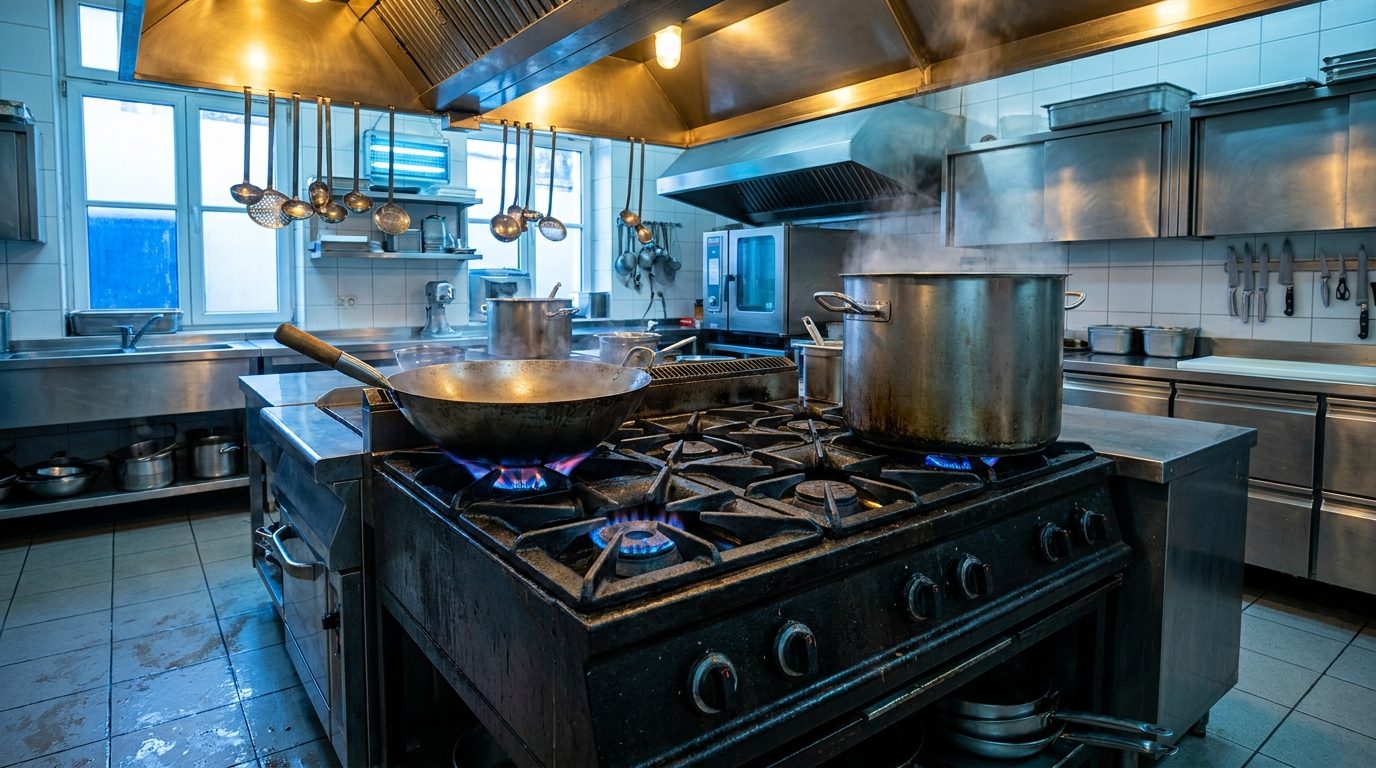
Commercial gas burners fall into a handful of families — open ring burners for general cooking, high-pressure wok burners for fast Asian cooking, wide low-level stock pot rings for bulk work, indirect burners under griddles and plates, and radiant or infrared burners for grilling. They are not interchangeable. Choosing correctly is a matter of matching flame character to pan shape, then matching burner count to how many pans have to be live at your busiest moment.
The main commercial gas burner types
| Burner type | Flame character | Best for | Pan type | Notes |
|---|---|---|---|---|
| Open ring (atmospheric) | Even, spread flame across the pan base | General à la carte cooking, sauces, curries, frying pans | Flat-bottomed pans and pots | The default commercial burner; usually arranged in 2, 4, 6 or 8 across a range |
| High-pressure wok burner | Concentrated, high-energy flame climbing the pan sides | Wok cooking, kottu gravy, fried rice, high-heat searing | Round-bottomed wok in a ring cradle | Needs a high-pressure regulator and heavy extraction above it |
| Forced-air (fan-assisted) wok burner | Same, with a blower pushing air into the flame for a more complete, hotter burn | Continuous high-volume wok stations | Round-bottomed wok | Requires a power socket as well as gas |
| Stock pot ring | Wide, low-set flame under a heavy frame at low working height | Large stock pots, bulk curry, rice, boiling | Large stock pots and cauldrons | Low height so a full pot can be lifted safely |
| Indirect (under griddle or plate) | Burners fire under a solid plate; the plate transfers heat | Griddle plates, teppan, breakfast lines | No pan — cook on the surface | Plate thickness governs heat recovery, not burner size alone |
| Radiant / infrared | Burner heats a ceramic or metal radiant surface that emits heat | Grilling, BBQ, chargrilled items | Grill bars | Reduces flare-up from fat compared with direct flame |
| Vertical burner bank | Wall of burners firing sideways at a rotating load | Shawarma, gyros, rotisserie | Vertical spit | Burner count controls how much of the meat column heats at once |
Most kitchens end up with two or three of these types. A Sri Lankan restaurant menu with curries, kottu and short-order work typically needs open ring burners for the main line, a wok burner for the high-heat section, and a stock pot ring for bulk rice and gravy.
Table top, stand-mounted or hob: choosing the format
The burner is only half the purchase. The format decides where it can live and how it works in the line.
Table top units sit on an existing bench or stainless table. They are the flexible choice: easy to reposition, easy to take out for deep cleaning, and sensible when your bench run is already built. An Industrial Gas Cooker 04 Burners(Table Top) drops into a counter run without any structural change, and the same family scales up to eight burners for larger lines.
Stand-mounted ranges come as a complete unit with legs and usually an undershelf. They set the working height for you, they can be levelled on an uneven floor, and the shelf underneath earns its keep for pans. An Industrial 06 Burner Stove With Stand (Linkrich) is the standard specification for a restaurant hot line where the range is the anchor of the cook block.
Stock pot cookers are deliberately low. That is the whole design intent: a 40-litre pot at bench height is a serious lifting hazard, and a low frame like the Industrial Stock Pot Cooker-04 Rings lets staff move a full pot without going above shoulder height. If you cook rice, stock or curry base in volume, this is a separate purchase from your main range, not an alternative to it.
Domestic hobs such as the Gas 04 Burner Hob -Domestic (SS top) belong in staff kitchens, guest apartments, small offices and pantry areas. They are built for domestic duty cycles. Putting one on a commercial line is a false economy that shows up within months.
How many burners do you actually need?
Ignore the temptation to buy by room size. Count instead.
- Write out your peak-hour menu. Take the busiest realistic hour and list every dish likely to be ordered.
- Count simultaneous pans. How many pans must be on heat at the same moment to clear that hour? That number is your minimum burner count, before any allowance.
- Add a holding allowance. In practice at least one burner is permanently occupied by something simmering — a gravy, a stock, a sauce. It is not available for orders.
- Check pan diameter against burner spacing. Four burners does not mean four large pans. Measure your widest pan and confirm two of them will sit side by side without fouling.
- Separate the high-heat work. If wok cooking is a real part of the menu, it needs its own dedicated burner. Trying to wok on an open ring burner produces slow, steamed food and blocks a burner your line needs.
An Industrial Wok Burner Double (With fan) is the answer for a station running continuous wok orders — two positions mean one chef can cook and reset without waiting. For roadside grilling, event catering or a chargrill section, an Industrial Infrared Gas BBQ Grill uses radiant heat to reduce the flare-up that plagues direct-flame grilling over dripping fat.
Gas supply, pressure and regulators
This is where commercial burners differ most from anything domestic, and where most installation problems originate.
Pressure class matters. High-pressure burners — wok burners in particular — require a regulator and hose rated for that pressure. Running a high-pressure burner from a low-pressure domestic regulator gives a weak flame and an underperforming station; the reverse is dangerous. Confirm the pressure class of every appliance before ordering the regulator, and have the installation done by a competent gas fitter in line with local requirements.
Size the cylinder bank for sustained draw. LPG has to vaporise inside the cylinder to feed the burner. Under heavy continuous draw a single cylinder cools, frosts on the outside and the vaporisation rate drops, which shows up as a burner that fades halfway through service. Manifolding several cylinders spreads the draw, and it is the standard fix when a kitchen reports losing pressure at peak.
Put the isolation valve where someone can reach it. An emergency shut-off inside the kitchen, clearly labelled, not behind the appliance you would be shutting down.
Read the flame. A healthy commercial burner burns blue with a defined inner cone. Persistent yellow tipping, sooting on pan bases or lifting flames indicate a blocked port, an air shutter out of adjustment, a partially blocked venturi — insects nesting in burner tubes is more common than people expect — or a pressure problem. None of those should be ignored.
Fitting burners into the cook line
Burners are the hottest, most services-hungry items on the line, so their position drives the rest of the layout.
- Extraction first. Every gas burner needs to sit under a canopy that captures its plume. Wok burners in particular put out enormous heat and vapour and need extraction sized for that duty — plan this alongside your kitchen extraction and exhaust fans before the range position is fixed.
- Keep burners away from fryers and water. Open flame beside hot oil is a risk you can design out. See the commercial fryer buying guide and the commercial fryer range when planning that station.
- Leave landing space. A heatproof surface immediately beside the range for hot pans is not optional.
- Allow pull-out access. Burners need to come away from the wall for cleaning behind and underneath.
- Combustible clearance. Check the clearance to any adjacent surface and keep timber, plastic and packaging well away.
How to choose: decision checklist
- Which burner families does my menu actually require — open ring, wok, stock pot, griddle, radiant?
- How many pans must be live simultaneously at peak, plus one for holding?
- Will my widest pans physically fit side by side on the burner spacing offered?
- Table top on an existing bench, or a stand-mounted range that sets its own height?
- Do I cook in bulk pots heavy enough to justify a low stock pot cooker?
- What pressure class does each appliance need, and is the regulator and hose specification confirmed?
- Is my cylinder bank sized for sustained peak draw without pressure fade?
- Can extraction capture the plume from the hottest burner I am buying?
- Are pan supports cast iron and heavy enough for the pots I lift onto them daily?
- Who cleans the burner ports weekly, and is that written into the closing routine?
Frequently asked questions
What is the difference between a commercial and a domestic gas burner? Commercial burners are built for continuous duty: heavier frames, cast pan supports that take large pots, higher gas throughput and easier access to burner ports for cleaning. Domestic hobs are designed for intermittent home cooking. A domestic hob on a restaurant line wears out quickly and cannot deliver the heat a commercial pan load demands.
How many burners does a restaurant kitchen need? Count the pans that must be on heat simultaneously in your busiest hour, then add one for the item that simmers all service. For most small restaurants that lands on four to six; high-volume kitchens and hotels typically run six to eight plus separate wok and stock pot stations.
What is a wok burner and do I need one? A wok burner produces a concentrated, high-energy flame in a ring cradle that heats the sides of a round-bottomed wok, not just its base. If wok-cooked dishes are a genuine part of your menu, you need one — a standard flat-top burner cannot reach the temperature that gives wok cooking its character.
Can I run a commercial burner from a domestic gas regulator? No. Commercial appliances specify their own pressure class, and high-pressure burners in particular require matching regulators and hoses. Using the wrong regulator produces poor performance at best and creates a real safety hazard at worst. Have the appliance's requirement confirmed and the installation carried out by a competent fitter under local requirements.
Why does my gas burner flame turn yellow? Yellow flame indicates incomplete combustion. The usual causes are blocked burner ports from boil-over, an air shutter out of adjustment, debris or insects in the venturi tube, or a supply pressure problem. Clean the ports, check the air intake, and if it persists have the appliance looked at rather than cooking on it.
Where to start
List the burner families your menu needs, count your simultaneous pans, then work through the commercial gas burner range format by format — table top, stand-mounted, wok and stock pot. If you are specifying a full kitchen rather than replacing one appliance, the commercial kitchen equipment guide for Sri Lanka and the wider commercial kitchen equipment range set the burner decision in the context of the whole cook line.
Share:
Commercial Kitchen Layout Plan: Designing for Workflow
Commercial Kitchen Ventilation: Choosing a Kitchen Exhaust Fan for a Restaurant