
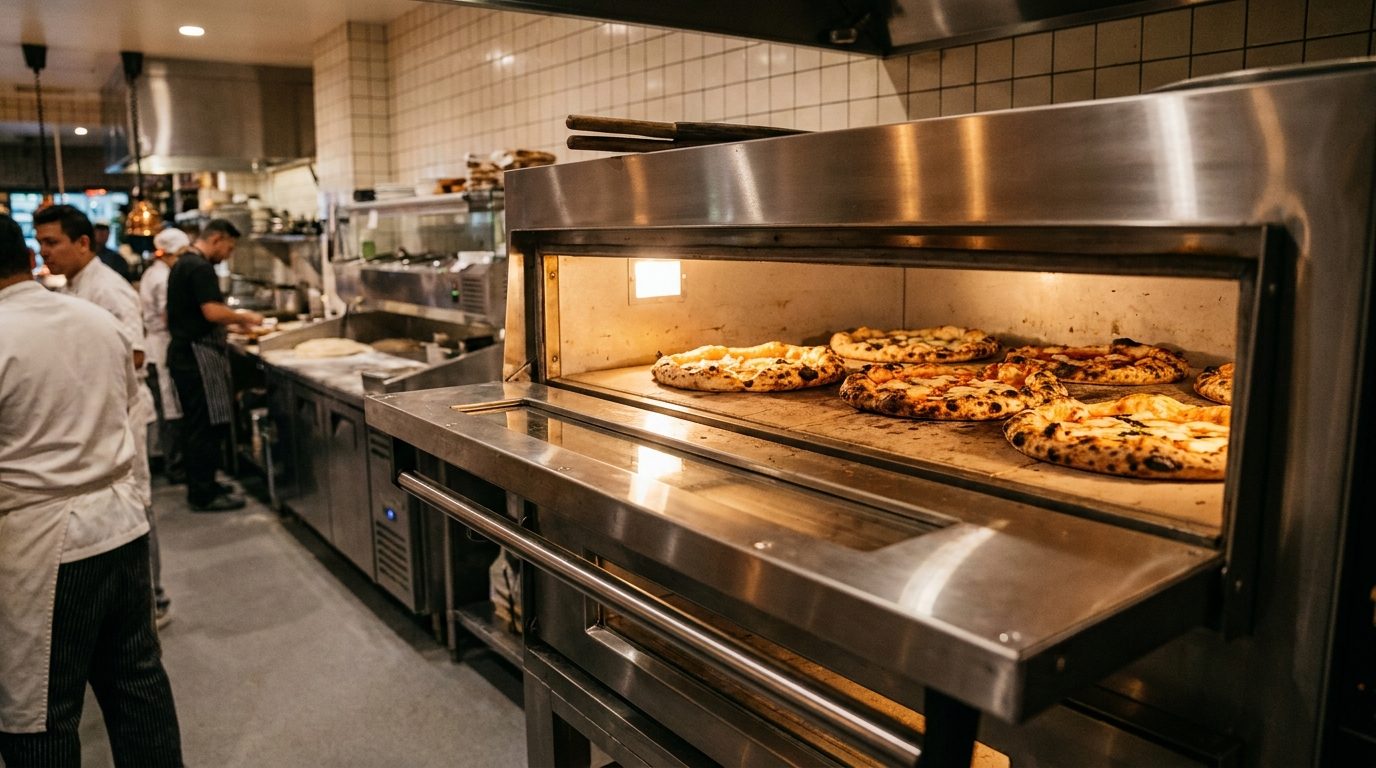
A deck oven bakes pizza on a hot hearth, with a chef judging when each pizza is ready — it gives you crust character and menu flexibility, but output depends on the person at the door. A conveyor oven carries pizzas through a heated tunnel on a belt at a fixed speed, so every pizza gets an identical bake with almost no skill required, at the cost of control. High-volume delivery and chain operations lean conveyor; pizzerias selling crust quality lean deck.
How a deck oven bakes
In a deck oven, the pizza sits directly on a heated hearth. Heat moves into the base by conduction while the enclosed chamber radiates onto the top. That base contact is what produces the leopard-spotted, dry, structural crust that a pizza on a tray never quite achieves.
The important operating characteristic is thermal mass. A deck holds a large reserve of stored heat, which is why the first pizza and the fifth pizza bake alike — but also why the oven takes a long pre-heat and cannot be started fifteen minutes before service. Recovery matters too: load six cold pizzas onto a deck and the surface temperature drops, so a busy pizzaiolo learns to leave the door shut and stage the loads.
Deck ovens also scale in a way that suits growing kitchens. A single deck is enough for a café adding pizza to an existing menu, while multiple decks let you run different products at different temperatures at the same time. Within the commercial pizza ovens range, the Industrial Electric Pizza Oven 1 Deck 2 Trays is the entry point for that approach, the Industrial Gas Oven 2 Deck 4 Trays doubles the chamber count for a kitchen running pizza alongside bakes, and the Industrial Gas Oven 3 Deck 9 Trays is a production-scale stack. The Industrial Electric Pizza Oven 890MM is the wider single-chamber option where floor width is available but height is not.
Before ordering, confirm with the supplier whether the deck in a specific model is refractory stone or steel — it changes pre-heat time and base browning, and it is not something you should assume from a photograph.
How a conveyor oven bakes
A conveyor oven is a tunnel. The pizza goes in one end on a moving belt, passes through a heated zone and comes out the other end finished. Bake time is set by belt speed, temperature is set once, and the operator's only decision is when to put the pizza on the belt.
Most commercial conveyor ovens bake by air impingement — jets of hot air directed at the top and bottom of the product through perforated plates. That moving air transfers heat fast and evenly, which is why conveyor pizzas cook quickly and consistently. It also means the crust is baked mostly by hot air rather than by hearth contact, giving a softer, more uniform base than a deck.
Where conveyors win is repeatability and labour. A new staff member can produce the same pizza on their first shift as your best cook produces on their thousandth. Where they lose is menu range: a single belt speed and temperature suit one product profile, so a thin Neapolitan-style base and a deep pan pizza cannot both be optimal on the same setting. The Industrial Electric Conveyor Pizza Oven is the tunnel option in the range for operations that value throughput and consistency above crust variation.
Deck vs conveyor: the honest comparison
| Factor | Deck oven | Conveyor oven |
|---|---|---|
| Heat transfer | Conduction from the hearth plus radiant heat | Forced hot air, usually impingement jets |
| Crust result | Drier, crisper base with hearth character | Softer, very uniform base |
| Consistency | Depends on the operator | Identical every time, set by belt speed |
| Skill needed | A trained pizzaiolo judging the bake | Minimal — load and collect |
| Menu flexibility | High; different products per deck | Low; one bake profile at a time |
| Peak output | Limited by loading skill and recovery | Predictable pizzas per hour, queue-proof |
| Pre-heat | Long — significant thermal mass | Shorter, but runs continuously through service |
| Idle running cost | Holds heat efficiently between loads | Belt and blowers run whether loaded or not |
| Footprint | Vertical; decks stack | Horizontal; needs load and exit space at both ends |
| Best for | Pizzerias, cafés, hotels, mixed bakery use | Delivery kitchens, food courts, high-volume chains |
Gas or electric, and what it means in practice
Both formats exist in gas and electric. In Sri Lankan kitchens the deciding factors are usually supply and position rather than baking theory.
Gas ovens such as the deck models above suit kitchens that already run LP gas and have a flue path. They typically bring heat back quickly after a heavy load. Electric ovens remove the gas line and flue from the equation, which matters in shopping-mall units and rented spaces where gas installation is restricted, but they need a properly rated circuit — confirm the electrical requirement for the specific model with the supplier before you commit to a position.
Whichever you pick, ventilation is not optional. Both oven types put substantial heat into the room, and an oven boxed into a corner with no extraction will make the kitchen unworkable and shorten the life of nearby refrigeration.
Pizza oven or general industrial oven?
This is worth settling early, because the two collections serve different jobs. A pizza oven is optimised for high-temperature, short bakes with strong base contact or fast air movement. A general industrial and bakery oven is optimised for bread, buns, cakes and trayed production — lower temperatures, longer bakes, often with steam and always with tray racks in mind.
The overlap is real: multi-deck gas ovens serve both worlds, which is why the same deck models appear on both pages. The distinction that matters for your purchase is what dominates your output. If pizza is the product, buy for hearth performance and top-heat control. If pizza is one line among bread, buns and cakes, buy a trayed production oven and accept a slightly softer pizza base. Kitchens planning a full bakery build should start from the bakery equipment setup guide for Sri Lanka and the wider bakery equipment range rather than from the pizza category.
How to choose: a decision checklist
- Write down your peak-hour pizza count. Not your daily total. The peak decides whether an operator-paced deck can keep up.
- Decide what your crust promise is. If crust character is on the menu description, a deck is the honest choice.
- Audit your staffing model. High turnover or rotating part-time staff favour a conveyor, where the oven holds the standard instead of the cook.
- Count the products the oven must bake. One profile suits a conveyor. Pizza plus garlic bread plus baked pasta plus a tray of buns favours multiple decks.
- Measure the space including working clearance. A conveyor needs loading space at the entry and collection space at the exit; decks need door swing and a peel-handling zone.
- Confirm the utility. Gas supply and flue path, or an adequately rated electrical circuit — verified for the exact model, at the exact position.
- Plan extraction before delivery, not after the oven arrives.
- Check the pre-heat against your opening routine. A long pre-heat is fine if someone opens the kitchen early; it is a daily problem if nobody does.
Frequently asked questions
Is a conveyor oven better than a deck oven for pizza? Better at consistency and throughput with untrained staff; worse at crust character and menu range. A conveyor removes operator variation, which is exactly what a delivery-led business wants. A pizzeria selling on crust quality generally gets a better product from a deck.
How many pizzas can a deck oven produce per hour? It depends on deck area, pizza diameter, bake time and how disciplined the loading is — not on a headline figure. Estimate it as the number of pizzas that physically fit on the hearth, multiplied by bakes per hour, then reduce it for door-opening heat loss during a rush.
Do I need a stone deck for good pizza? A stone or refractory hearth stores and releases heat into the base more gently than steel, which helps crust structure. Good pizza is still possible on steel with the right dough and temperature management. Ask which surface a specific oven uses before you buy.
Can I bake bread in a pizza oven? Deck ovens bake bread well, which is why bakeries use them — though many bread products want steam injection, which pizza-focused ovens often lack. Conveyor ovens are a poor fit for bread, because bread needs a longer, changing bake rather than one fixed pass.
Should a small café start with one deck or two? Start with one deck if pizza is an addition to an existing menu, and buy the model whose chamber suits your largest pizza. Move to two or three decks when you need to hold different products at different temperatures at the same time, which is usually the real trigger rather than volume alone.
Where to start
Compare the deck and conveyor options side by side in the commercial pizza ovens collection, then check the same shortlist against the trayed production ovens if bread and cake are also part of your output. For operators specifying a whole kitchen at once, the commercial kitchen equipment guide for Sri Lanka covers how the oven, extraction, refrigeration and prep line fit together. Trendy Zone Lanka can confirm chamber dimensions, deck surface and utility requirements for a specific model before you plan the kitchen around it.
Share:
How to Choose a Bottle Cooler for a Shop or Café
What Temperature Should a Pizza Oven Be?