
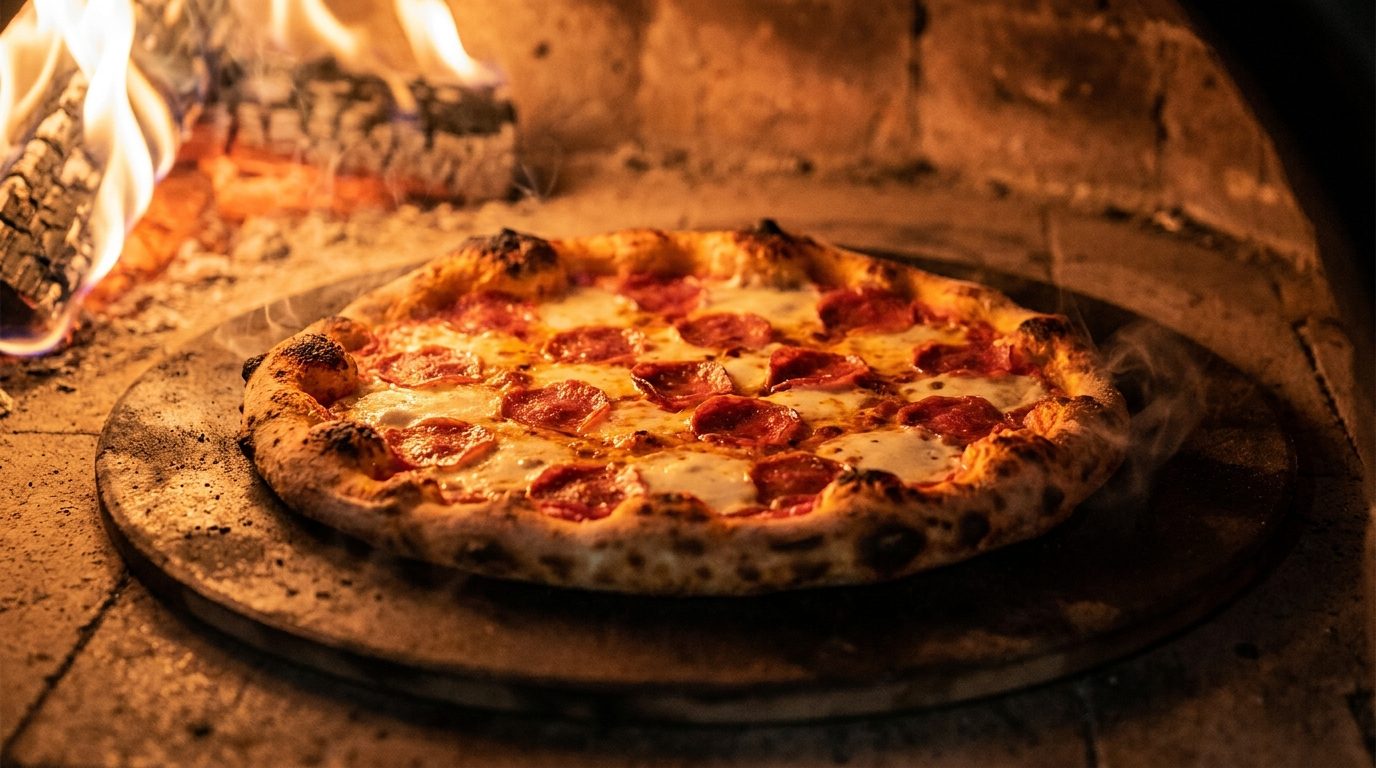
The right temperature for a pizza oven depends on the style you are baking, not on the oven's maximum setting. Neapolitan pizza is baked at roughly 430–480°C for 60–90 seconds; New York-style thin crust sits around 290–320°C for six to ten minutes; pan, deep-dish and Sicilian styles bake nearer 260–290°C for twelve minutes or more. Most commercial electric and gas deck ovens are built for the middle of that range rather than the extreme top of it, so match the oven to the pizza you actually intend to sell.
Temperature and time by pizza style
Bake time and temperature move together. Hotter is not better — it is a different pizza, with different dough hydration, different topping loads and different failure modes.
| Style | Typical oven temperature | Typical bake time | What the heat is doing |
|---|---|---|---|
| Neapolitan | 430–480°C | 60–90 seconds | Puffs the rim before the base dries; needs a very hot hearth |
| New York thin crust | 290–320°C | 6–10 minutes | Dries and crisps a thin base while melting a heavier cheese load |
| Pan and Sicilian | 260–290°C | 12–18 minutes | Fries the base in oil in the tray; needs time, not extreme heat |
| Deep dish | 230–260°C | 20–30 minutes | Cooks a thick, wet filling through without burning the rim |
| Par-baked or frozen finishing | 230–260°C | 5–8 minutes | Reheats and browns an already-cooked base |
| Focaccia and flatbreads | 220–260°C | 10–20 minutes | Sets an open crumb without hard crusting |
Two practical notes. First, oven thermostats read the air in the chamber, not the hearth — the deck itself may be hotter or cooler than the dial suggests. Second, a very high setting is only useful if the deck and the chamber both reach it and hold it; a chamber that hits 400°C over a cold deck will burn the top of a pizza before the base sets.
Top heat and bottom heat are separate problems
Good pizza is a balance between two heat paths. Base heat comes from conduction — the hearth touching the dough. Top heat comes from radiation and hot air in the chamber. Ovens that give you independent top and bottom controls let you fix the two most common faults directly.
- Base pale, top browned: raise bottom heat or lower top heat, and check that the deck had time to recover.
- Base scorched, cheese barely melted: lower bottom heat, raise top heat, or move the pizza off the hottest part of the hearth.
- Everything browning but the middle still wet: the pizza is too heavily topped for the bake time, not the oven's fault.
Multi-deck ovens make this easier because each chamber can be set separately. The Industrial Gas Oven 1 Deck 2 Tray suits a kitchen running one profile, while a stack such as the Industrial Gas Oven 3 Deck 6 Trays (Unique) lets you hold a hot chamber for pizza and a cooler one for garlic bread, baked pasta or trays of buns without constantly re-setting the thermostat. Across the commercial pizza ovens range, the wider chamber of the Industrial Electric Pizza Oven 890MM gives you more hearth area to move pizzas around on, which is itself a heat-management tool.
The deck: how a stone hearth stores and returns heat
A pizza deck is a thermal battery. Refractory stone absorbs heat slowly during pre-heat and gives it back into the base of the dough on contact. That transfer is what produces a dry, structured crust rather than a bread-like one.
Steel decks behave differently. Steel conducts faster and heats more quickly, so it browns aggressively at first but has less stored reserve than a thick stone of equivalent size. Neither is wrong; they just want different handling. Ask which surface a specific model uses before you buy — it changes your pre-heat routine and the temperature you settle on.
Conveyor ovens sidestep the question entirely by baking with moving hot air on a belt, which is why an Industrial Electric Conveyor Pizza Oven is set once by temperature and belt speed rather than managed pizza by pizza. If you are still deciding between the two formats, that trade-off is the whole decision.
Pre-heat and recovery: why the third pizza fails
Most commercial pizza problems are recovery problems, not temperature problems.
Pre-heat properly. A deck oven needs long enough for the hearth — not just the air — to come up to temperature. Reaching the set point on the dial in fifteen minutes means the chamber is hot and the stone is not. As a working rule, allow the oven to sit at temperature well beyond the point the thermostat is satisfied, and treat that soak time as part of your opening routine.
Understand the drop. Every cold pizza you place on the hearth pulls heat out of the surface directly beneath it. Load four in quick succession and the deck surface temperature falls. The oven will recover, but recovery takes minutes, and the pizzas going in during that window bake on a cooler stone.
Manage the door. Opening the door dumps chamber heat far faster than opening a bake oven does, because the temperature difference with the room is larger. Load decisively, close the door, and resist opening it to check.
Rotate positions. Almost every oven has a hotter zone. Learn where yours is and use it deliberately — start pizzas on the hot spot and move them to finish, rather than pretending the deck is uniform.
Caring for a pizza stone or deck
A hearth lasts for years if it is treated as a cooking surface rather than a shelf.
- Never wash it with water or detergent. Porous stone absorbs both, and trapped moisture cracks the deck the next time it is heated. Scrape debris off with a metal brush or scraper while the oven is warm and let carbon burn off at temperature.
- Avoid thermal shock. Do not put frozen product straight onto a fully heated stone repeatedly, and do not cool a hot deck quickly.
- Manage the flour. Excess semolina or flour under the pizza carbonises and eventually tastes bitter. Brush the deck between bakes.
- Let it heat and cool slowly. Bring the oven up in one steady pre-heat rather than cycling it hard, and let it cool with the door closed at the end of service.
- Watch for hairline cracks. A cracked stone still bakes; a broken one bakes unevenly and should be replaced rather than worked around.
How to set your oven up: a checklist
- Pick the style first. Your dough recipe, topping load and target temperature have to agree with each other.
- Confirm the oven's thermostat range for the exact model with the supplier before assuming it will reach a style's target.
- Check the deck surface — stone or steel — and set your pre-heat routine accordingly.
- Time your true pre-heat once, with a probe or an infrared reading on the deck, and write the result into the opening checklist.
- Set top and bottom heat separately if the oven allows it, and record the settings that worked instead of re-guessing each shift.
- Bake a test run at peak load, not one pizza on an empty hearth, so you see the real recovery behaviour.
- Plan extraction and clearance. High-temperature ovens throw heat into the room and into any refrigeration standing beside them.
- Train the door discipline. It is the cheapest performance improvement available.
Frequently asked questions
What temperature should a commercial pizza oven be set to? Set it to the style you sell. Around 290–320°C suits most thin-crust menus, 260–290°C suits pan and Sicilian pizza, and true Neapolitan needs 430°C or more, which most standard commercial deck ovens are not built to hold. Check the thermostat range of the specific model.
How long should I pre-heat a pizza oven? Long enough for the hearth, not just the air, to reach temperature — which is considerably longer than the dial takes to settle. Measure it once with an infrared thermometer on the deck, then build that soak time into your opening routine and stop guessing.
Why is my pizza base soggy but the top is cooked? Bottom heat is too low, the deck has not recovered from earlier bakes, or the pizza is too wet — over-sauced, over-topped, or made with under-drained mozzarella. Raise bottom heat, allow recovery time between loads, and reduce the topping load before blaming the oven.
Do I need to season a pizza stone? No. Unlike cast iron, a refractory pizza stone is not seasoned with oil — oil soaks in and smokes. Keep it dry, scrape it clean while warm, and let residues burn off at temperature. Never wash it with water or detergent.
Can a normal commercial oven bake pizza? A convection or bakery oven will bake an acceptable pizza on a tray, but the base will be softer because there is no hot hearth in contact with the dough. If pizza is a small side line, a general oven is a reasonable compromise; if pizza is the product, buy for the deck.
What temperature kills a pizza stone? Sudden change, not high heat. Stone tolerates sustained high temperatures well but cracks from thermal shock — water on a hot deck, frozen product dropped repeatedly onto the same spot, or fast cooling. Heat and cool it gradually.
Where to start
If you are matching an oven to a specific pizza style, work through the deck, wide-chamber and conveyor options in the commercial pizza ovens collection and confirm the thermostat range and deck surface for the model you shortlist. Kitchens where pizza shares an oven with bread, buns and cakes should compare those against the trayed production models in the industrial and bakery ovens range, and read the bakery equipment setup guide for Sri Lanka before committing. Trendy Zone Lanka can confirm the specification of a particular oven so you can plan pre-heat, extraction and clearance around it.
Share:
Deck Oven vs Conveyor Pizza Oven: Choosing for a Commercial Kitchen
How Many Trays Does Your Commercial Oven Need?