
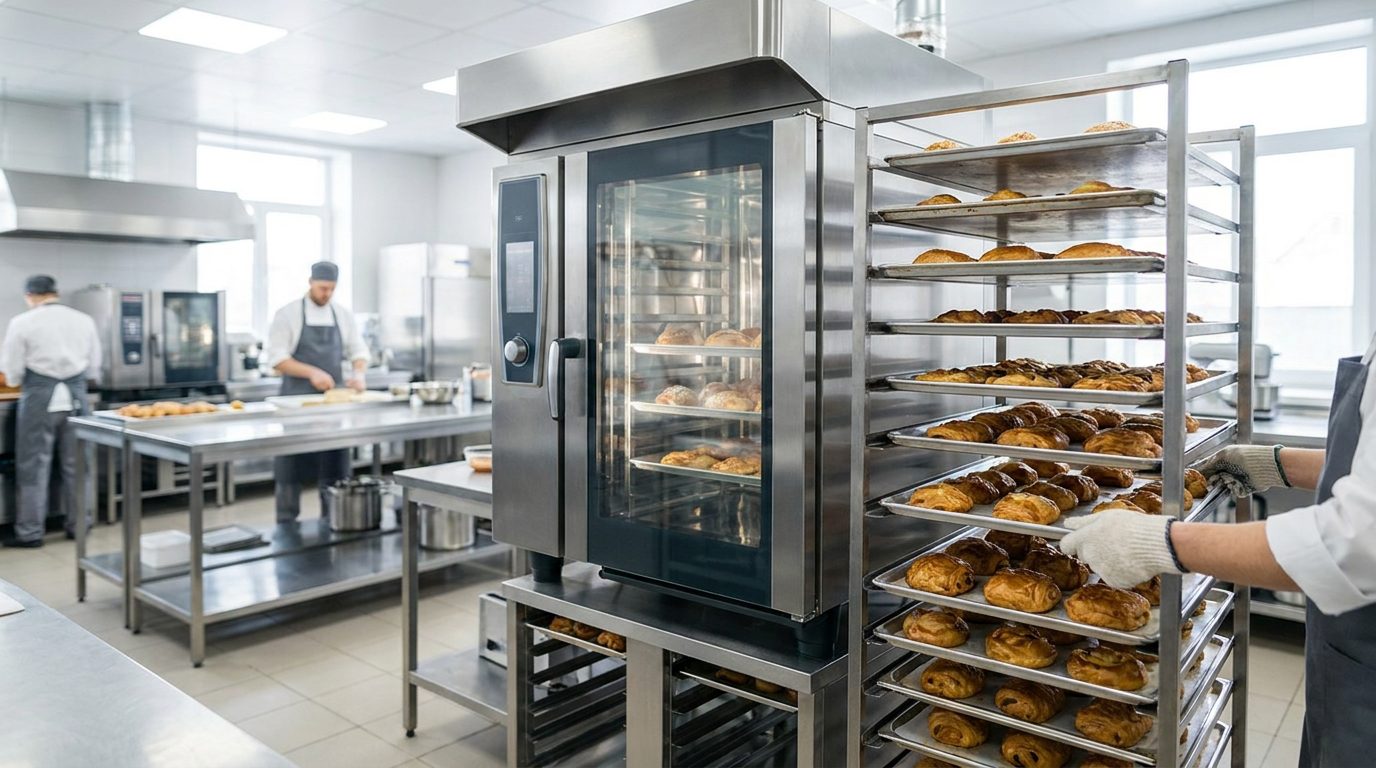
Tray capacity is not a number you pick from a brochure — it is the result of an arithmetic you do backwards from your daily output. Take the units you need to sell, divide by units per tray, then divide by how many bake cycles your production window allows. That gives trays per bake, which is the figure that should decide the oven. Buying by headline tray count without doing that sum is the most common reason a bakery outgrows an oven in its first year or runs an over-sized one half empty.
The calculation that actually matters
Four numbers set your requirement.
- Units per day. Loaves, buns, rolls, trays of short eats, cakes — count each product line separately, because they bake differently.
- Units per tray. Physically lay out one tray of each product and count. Do not estimate; spacing for oven spring and airflow costs more room than people expect.
- Bake time per product, including loading and unloading.
- Usable production window. The hours between when dough is ready and when product must be on the shelf — not the hours the shop is open.
Trays per bake = (units per day ÷ units per tray) ÷ (production window ÷ bake time).
An illustration: 900 buns a day at 30 buns per tray gives 30 trays. A 20-minute bake plus 10 minutes of turnaround means two bakes per hour, so a four-hour morning window allows eight bakes — about four trays per bake, or five with headroom. That points to a mid-sized deck stack rather than a rotary oven, and it also tells you your real constraint is owning 30 trays and somewhere to prove and cool them.
Run the same sum for your busiest day of the week, not the average. Bakeries fail on Poya weekends and festival orders, not on Tuesdays.
Deck, convection and rotary: how each counts trays
The three oven families reach capacity in different ways, and their tray counts are not directly comparable.
| Oven type | How capacity is expressed | Loading | Best suited to |
|---|---|---|---|
| Deck oven | Decks × trays per deck | Loaded and unloaded by hand, deck by deck | Bread, pizza, mixed product lines, staged bakes at different temperatures |
| Convection oven | Layers or shelves | Trays slid into fixed runners | Buns, pastries, biscuits, cakes — even browning from moving air |
| Rotary rack oven | Trays on one wheeled rack | Whole rack rolls in on a trolley | High-volume single-product runs where handling time dominates |
A deck oven gives you independent chambers. That is a scheduling advantage rather than a raw capacity advantage: three decks let you hold three different temperatures at once. In the industrial ovens range, the progression is visible in the product names — the Industrial Gas Oven 1 Deck 2 Tray for a café or small bakery adding baked product, the Industrial Gas Oven 2 Deck 4 Trays as a step up, and the Industrial Gas Oven 3 Deck 9 Trays for a production bakery running several lines in parallel.
Convection ovens count layers instead of decks. An Industrial Linkrich 600mm Convection Oven -4 Layers (Including Steam Function) is a four-layer machine, and the steam function matters for crusted breads — worth confirming before you shortlist, since the same cabinet is also sold without it.
Rotary ovens change the labour equation entirely. An Indsutrial Rotary Diesel Oven-32 Trays is a 32-tray class oven where the whole rack rolls in on a trolley. One person loads it in the time it takes to hand-load a few decks — but only if you own enough racks and trays to keep the cycle turning, and only if your product mix justifies baking 32 trays of one thing at once.
The bottleneck is rarely the oven
Operators buy oven capacity and then discover the queue moved somewhere else. Before you size the oven, check the three constraints that usually bind first.
Trays and racks. You need one set in the oven, one set proving or being made up, and one set cooling — roughly three times your per-bake tray count, a cost that is easy to forget and impossible to work around on the day.
Proving. Dough that is not proved cannot be baked, however much oven you own. A prover sized to the oven is what makes the oven's capacity real; the Industrial Electric Dough Prover-16 Trays is the trayed version of that logic, holding a batch at controlled conditions so bakes leave on schedule instead of when the dough happens to be ready.
Cooling and packing. Hot product cannot be bagged. Double the bake capacity without adding cooling rack space and you simply move the pile-up to the back of the shop.
Mixing. Mixer capacity per batch and mixing time set the ceiling for everything downstream — the spiral and planetary options in commercial bakery machines are where that ceiling is decided.
Tray sizes: measure, do not assume
Tray counts only mean something once you know the tray. An oven quoted as taking four trays is a different machine depending on which size those trays are. Before ordering:
- Measure the trays you already own, including any lip or handle.
- Confirm with the supplier which tray size the specific oven accepts and how many runners it has.
- Check runner spacing against your tallest product — high-domed bread and tall tins lose you a shelf.
- Check whether your existing racks and trolleys fit a rotary oven's chamber before assuming they will.
Buying trays to fit the oven is normal. Discovering after delivery that none of yours fit is expensive.
How to choose: a decision checklist
- Do the arithmetic first — units, units per tray, bake time, production window — for your busiest day.
- Add 25–30% headroom. An oven bought exactly to today's output has no capacity for growth or for a large order.
- Decide whether you need parallel temperatures. If yes, buy decks. If you bake one product in long runs, look at rotary.
- Check the steam requirement. Crusted breads want steam; biscuits and short eats do not.
- Confirm the fuel. Gas, electric or diesel — decide against your available supply, flue path and electrical capacity at the intended position, verified with the supplier for the exact model.
- Count the trays and racks you will need to buy alongside the oven, at roughly three sets.
- Match the prover and cooling space to the new bake rate before commissioning.
- Measure the delivery route. Doorways, corridors and floor loading defeat more large ovens than budgets do.
- Plan extraction and clearance around the oven position, not after installation.
Bakery ovens and pizza ovens are different purchases
The two categories overlap, which causes confusion when the same multi-deck models appear on both pages. The distinction that should guide you is what dominates your output.
If you are baking bread, buns, cakes and short eats on trays, buy from the industrial and bakery oven range and size by tray count, steam and temperature staging. If pizza is the product and the base is the selling point, buy from the commercial pizza ovens range and size by hearth area and top-heat control instead — tray counts tell you very little about pizza throughput. Mixed operations often end up with a multi-deck gas oven precisely because it serves both, at a small compromise on each.
The wider production picture — mixers, sheeters, provers, slicers and the sequence they sit in — is covered in the bakery equipment setup guide for Sri Lanka, and the full bakery equipment range is where the supporting machines live.
Frequently asked questions
How many trays does a commercial oven hold? It varies from one or two trays in a single-deck oven to 32 trays in a rotary rack oven. The right question is how many trays you need per bake, which comes from your daily output divided by units per tray, divided by the number of bake cycles your production window allows.
Is a 3-deck oven better than a convection oven? They solve different problems. A three-deck oven lets you bake three products at three temperatures at once, which suits mixed bakeries. A convection oven browns evenly across layers and suits repeated runs of the same product. Choose by product mix, not by which sounds larger.
How many trays do I need to buy with the oven? Plan on around three sets of your per-bake tray count — one in the oven, one being made up or proved, and one cooling. Running with fewer forces staff to wait for trays to clear, which quietly caps output no matter what the oven can do.
Do I need a rotary oven for a small bakery? Usually not. Rotary ovens save handling labour on long single-product runs and need enough racks and trays to justify the cycle. A small or mixed-product bakery normally gets more value from a multi-deck oven, which allows different products and temperatures at the same time.
What size trays fit a commercial oven? That depends on the model, and it should be confirmed before purchase rather than assumed. Measure the trays you already use, ask which size the oven accepts, and check runner spacing against your tallest product before ordering.
Will a bigger oven solve my production delays? Only if the oven is genuinely the bottleneck. Delays more often come from mixing capacity, proving time, tray supply or cooling space. Time one full production cycle and find where product actually waits before spending on oven capacity.
Where to start
Work out your trays-per-bake figure first, then compare the deck, convection and rotary options in the industrial and bakery ovens collection against it, and check the prover, mixer and cooling capacity that has to keep pace. Operators building a full line should also read the commercial kitchen equipment guide for Sri Lanka. Trendy Zone Lanka can confirm tray size, runner spacing and utility requirements for a specific oven before you plan the bakery around it.
Share:
What Temperature Should a Pizza Oven Be?
Commercial Blender vs Home Blender: What Duty Cycle Really Means