
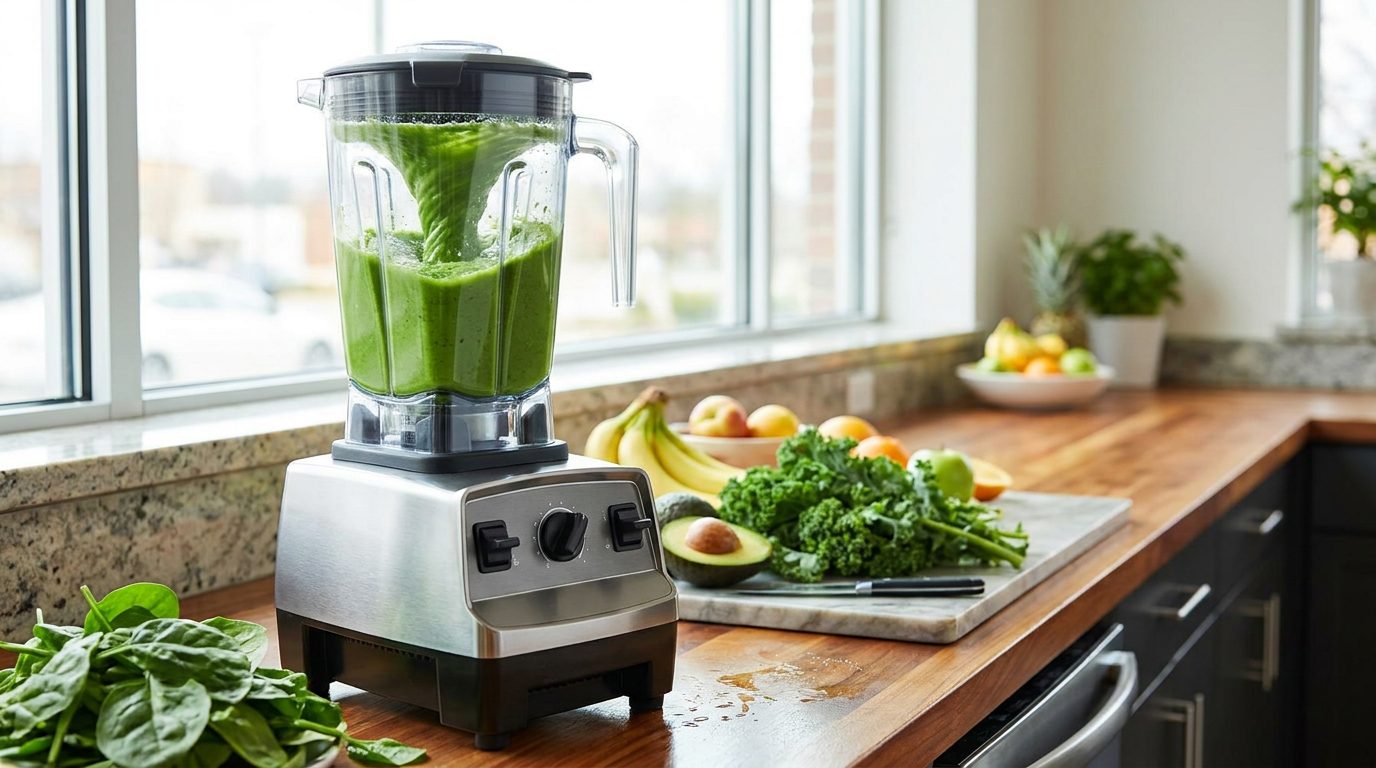
A commercial blender is engineered to run under load, repeatedly, for a full trading day. A home blender is engineered for short bursts with long cooling gaps in between. That single engineering difference — duty cycle — explains why a domestic jug blender that works perfectly in a kitchen at home starts cutting out, smelling hot and losing power within months on a busy juice bar.
If you are choosing between the two for a café, hotel, juice counter or catering kitchen, duty cycle is the specification that should decide it, not motor wattage on the box.
What duty cycle actually means on a blender
Duty cycle is the proportion of time a motor is designed to run versus rest within a given period. A domestic motor might be designed around a 1-in-5 pattern: one minute of blending, several minutes idle while the operator pours, serves and reloads. The motor sheds accumulated heat during those gaps.
A commercial motor is designed for a much higher ratio of run time to rest, and it gets there through physical differences you can see and hear:
- Motor mass and winding quality. More copper and iron store and shed heat better under sustained load.
- Cooling path. Commercial units are built with a deliberate airflow route through the motor housing rather than relying on ambient cooling.
- Bearings and drive coupling. The coupling between motor shaft and jar blade is a wear part. Commercial couplings are heavier, and on better machines they are replaceable.
- Thermal overload protection. A good commercial blender cuts out to protect itself rather than cooking its own windings. Frequent cut-outs are a sizing message, not a fault.
When a home blender is pushed past its intended duty cycle, the failure sequence is predictable: the motor runs hot, the thermal protector trips mid-service, the drive coupling rounds off, and finally the bearings or windings go. None of that is a manufacturing defect. It is a machine being used outside its design brief.
Commercial blender vs home blender: the differences that matter
| Factor | Home blender | Commercial / industrial blender | Commercial stick mixer |
|---|---|---|---|
| Designed run pattern | Short bursts, long rests | Repeated cycles across a service | Sustained runs inside a pot or tub |
| Typical role | Family smoothies, soups, sauces | Juice bar, café drinks, kitchen sauces, batch prep | Blending soups and gravies in the cooking vessel |
| Jar / working vessel | Plastic or glass jug, fixed | Heavier jar, often with replaceable blade assembly | No jar — the shaft goes into your own pot |
| Noise management | Rarely addressed | Sound enclosures available on café models | Moderate, but you are standing over it |
| Blade and coupling wear | Assembly usually not serviceable | Wear parts designed to be replaced | Blade guard and shaft seal are the wear points |
| Cleaning between flavours | Full jar wash | Purge-and-rinse workflow between drinks | Rinse shaft in a water tub, wipe down |
| Best fit | Home kitchen | Café, hotel, restaurant, juice counter | Production kitchen, large-batch soups |
If your use case sits entirely in the left-hand column, the domestic range in the home and kitchen blender collection is the sensible place to buy. Everything from the middle column onwards belongs to commercial and industrial blenders.
How many drinks per hour do you actually need?
Work backwards from your peak, not your average. Count the busiest 60 minutes of your week and ask how many blended drinks land in that hour. A café that pushes 12 smoothies over a lunch rush has a very different requirement from a hotel breakfast buffet running a juice station for three hours straight.
Three practical rules:
- Peak hour sets the machine class. Averages hide the hour that breaks equipment.
- Two smaller blenders often beat one large one. Parallel machines let you keep one on savoury and one on sweet, and you keep trading when one is being cleaned.
- Jar volume should match your serve size multiplied by your typical batch, with headroom. Blending a single small serve in an oversized jar gives poor vortex formation and inconsistent texture.
For batch prep and larger production runs, jar capacity is the constraint that bites first. The Topmix 5L Industrial Blender and Honeyson 4L Industrial Blender sit in the larger-jar class, where you are blending several serves or a sauce batch in one go rather than one drink at a time.
Noise: the specification cafés forget
A blender running at full speed inside a small café is genuinely disruptive to conversation, and in a hotel lobby bar it is worse. This is why sound-enclosure models exist: a hinged acoustic hood over the jar that cuts the perceived noise substantially without changing the blending action.
If your blender sits in the customer's line of sight and earshot — an open bar, a counter-service café, a breakfast buffet — treat an enclosure as a service-quality decision rather than a luxury. Models such as the Topmix 1.5L Soundproof Industrial Blender are built around exactly this problem. Back-of-house sites where the machine lives behind a wall can ignore it entirely and spend the budget on capacity instead.
When a stick mixer is the better tool
A jug blender is the wrong machine for a 40-litre stockpot. Decanting hot soup into a jar in batches is slow, and it is the most common scald risk in a production kitchen. A commercial stick mixer takes the blade to the pot instead, which removes the transfer step entirely.
Stick mixers such as the Industrial Stick Mixer 500T (Linkrich) suit soups, gravies, curries, purées and large sauce batches. They will not give you the fine, aerated texture a high-speed jar blender produces on a fruit smoothie, so most busy kitchens end up owning both. If your blended output is almost entirely milkshakes, a dedicated spindle machine like the Industrial Milk Shake Machine does that one job faster and with less cleaning than a jar blender — the wider milkshake machine range is worth a look before you buy a general-purpose unit.
How to choose: a decision checklist
Work through these in order:
- Count your peak-hour blended serves. This is the single number the whole decision rests on.
- Decide savoury, sweet, or both. Both usually means two machines or a strict purge-and-rinse routine between flavour groups.
- Check what you blend. Ice, frozen fruit and fibrous ingredients such as ginger or beetroot demand a commercial drive, not a domestic one.
- Match jar volume to batch size, with headroom rather than a jar you can only ever half fill.
- Assess where the machine sits. Customer-facing position means noise-reduction matters.
- Confirm the wear parts are serviceable — blade assembly, jar seal and drive coupling are the parts that will need attention first.
- Plan the counter space and the power point before the machine arrives, including clearance to lift the jar out under a wall unit.
- Decide whether a stick mixer covers part of the workload and lets you buy a smaller jar blender.
If you want the wider selection framework — motor classes, jar materials and matching a machine to a service format — the commercial blender buying guide for Sri Lanka covers that ground in detail, and this article is the duty-cycle companion to it.
Frequently asked questions
Can I use a home blender in my café?
You can, but expect a short service life. Domestic motors are designed around long cooling gaps that a café service does not provide. The usual outcome is mid-service thermal cut-outs, a worn drive coupling and a replacement within months — which costs more over a year than buying a commercial machine once.
What does duty cycle mean on a blender?
Duty cycle is the ratio of running time to rest time a motor is designed for. A high duty cycle means the machine can run repeatedly under load without overheating, because of heavier windings, a deliberate cooling path and stronger bearings. It is the most useful single indicator of whether a blender suits commercial use.
Why does my blender stop by itself during busy periods?
That is usually thermal overload protection doing its job. The motor has reached its temperature limit and cut power to protect itself. It signals that the machine is undersized for the workload, the ventilation slots are blocked, or the mix is too thick and stalling the blade.
Is a higher wattage blender always better?
No. Wattage tells you power draw, not how long the motor can sustain it or how well it sheds heat. A well-cooled commercial motor will outlast a higher-wattage domestic one in daily service. Look at build, cooling and serviceability of wear parts before comparing wattage figures.
Do I need a soundproof blender?
Only if the machine is within earshot of guests. Open cafés, lobby bars and buffet stations benefit noticeably from an acoustic hood. A back-of-house prep kitchen does not, and that budget is better spent on capacity or a second machine.
Where to start
If you are replacing a domestic unit that keeps failing, begin with the industrial blender range and shortlist by peak-hour output first, then jar size, then noise. If blending is one line on a larger fit-out list, the commercial kitchen equipment guide for Sri Lanka puts it in the context of the rest of the prep section.
Share:
How Many Trays Does Your Commercial Oven Need?
Meat Mincer Plate Size Guide: Hole Diameters and Real Throughput