
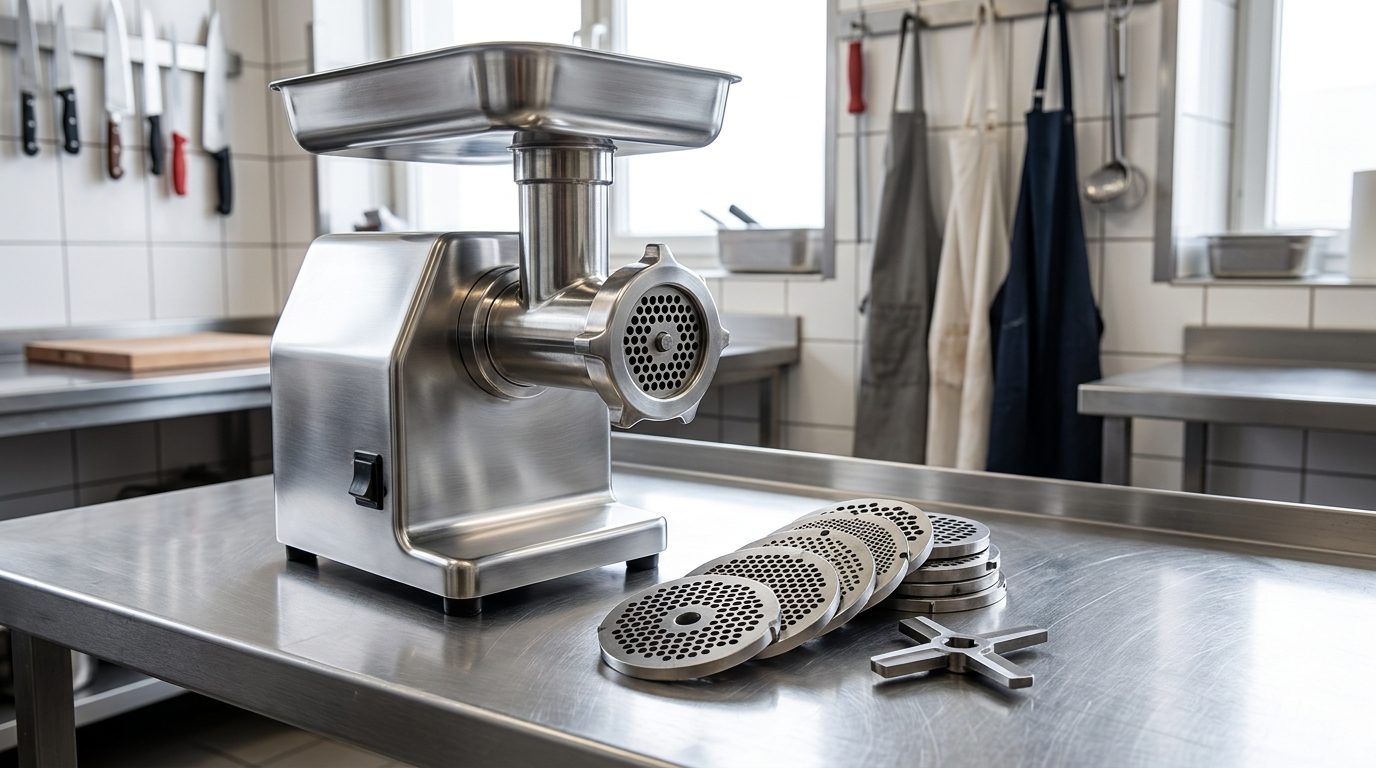
Mincer plate size is the hole diameter of the perforated disc the meat is forced through, and it controls texture more than any other variable. Small holes give a fine, cohesive mince for sausage and pâté; large holes give a coarse, open texture for burgers and meatballs. The second number that matters is throughput — and the kg-per-hour figure on a mincer is a laboratory best case, not what your kitchen will see.
This guide covers both: how to pick plates for the products you actually sell, and how to size a machine so it keeps up during a production morning.
How plate hole size changes the product
The plate and the knife work as a pair. The auger pushes meat against the plate, the rotating knife shears it flush against the plate face, and the sheared meat extrudes through the holes. Everything about the finished texture comes from that geometry.
| Plate hole size | Resulting texture | Typical use | Notes |
|---|---|---|---|
| Around 3 mm | Very fine, paste-like | Pâté, fine sausage emulsion, spreads | Almost always a second pass after a coarse plate |
| 4–5 mm | Fine, cohesive | Breakfast sausage, seekh-style kebabs, meatloaf | The most common fine plate in a butchery |
| 6–8 mm | Medium, still binds well | Burger patties, meatballs, cutlet and roll fillings | Good all-round default if you buy one plate |
| 10–13 mm | Coarse, visible strands | Coarse sausage, first pass before a fine plate, curry mince | Reduces motor load noticeably |
| 16 mm and above | Very coarse / pre-break | Breaking down large primals before regrinding | Protects the machine on tough or sinewy cuts |
The habit that separates a professional result from a domestic one is double grinding. Run tough or sinewy meat through a coarse plate first, then through your target plate. The first pass does the hard structural work; the second pass sets the texture. Single-passing everything through a 4 mm plate is what causes smearing, motor strain and a grey, pasty product.
Head size, plate diameter and why they are not interchangeable
Mincer heads are commonly described by numbers such as #12, #22 and #32. That number refers to the head and plate diameter, not the hole size — a #32 plate is physically wider than a #22 plate, and the two are not interchangeable. Hole size is a separate specification within each head family.
Two practical consequences:
- Buy plates for the head you own. A 5 mm plate in the wrong diameter simply will not seat. Note the head size before ordering spares.
- Larger head, more open area. A bigger plate diameter passes more meat per revolution at the same hole size, which is part of why larger machines carry higher throughput ratings.
Each plate should be married to its own knife. Knives and plates bed into each other with use, and swapping a knife between plates leaves gaps at the cutting face. Gaps mean the meat is crushed rather than sheared — the texture goes mushy, the fat smears, and the machine works harder for less output.
What a kg-per-hour rating really assumes
A throughput figure is measured under ideal conditions: chilled, boned, trimmed, evenly sized meat, a sharp knife and plate pairing, a medium plate, continuous feeding by a dedicated operator, and no cleaning breaks. Your kitchen has none of that for a full hour.
Sensible planning rules:
- Derate the rating. Plan on comfortably less than the stated figure once you account for loading, sinew clearing and pauses.
- Fine plates cut output. The smaller the holes, the lower the flow at the same motor speed. A machine rated on a medium plate will be slower on a 3 mm plate.
- Double grinding roughly doubles the work. If your product needs two passes, size the machine on total passes, not finished kilograms.
- Add cleaning time. Stripping, washing, drying and reassembling a head is real production time and it happens between meat types, not just at the end of the day.
Within the commercial meat mincer and processing range, machines are separated by throughput class — the Industrial Meat Mincer 120KGH and the higher-capacity Industrial Meat Mincer 220KGH sit at different points on that curve. Pick the class above your realistic peak rather than the one that exactly matches it on paper, because a machine running at its ceiling all morning is a machine running hot.
Keeping meat cold: the variable nobody specs
Mincing generates heat through friction, and fat is the thing that suffers. Above a fairly low temperature, fat starts to smear rather than cut, coating the plate holes and the auger. The result is a slower, greasier grind, a duller texture and a product that binds badly.
Standard practice in any butchery or production kitchen:
- Bring meat to the mincer straight from chilled storage, not from the bench.
- Chill the head, auger, knife and plate before a long run if you can.
- Work in batches sized to what you can mince and get back under refrigeration promptly.
- Stop and clear if the extrusion turns from clean strands to a smeared paste — that is the smear point, and pushing through it makes the batch worse.
Keeping cut and minced product moving back into chilled storage is basic food-safety practice as well as a quality decision, and it applies equally to a small butchery counter and a hotel production kitchen.
Matching the mincer to what you make downstream
The mincer is rarely the end of the line. What you do after the grind should influence which machine you buy.
- Sausage production. A grind-then-stuff workflow is far cleaner and more consistent than trying to stuff through the mincer head. Dedicated stuffers such as the Industrial Sausage Stuffer Machine 5L and the larger Industrial Sausage Stuffer Machine 10L let you control fill rate and avoid air pockets.
- Burger and patty production. A medium plate plus a forming step gives a better bite than a fine grind pressed into shape. The Industrial Hamburger Machine - Manual gives repeatable portion weight and thickness.
- Emulsions, pastes and fillings. If your product is closer to a paste than a mince, a bowl cutter does that job properly — the Industrial Electric Food Processing Vacuum Bowl Cutter Machine works the meat with a rotating bowl and blades rather than extruding it.
- Light or intermittent use. A compact unit such as the Yina Meat Grinder suits a small kitchen mincing to order rather than running production batches.
For vegetable-side prep that runs alongside a mincing station, the food grinder and cutter collection covers spice grinders, bowl choppers and vegetable cutters.
How to choose: a decision checklist
- List your products and their target textures, then write down the plate sizes each one needs.
- Decide whether any product requires a double grind, and count both passes in your volume planning.
- Calculate peak-session kilograms, not daily kilograms — the morning production block is the constraint.
- Choose a throughput class above that peak, allowing for fine-plate slowdown and cleaning time.
- Note the head size and buy a knife for each plate you intend to run.
- Check how the head strips down for cleaning — the number of parts and whether it comes apart without tools decides how willingly staff clean it properly.
- Confirm bench space and a stable, level surface with clearance for the tray and a collection bin below the outlet.
- Plan for spares: plates, knives and the ring nut are consumables in daily production.
Frequently asked questions
What plate size should I use for burgers?
A medium plate in the 6–8 mm range is the usual choice. It leaves visible strands so the patty holds its bite and does not turn dense when pressed, while still binding enough to hold together on the grill. Many kitchens coarse-grind first, then pass through the medium plate.
What is the difference between a #12 and a #22 mincer head?
The number describes head and plate diameter, not hole size. A #22 head is physically larger than a #12, takes wider plates and generally passes more meat per turn. Plates, knives and rings are not interchangeable between the two, so record your head size before ordering replacement parts.
Why does my mince come out mushy?
Almost always a blunt or mismatched knife-and-plate pair, or meat that has warmed up. When the knife no longer shears cleanly against the plate face, the auger crushes and smears the meat instead of cutting it. Re-pair the knife to its plate, sharpen or replace it, and mince straight from chilled.
How do I know what capacity mincer I need?
Work from your busiest production session. Total the kilograms you need through the machine in that block, count double grinds twice, then choose a machine rated comfortably above that figure. Published kg-per-hour ratings assume ideal conditions and a medium plate, so treat them as a ceiling.
Can I mince bone in a meat mincer?
No. Bone will damage the auger, knife and plate. Bone work needs a purpose-built bone saw or bone cutter, which is a separate machine class designed with the guarding and blade type for that job.
Where to start
Shortlist by throughput class first, then by how easily the head strips for cleaning, then by the plates and accessories you will need on day one. The meat mincer and meat processing collection groups mincers with stuffers, bone saws and slicers so you can plan the whole butchery station together. If this is one part of a wider fit-out, the commercial kitchen equipment guide for Sri Lanka sets out the rest of the sequence.
Share:
Commercial Blender vs Home Blender: What Duty Cycle Really Means
Food Processor vs Blender vs Grinder: Which Machine Does What