
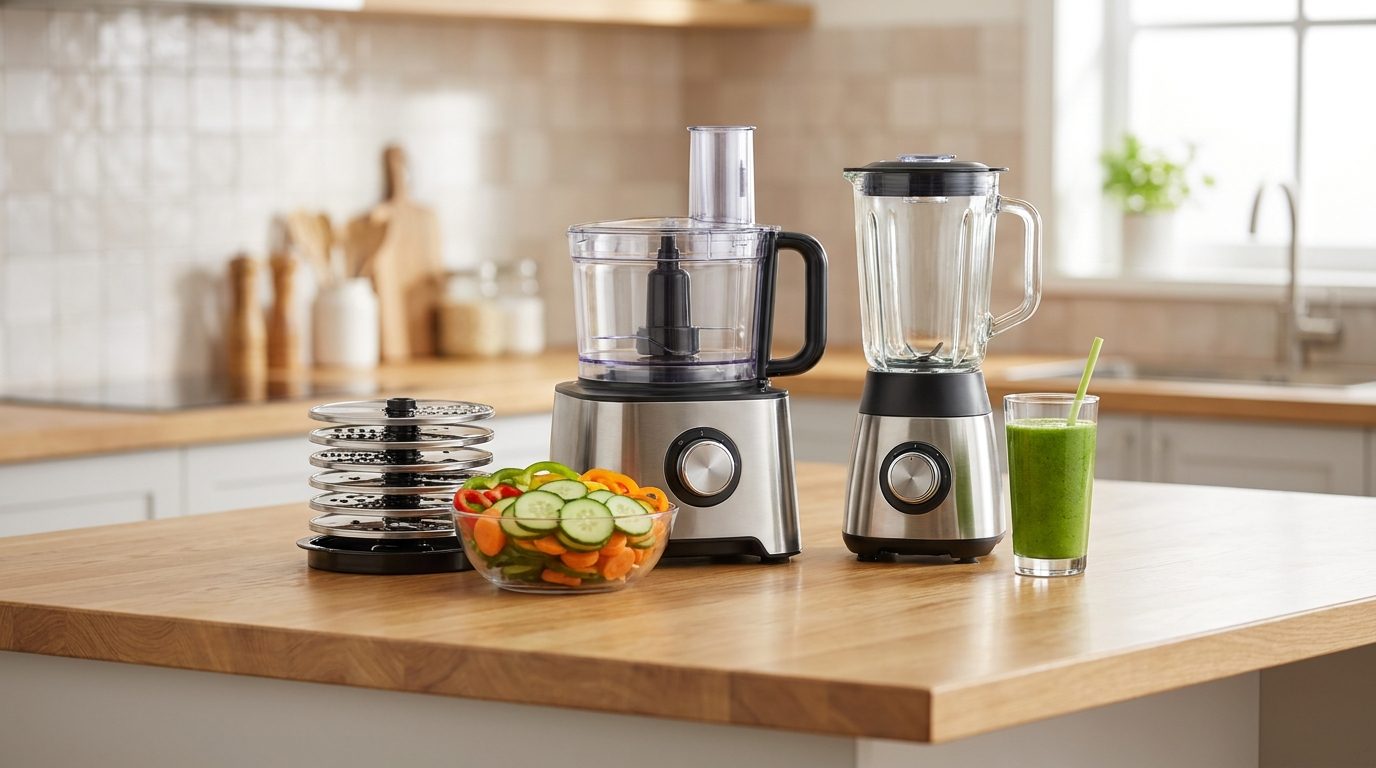
The food processor vs blender difference comes down to liquid and blade geometry. A blender uses a tall narrow jar and high blade speed to pull ingredients into a vortex — it needs liquid, and it makes things smooth and pourable. A food processor uses a wide shallow bowl with a slow-sweeping blade or a cutting disc — it works with little or no liquid, and it gives you control over how coarse the result is. A grinder is a third machine again: a small sealed chamber built to reduce dry or hard material to a powder or paste.
Buy the wrong one and you end up fighting it every service. Here is how to tell them apart and which to buy first.
The three machines side by side
| Food processor | Blender | Grinder | |
|---|---|---|---|
| Working vessel | Wide, shallow bowl | Tall, narrow jar | Small sealed chamber or milling head |
| Blade action | S-blade sweeping near the base, plus interchangeable slicing and shredding discs | Fixed blade at high speed creating a vortex | Hammer, blade or burr reducing hard material |
| Liquid needed | Little or none | Yes — liquid carries the mix to the blade | None for dry grinding; minimal for paste work |
| Texture control | High — pulse to coarse, medium or fine | Low — mostly smooth, or not blended at all | Controlled by run time and screen or burr setting |
| Best at | Chopping, mincing, emulsifying, slicing, shredding, pastry and dough | Smoothies, juices, soups, sauces, purées, batters | Spices, chilli, curry powder, grain and flour, wet masala |
| Poor at | Thin liquids — they leak past the bowl seal or spin unblended | Dry chopping — food climbs the jar walls and never meets the blade | Anything wet and bulky, or anything needing texture |
| Typical commercial home | Prep bench | Bar, juice counter, sauce station | Spice and dry goods section |
The categories overlap at the edges, which is exactly why buyers get stuck. A food processor will make a passable soup and a blender will roughly chop an onion if you flood it with water — but each does the other's job badly, slowly, and with a worse result.
Food processor: the prep-bench workhorse
A food processor earns its place through versatility and texture control. The bowl is wide enough that ingredients fall back into the blade path, and pulsing gives you a coarse chop, a fine mince or a smooth paste from the same load. Swap the S-blade for a disc and the same motor slices, shreds and grates.
In a commercial kitchen it typically handles onion and garlic mincing, herb chopping, coconut and vegetable shredding, cutlet and roll mixes, meat pastes, pastry rubbing-in and short doughs, plus emulsified sauces such as mayonnaise.
Bowl volume is the deciding specification, and it is not the same as usable volume — a processor is only filled to roughly the blade-and-sweep zone for wet work. The commercial food processor range runs from bench-scale units such as the Industrial Food Processor 2.5L up through the Industrial Food Processor 7L and Industrial Food Processor 10L for batch prep. If you want the disc set rather than the blade alone, the Industrial Food Processor Set - 04 Pcs is built around that multi-attachment approach.
Rule of thumb: size the bowl to your single largest recurring batch, then check you can still do a small batch in it. A very large bowl with a very small load leaves the food sitting outside the blade path.
Blender: liquids, smoothness and speed
A blender's whole design is a vortex. Blade speed pulls the mix down and back through the blade, which is why liquid content matters so much — without it, the mix simply climbs the jar wall and spins in place. What you get back is smooth and pourable.
That makes it the right machine for smoothies, fruit juices, milkshakes, blended soups, curry gravies, thin sauces, batters and crushed-ice drinks. It is the wrong machine for dry chopping, for anything you want left chunky, and for kneading.
Blenders also split cleanly into two markets, and confusing them is a common and expensive mistake. Domestic jug blenders are designed for short bursts with cooling gaps; commercial units are designed to run repeatedly under load through a service. If you are buying for a café, hotel or juice counter, start in the commercial and industrial blender range — a machine such as the Topmix 2L Industrial Blender is built for that pattern of use. The commercial blender buying guide for Sri Lanka works through motor class and jar sizing in detail.
Grinder: hard, dry and aromatic material
A grinder is a reduction machine, not a mixing machine. The chamber is small and tight so material cannot escape the working zone until it is fine enough, and the mechanism is chosen for hardness rather than for chopping.
In Sri Lankan food production this is the machine behind roasted curry powder, chilli powder, black pepper, turmeric, coriander and cumin blends, wet masala pastes, and grain milling for rice flour and kurakkan. A blender will not do this work properly: its blade speed is high but its chamber is wrong, the powder climbs and coats the jar, and the fines never come back through the blade.
Two things to check before buying:
- Batch size versus continuous feed. A batch grinder such as the Industrial Spice Grinder Machine 2500G is loaded, run and emptied. Continuous mills feed from a hopper and are better suited to steady production.
- Cross-contamination between aromatics. Chilli and turmeric will carry over. Producers running multiple blends usually dedicate chambers to specific product groups rather than trying to clean between every run.
The food grinder and cutter collection covers spice grinders and grain grinders alongside the bowl choppers and vegetable cutters that share the same prep area.
How to choose: a decision checklist
Answer these in order and the machine usually picks itself:
- Is the finished product pourable? Yes points to a blender. No points to a processor.
- Does the recipe need added liquid to work? If adding liquid ruins the dish, it is not a blender job.
- Do you need to stop at "coarse"? Only a processor gives you reliable control between chopped and puréed.
- Is the material hard and dry? Spices, grain and dried chilli are grinder work, whatever else you own.
- Are you slicing or shredding to a uniform thickness? That is a disc job — a processor with discs, or a dedicated vegetable cutter for high volumes.
- What is your peak batch size? Size the bowl or jar to that batch with headroom, not to the biggest machine available.
- Who cleans it, and how often? Count the parts that come apart. A machine that is slow to strip down gets cleaned less thoroughly.
- If you can only buy one to start with, the food processor covers the widest range of daily prep tasks in most kitchens — but if your business is drinks, buy the blender first.
Frequently asked questions
What is the main difference between a food processor and a blender?
A blender uses a tall jar and high blade speed to create a vortex, so it needs liquid and produces smooth, pourable results. A food processor uses a wide bowl and a sweeping blade or cutting disc, works with little or no liquid, and lets you stop at any texture from coarsely chopped to smooth.
Can a food processor replace a blender?
Not fully. A processor will handle thick mixtures and can purée cooked vegetables, but thin liquids tend to leak past the bowl seal and never form a proper vortex, so drinks and thin soups come out uneven. Kitchens making both drinks and prep almost always run both machines.
Can I grind spices in a blender?
Poorly. The jar is too large and the wrong shape, so powder climbs the walls and never returns to the blade, and the result is uneven with visible fragments. A dedicated grinder uses a small, tight chamber built for hard dry material and gives a consistent fineness.
What size food processor do I need for a restaurant?
Size the bowl to your largest recurring batch, allowing headroom because a processor is not filled to the brim for wet work. A small bench unit suits made-to-order prep; larger bowls suit kitchens producing sauces, mixes and pastes in batches ahead of service.
Is a food processor good for making dough?
For short doughs, pastry and rubbing fat into flour, yes — the S-blade does that quickly and keeps the fat cold. For bread doughs that need extended kneading, a dough mixer is the correct machine, because a processor is not designed for sustained gluten development.
Where to start
If your prep bench is the bottleneck, begin with the commercial food processor collection and shortlist by bowl size and the attachments you will actually use. If the bottleneck is drinks, start with the industrial blenders; if it is spice and dry goods, start with the grinders. Most kitchens end up with all three — the order you buy them in should follow where your service is slowest today.
Share:
Meat Mincer Plate Size Guide: Hole Diameters and Real Throughput
Commercial Vegetable Cutting Machine: How to Equip a Prep Station