
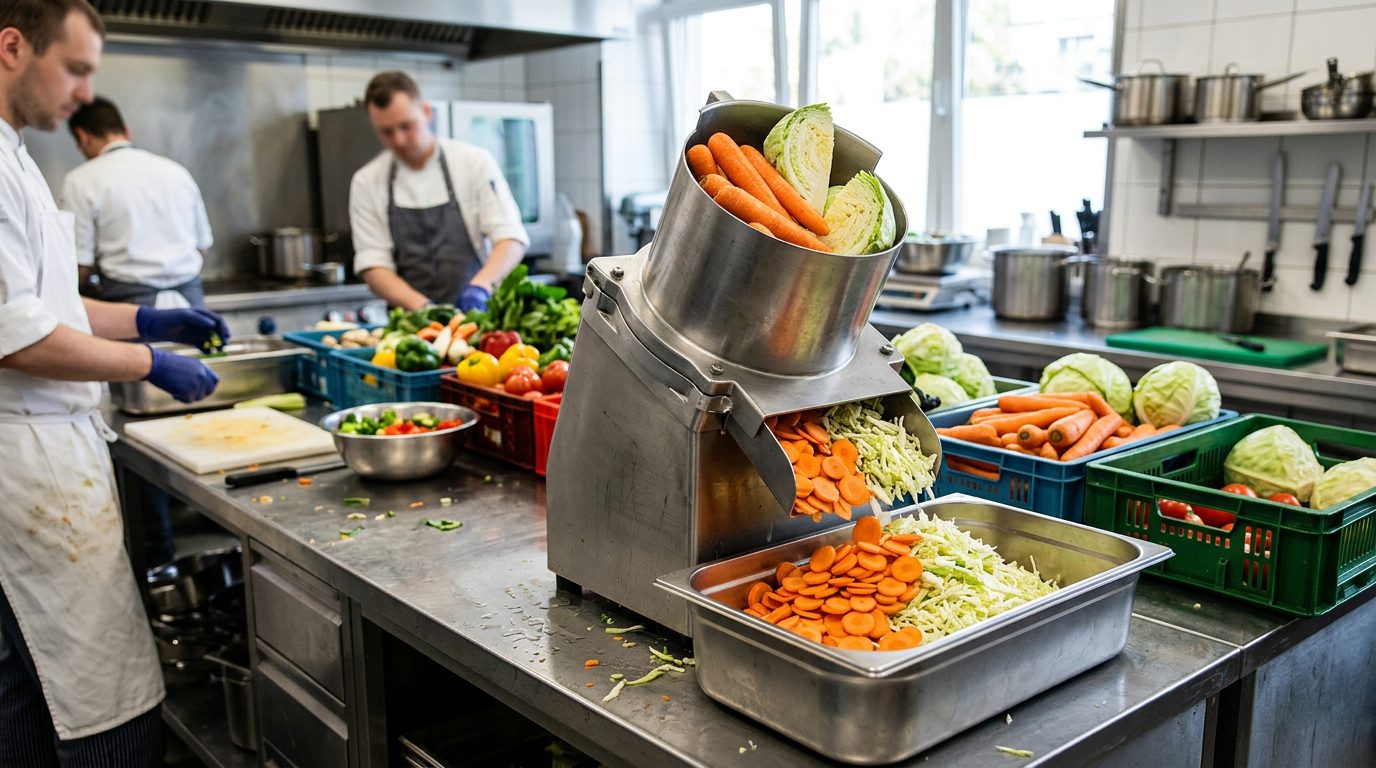
A commercial vegetable cutting machine replaces the slowest, most repetitive job in any kitchen: turning sacks of raw produce into uniform, service-ready cuts. The machine you need depends less on your menu than on your volume and your cut shapes — a continuous-feed disc cutter, a batch peeler, a dedicated onion machine and a bowl chopper all solve different parts of the same problem.
This guide walks the prep station in order, from sack to service, and shows where each machine earns its keep.
Walk the station in order: wash, peel, cut, hold
Most kitchens buy a cutter first and then discover that peeling is the actual bottleneck. Map the workflow before you buy anything:
- Wash and sort. Manual, but it sets the pace for everything downstream. Grit that reaches a cutting disc dulls it.
- Peel. Potato, manioc, carrot and beetroot. This is where hours disappear in a high-volume kitchen.
- Cut. Slice, shred, julienne, dice or chip — the shape your dish needs, at a consistent thickness.
- Chop or paste. Sambols, curry bases, stuffing mixes and anything that needs to be worked rather than sliced.
- Hold cold. Cut vegetables deteriorate quickly at room temperature. Prep straight into containers that go back under refrigeration.
Whichever step takes the most staff hours today is the machine you should buy first. The commercial vegetable cutter and food grinder collection is the store's home for all of these — cutters, peelers, choppers and grinders sit together because they belong to the same station.
Which machine for which job
| Task | Machine type | What it produces | Where it pays back |
|---|---|---|---|
| High-volume slicing, shredding, julienne | Continuous-feed disc cutter | Uniform cuts at a steady rate, fed through a hopper | Kitchens cutting daily sacks of carrot, leek, cabbage, beetroot |
| Chips and thicker cuts | Chip / fry cutter | Consistent chip section for even frying | Any site with fries or crisps on the menu |
| Bulk peeling | Abrasive drum peeler | Batch-peeled roots ready for cutting | Potato-heavy menus, catering, hotel kitchens |
| Onion volume | Dedicated onion cutter | Uniform onion cut without the crew's eyes streaming | Curry production, kottu, catering |
| Garlic volume | Garlic peeler | Peeled cloves without hand labour | Curry bases, spice pastes, food manufacturing |
| Pastes, sambols, stuffing mixes | Bowl chopper | Coarse-to-fine worked texture, not a slice | Sambol, meatball and cutlet mixes, curry pastes |
| Small batches, mixed tasks | Food processor with discs | One machine covering several light jobs | Cafés and small kitchens without a dedicated prep room |
Disc types: the specification that decides your menu
On a continuous-feed cutter, the motor unit is the constant and the discs do the work. Understanding the four families saves you from buying attachments you never use:
- Slicing discs cut flat slices; blade projection sets the thickness. Cucumber, carrot, potato, beetroot, onion rings.
- Shredding and grating discs produce strands or fine shreds. Cabbage, carrot, coconut, cheese.
- Julienne discs combine a slicing edge with a comb to produce sticks. Salads, stir-fries, garnish.
- Dicing grids work with a slicing disc to push the slice through a grid and produce cubes. The most labour-saving of all, and the most demanding to clean.
Two practical points operators learn the hard way. First, feed geometry matters as much as the disc: a large hopper suits bulk produce such as cabbage, while a narrow tube gives control over orientation for items you want cut a specific way. Second, buy the discs you will use weekly, not the full set. Discs that live in a drawer are cost, not capability.
Machines such as the Industrial Electric vegetable Cutter are built around this disc-and-hopper approach, while the Industrial Chips and vegetable cutter is set up for the thicker sections that fryers need.
Peeling: usually the real bottleneck
An abrasive drum peeler works by tumbling roots against a rough lining while water carries away the removed skin. It is a batch machine: load, run for a short cycle, drain, unload, inspect. It will not produce a perfectly finished peel on irregular produce — expect a quick hand tidy on eyes and blemishes — but it removes the bulk of the labour.
Sizing is by batch weight against your prep window. A machine described as a 30 kg class, such as the Industrial Potato Peeler 30KG, handles a batch of that order per cycle; total throughput is that batch size multiplied by how many cycles fit into your morning. Two things to plan before installation: a water supply and a drain point for the waste slurry, and a bin position where staff can unload without carrying wet loads across a walkway.
Onions, garlic and the jobs staff quietly hate
Some prep tasks damage staff throughput far beyond their kilogram count. Onion is the obvious one — the volume in Sri Lankan kitchens is high, and the eye irritation slows a crew badly. A dedicated Industrial Electric Onion Cutter converts that job into a machine-fed task with a consistent cut.
Garlic is the same story with different physics. Hand-peeling garlic for curry bases is slow, and an Industrial Electric Garlic Peeler removes skins in bulk. For kitchens producing pastes and sambols rather than slices, a bowl chopper such as the Industrial Bowl Chopper 400MM works the ingredients between a rotating bowl and blades, which gives a very different texture from anything a disc cutter can produce.
If your prep also includes meat portioning, the meat mincer and processing range sits alongside this station — keep the two areas and their boards, containers and cleaning routines separated to avoid cross-contamination between raw meat and ready-to-eat vegetables.
How to choose: a decision checklist
- Weigh a normal prep day. Record kilograms by vegetable for one week. The list writes your equipment order for you.
- List the cut shapes your menu genuinely needs. Every extra shape is another disc, another cleaning task and another storage slot.
- Identify the slowest step, not the biggest volume. Peeling often beats cutting for hours consumed.
- Match batch size to your prep window, not to your daily total — a batch machine's real capacity is batch size times cycles.
- Check utilities before you commit: power point, water supply and drainage for peelers, and bench height for continuous cutters.
- Ask how it strips for cleaning. Discs, grids and shafts need to come apart quickly, and dicing grids are the hardest of the lot.
- Confirm safety interlocks and the pusher for every feed opening. A machine that runs with the hopper open is a machine that will hurt someone.
- Plan cold storage for the output. Cut vegetables need to go straight back under refrigeration; producing faster than you can chill just moves the problem.
- For small or mixed workloads, a commercial food processor with disc attachments may cover the whole station without a dedicated machine.
Frequently asked questions
What machine is best for cutting vegetables commercially?
For steady daily volume, a continuous-feed disc cutter is the standard choice: produce goes in a hopper, discs set the shape and thickness, and output is uniform. For mixed light prep in a small kitchen, a food processor with slicing and shredding discs covers more tasks with one motor.
How do I choose the right vegetable cutter capacity?
Weigh your actual prep for a week, then divide by the prep window you have before service. Continuous cutters are rated by flow rate, batch machines by load size and cycle time. Choose a class above your peak so the machine is not running flat out every morning.
Is a commercial potato peeler worth it for a small restaurant?
If potato, manioc or other roots are a daily fixture, usually yes — peeling is one of the highest labour-hour tasks in a kitchen. It needs a water supply and a drain, and it still requires a quick hand tidy afterwards, so factor in both before deciding.
Can one machine do slicing, dicing and shredding?
Yes, if it is a disc-based machine and you buy the matching attachments. The motor unit stays the same and you change the disc for each shape. Dicing needs a slicing disc plus a grid, and that combination takes the longest to clean, so it is worth confirming your team will use it.
How do I keep a vegetable cutter hygienic?
Strip the discs, shafts and hopper after every session, wash and sanitise the contact surfaces, and dry them fully before reassembly. Keep vegetable prep tools separate from raw meat equipment, and move cut produce into chilled storage promptly rather than leaving it on the bench.
Where to start
Start with the step that costs you the most staff hours today, then build the station outwards from it. The vegetable cutting and food grinder collection covers cutters, peelers, choppers and grinders in one place. If you are planning a full prep room rather than a single machine, the commercial kitchen equipment guide for Sri Lanka sets out how the prep, cooking and holding sections should relate to each other, and the hotel equipment guide covers the larger banquet-scale version of the same problem.
Share:
Food Processor vs Blender vs Grinder: Which Machine Does What
How to Use a Commercial Meat Slicer Safely