
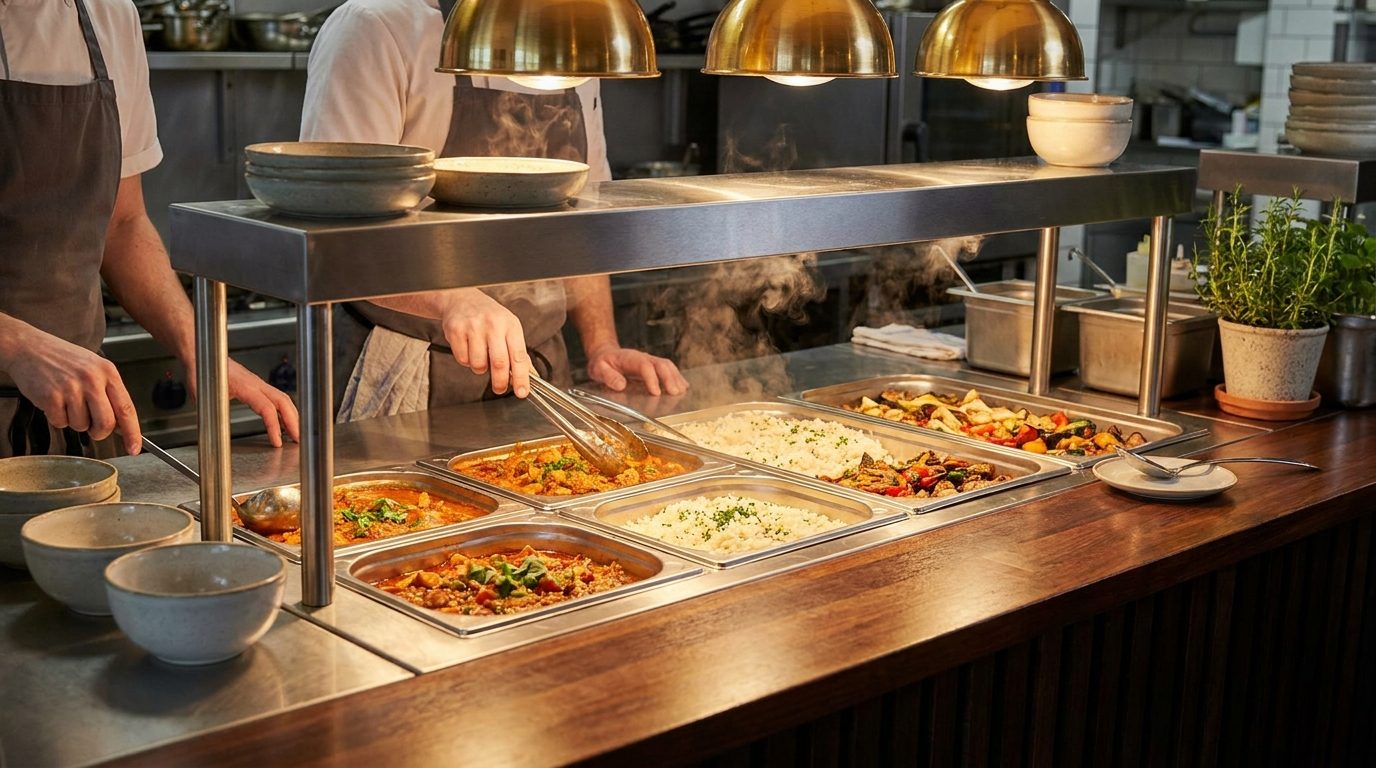
A bain marie holds food using wet heat — pans sit in or above a heated water bath, so the food is warmed indirectly in a humid environment. A dry food warmer holds food using direct radiant or convected heat with no water. That single difference decides everything else: wet heat protects moisture and is forgiving over long holding windows, dry heat preserves crispness but dries anything saucy. Choosing between them is really a question of what you are holding and for how long.
Most busy kitchens end up with both, in different places. The mistake is buying one and using it for everything.
How a bain marie works
A bain marie is a heated water reservoir with Gastronorm-sized wells above it. The element heats the water, the water heats the pan, and the pan heats the food. Nothing is in direct contact with the heat source.
That indirect path is the whole point. Water cannot exceed its boiling point at normal pressure, so the transfer temperature is naturally capped and stable. Food does not scorch against a hot surface, sauces do not split at the base, and the humid air trapped around the pan stops a skin forming on gravies, curries and dhal. It is the reason wet holding is the default in any kitchen that serves sauce-based food.
The trade-off is equally clear: that same humidity destroys crispness. Anything fried, roasted or baked that is meant to stay crisp will soften in a bain marie within minutes.
Formats differ mainly in where the unit sits. A table-top unit such as the Industrial Electric Bain Marie 06 Pans Table Top sits on an existing counter and suits a service pass or a small hot line, holding six pans across a compact footprint. The Industrial Electric Bain Marie 06 Pans Table Top (Unique) offers the same six-pan layout as an alternative build. Where you need holding and storage in one footprint, a cabinet unit such as the Industrial Electric Bain Marie Cabinet 05 Pans puts five pans on top with enclosed space beneath — the usual choice for a free-standing service counter rather than a counter-mounted pass.
The full commercial bain marie range covers both table-top and cabinet formats.
How a dry food warmer works
A dry food warmer applies heat directly — usually radiant elements above the food, sometimes a heated base, sometimes both. There is no water reservoir and no added humidity.
This is what you want for anything with a crust or a coating. Fried chicken, roast items, samosas, cutlets, short eats and baked goods all hold far better under dry heat, because the surface stays dry and the coating stays firm. Curved-glass counter warmers such as the Industrial Food Warmer Curved 990MM are the standard format for a retail or hotel counter where the food is on display and being sold by sight.
The trade-off runs the opposite way to the bain marie. Dry heat pulls moisture out. A curry, a gravy or a soup left in a dry warmer will skin over and thicken, and the exposed edges will darken. Dry warmers also concentrate heat on the surface facing the element, so items need turning or rotating on a long service.
Some items sit awkwardly between the two. Thick sauces served alongside dry food are usually best held in a dedicated vessel rather than in either cabinet — a unit such as the Industrial Electric Sauce Warmer Double keeps two sauces at temperature next to the service point without occupying a warmer well.
Comparison: holding equipment by heat type and use
| Equipment | Heat type | Best for | Weak at | Typical position |
|---|---|---|---|---|
| Bain marie | Wet, indirect via water bath | Curries, dhal, gravies, rice, braised meats, vegetables | Anything crisp or coated | Kitchen pass, service counter, back of buffet line |
| Dry food warmer / heated display | Dry, radiant or convected | Fried and roast items, short eats, baked goods | Sauces and thin liquids — they skin and reduce | Front counter, retail display, breakfast line |
| Soup kettle | Wet, self-contained heated vessel | Soups, stocks, single liquid items in volume | Anything portioned in pans | Buffet end, soup station |
| Chafing dish | Wet, water pan over fuel or element | Buffet presentation at the table | Long unattended holding; limited capacity per pan | Front-of-house buffet line |
| Sauce warmer | Wet, small dedicated wells | Two or three sauces at a service point | Bulk volume | Beside the pass or the fryer station |
Which one your operation actually needs
Answer three questions and the choice usually resolves itself.
What proportion of your held food is sauce-based? In most Sri Lankan hotel, canteen and catering menus the answer is "most of it", which makes a bain marie the primary holding unit and a dry warmer the secondary one. If you run a fried-chicken or short-eats counter, invert that.
How long does food sit before it is served? Short holding windows are forgiving of either. Long windows — a two-hour breakfast, a banquet service, an all-day canteen line — expose dry heat's moisture loss quickly. Wet holding is the safer default for long windows.
Is the food on display to the customer? A heated glass display is a selling tool as well as a holding tool. If the guest is choosing by sight, a curved-glass warmer earns its place even for items that would technically hold better in a bain marie. In that case, hold the bulk in a bain marie behind the line and display a working quantity in the warmer.
That last pattern — bulk wet holding in the back, small display quantity in the front — is how most well-run counters solve the problem, and it is worth designing for from the start.
How to choose: holding equipment checklist
- Split your menu into sauce-based and crisp items, then count how much of each you hold at once. That ratio sets your primary unit.
- Size in pans, not litres. Count the GN pans you need on the line simultaneously, then add one for replenishment.
- Match the pan module across bain marie, transport and buffet so nothing gets decanted between vessels.
- Choose table-top if you have counter space and a fixed pass; choose a cabinet unit if the equipment is free-standing and you need storage beneath.
- Confirm the electrical provision at the intended position before committing to a format — holding equipment usually runs for the whole service, so it is a continuous rather than intermittent load.
- Bring food up to temperature in cooking equipment, never in holding equipment. Holding units maintain temperature; they are not designed to reheat.
- Check the hot-holding temperature your local food-safety rules require and confirm the unit is being run and monitored against it.
- If food is sold by sight, plan a two-stage setup: bulk holding behind the line, display quantity in front.
Frequently asked questions
What is the difference between a bain marie and a food warmer?
A bain marie uses a heated water bath to warm food indirectly, creating a humid environment that protects sauces and prevents drying. A food warmer applies dry radiant heat directly, which keeps fried and roast items crisp but dries out anything saucy. The heat type is the whole distinction.
Can you use a bain marie for fried food?
You can, but it is the wrong tool. The humidity from the water bath softens coatings and crusts within minutes. Fried items, short eats and roast products hold far better under dry heat in a heated display or counter warmer.
Does a bain marie cook food or just keep it warm?
It holds food at serving temperature. A bain marie is not designed to bring cold or lukewarm food up to a safe temperature — that must happen in cooking equipment first. Using holding equipment to reheat leaves food in the temperature danger zone for too long.
Do I need a bain marie and a food warmer, or just one?
If your menu is mostly sauce-based, a bain marie alone will cover you. If you also sell fried or baked items, or you display food to the customer, you need both — bulk wet holding at the back and a dry heated display at the front.
How many pans should a bain marie hold?
Count the dishes you need on the line at the same time, then add one well for replenishment. Table-top units in the five-to-six pan class suit a service pass or a small buffet line; wider counters and long banquet services need proportionally more.
Choosing your holding unit
If sauce-based dishes dominate your service, start with the commercial bain marie range and match the pan count to your line. If you are holding crisp items or selling from a display counter, look at food warmers and heated displays instead, and consider a soup kettle for high-volume liquid items. For front-of-house buffet presentation, buffet and chafing dish sets handle the table itself. Wider kitchen planning context is in the commercial kitchen equipment guide.
Share:
GN pan sizes chart and how to set up a buffet line
Banquet hall equipment list: planning by service style, not by guest count