
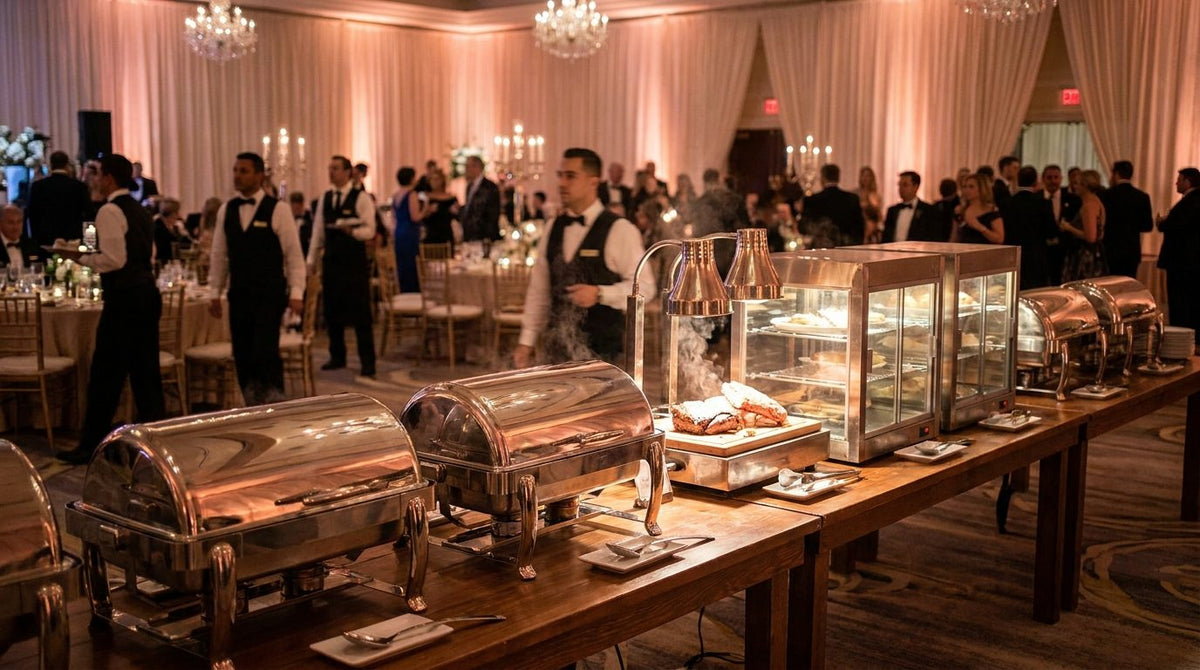
A banquet hall equipment list starts with one decision: how the food reaches the guest. Plated service, buffet service, live stations and cocktail service each need a different set of equipment, and guest count only tells you how many of each. A 300-cover plated dinner and a 300-cover buffet share almost nothing except the trolleys. This guide works through the equipment zone by zone, so you can build a list against the service style you actually sell.
The recurring theme is holding. Banquet food is cooked in advance in a kitchen that is rarely adjacent to the hall, so most banquet equipment exists to keep food at temperature and move it there in condition.
The four zones of a banquet hall
Every function room, whatever its size, resolves into the same four zones. Assigning equipment to a zone rather than to a generic list is what keeps a banquet operation from being over-equipped in one place and short in another.
The holding line sits between the kitchen and the guest — usually in a service corridor or a screened area at the back of the hall. This is where food waits.
The service point is what the guest sees: a buffet counter, a carving or live station, or nothing at all if service is plated.
The beverage station runs on its own logic and its own peak, which is almost never the same as the food peak.
The clearing route is the return path. Under-planning it is why banquet turnarounds run late.
Zone 1 — The holding line
Hot holding is the single largest equipment block in a banquet operation, and heated counters are what make a long service window survivable.
Counter-format heated displays are specified by run length, because the constraint is how many pans sit on the line at once. A Curved Food Warmer 1200MM covers a wide multi-dish holding line; the Industrial Food Warmer Curved 990MM suits a narrower run, and the Industrial Food Warmer Curved 660MM fits a secondary or overflow position where a full-length counter will not fit. Curved glass matters more than it appears: it keeps ambient air off the food while leaving the line visible to staff, so replenishment is judged by sight rather than by lifting lids.
Steamed and high-moisture items need a different vessel. Rice, dim sum, string hoppers and similar items dry and harden under radiant heat, so a display steamer such as the Industrial Food Display Steamer 480MM is worth a dedicated position rather than being forced onto the dry line.
Sauces are the third element. Gravies held on an open counter skin over, and holding them in a main well wastes a pan position. A dedicated Industrial Electric Sauce Warmer Double keeps two sauces at the service point and frees the counter for solid dishes.
Behind all of this, wet holding does the bulk work. A bain marie keeps the next replenishment round at temperature in the same pans that will go onto the line — the difference between a buffet that runs continuously and one that runs down between courses.
Compare formats across the heated food warmers and display counters range when you are matching counter length to your hall.
Zone 2 — The service point
What sits in front of the guest depends entirely on service style.
Buffet service needs chafing dishes at the table plus the holding line behind it. The buffet and chafing dish sets range covers fuel-heated frames for marquee and garden functions and electric formats for fixed indoor halls. Plan the counter in Gastronorm modules so pans move straight from the holding line to the chafer.
Plated service removes the buffet entirely and moves the whole load into the holding line and transport. Plate covers, heated holding and a disciplined dispatch sequence replace the counter. This is the service style most often under-equipped, because the equipment is invisible to the client.
Live and carving stations need a heat source at the station, a clear guest-facing footprint and an operator. They are slower per cover than a buffet and should be treated as a feature, not as primary capacity — count them out of your throughput calculation, not into it.
Cocktail and canapé service shifts almost everything to transport and beverage, with small heated holding for hot canapés.
Zone 3 — The beverage station
Beverage demand peaks at arrival and at the end of the meal, not alongside food service, so it needs its own equipment rather than sharing the food line.
Bulk hot water for tea and coffee service is sized against the number of guests served in the peak fifteen minutes rather than the total. Chilled service runs off juice and beverage dispensers — and the practical rule is to split volume across more service points rather than concentrating it in one large unit, because a banquet queue is a throughput problem, not a capacity problem.
Position matters as much as capacity. A beverage station placed in the guest flow rather than at the end of the buffet halves the queue at the food line.
Zone 4 — Transport and clearing
Everything cooked has to travel, and everything served has to come back.
Service and tray trolleys carry replenishment pans out and cleared crockery back. Specify by the number of covers a single trip should clear: a banquet that needs four trips per course to replenish will always run behind. GN-format racks move pans from the kitchen to the holding line without decanting, and multi-shelf serving trolleys handle plated dispatch and clearing.
The clearing route deserves a named plan. Establish where dirty crockery is staged, how it reaches the wash-up, and whether that path crosses the guest route. Banquet turnaround time between functions is usually determined by clearing, not by setup.
Banquet equipment by service style
| Service style | Holding line | Service point | Transport load | Main constraint |
|---|---|---|---|---|
| Buffet | Heated counters plus bain marie for replenishment | Chafing dishes on GN modules | High — continuous pan replenishment | Replenishment cycle speed |
| Plated | Heavy — all covers held before dispatch | None guest-facing | Very high — every cover moves twice | Dispatch sequencing and holding capacity |
| Live stations | Light — cooking happens at the station | Cooking equipment and operator at station | Low for food, high for prep | Covers per hour per station |
| Cocktail / canapé | Light, small hot holding for canapés | Passed trays and small counters | Continuous, low volume per trip | Staff numbers and tray turnaround |
| Mixed (buffet plus station) | Full holding line | Chafers plus one or two feature stations | High | Space in the hall, not equipment |
How to choose: banquet equipment checklist
- Fix the service style first. Guest count only multiplies the list; the style determines what is on it.
- Set the maximum function size you will accept, and equip to that rather than to your average booking.
- Measure the holding line in counter length and pan positions, not in guest numbers.
- Give steamed and high-moisture items a dedicated holding position rather than forcing them onto a dry counter.
- Hold sauces separately so main-line pan positions are not consumed by gravies.
- Size beverage equipment on the peak fifteen minutes at arrival, and split it across multiple service points.
- Count the kitchen-to-hall distance and specify enough trolleys that one replenishment round is one trip.
- Plan the clearing route and the wash-up staging point before the first function, not after it.
- Confirm electrical provision along the whole holding line — banquet equipment runs continuously through the service window.
Frequently asked questions
What equipment is needed for a banquet hall?
A holding line of heated counters and bain marie units, a service point matched to the style (chafing dishes for buffet, nothing guest-facing for plated), a beverage station with bulk hot water and chilled dispensers, and enough trolleys to move replenishment out and cleared crockery back.
How do I calculate banquet equipment for the number of guests?
Work from the largest function you will accept, not the average. Convert guest count into pan positions on the holding line and into replenishment trips per course, then check that one trip covers one round. Beverage equipment is sized on the peak fifteen minutes, not the total.
What is the difference between buffet and plated banquet equipment?
Buffet service puts the equipment in front of the guest — chafing dishes on a counter — with holding behind it. Plated service removes the counter entirely and shifts the whole load into back-of-house holding and transport, which usually means more holding capacity and more trolleys, not less equipment.
Do banquet halls need a separate kitchen?
Not usually. Most properties cook banquet food in the main kitchen and treat the hall as a holding, service and transport problem. What the hall does need is a dedicated holding line and a defined route from kitchen to service point.
Why do banquet turnarounds run late?
Almost always clearing rather than setup. If dirty crockery has no staged route to the wash-up and there are not enough trolleys to move it, the room cannot be reset regardless of how fast the service was.
Building your banquet list
Start with the holding line, because it is the block that scales with every service style. The heated food warmers and display counters range covers the counter formats described above and pairs with the bain marie, buffet and trolley ranges linked in each section. For the wider property-level view of equipping F&B operations, see the hotel equipment guide.
Share:
Bain marie vs food warmer: what the difference actually means for your food
Room service trolley types for hotels, and how to choose between them