
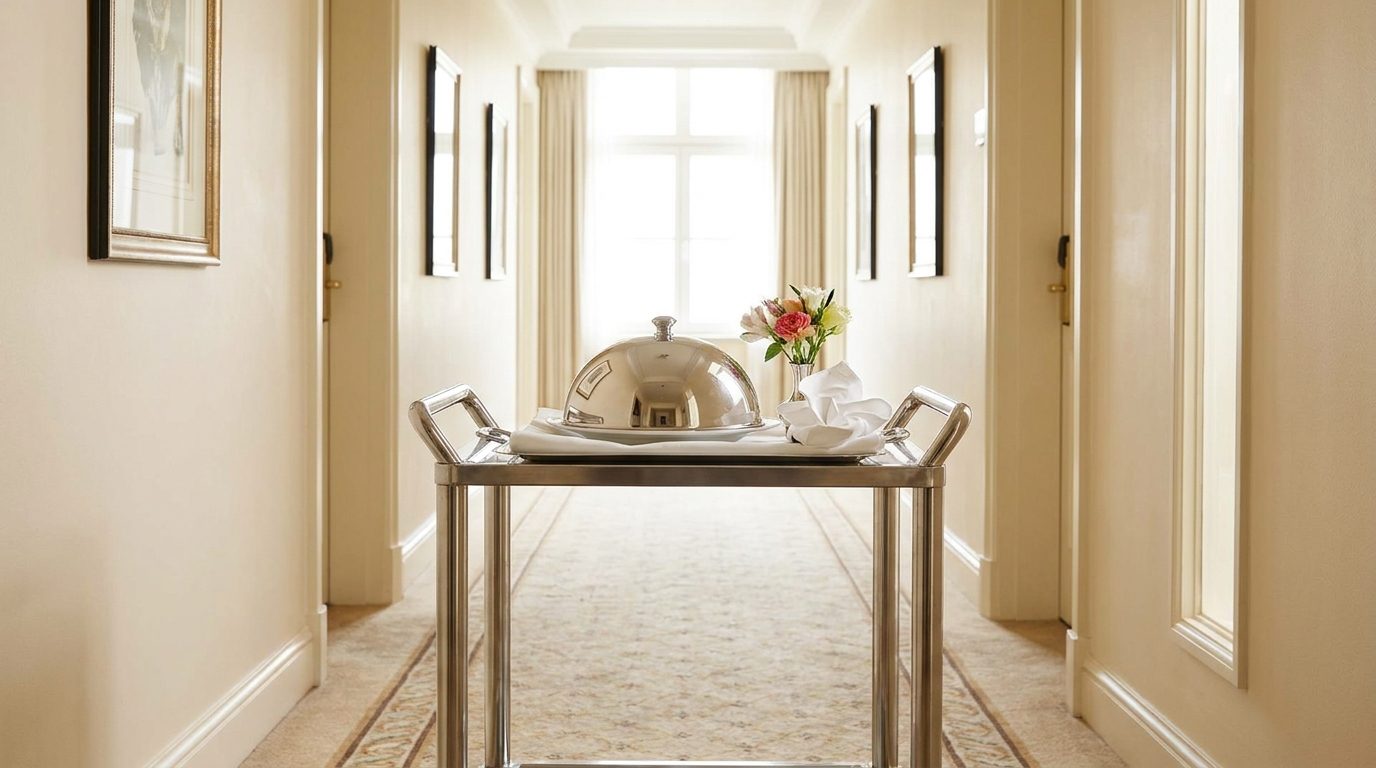
Hotels use four broad trolley types, and they are not interchangeable: open-shelf serving trolleys for room service and guest-facing delivery, GN rack trolleys for moving Gastronorm pans between kitchen and buffet, tray rack trolleys for bakery and production, and clearing trolleys for the return run to the wash-up. The right choice is decided by what sits on the shelves, how far the route is, and what the floor is made of. Get the trolley wrong and you either double the number of trips or damage the corridor.
Most properties end up with a small fleet rather than one universal model. Planning that fleet by route is more useful than planning it by department.
The four hospitality trolley types
Open-shelf serving trolleys are the guest-facing workhorse. Two or three flat shelves, four castors, a push handle. They carry room-service covers, in-room amenity setups, welcome trays and beverage service, and they double as clearing trolleys on the way back. Because they are seen by guests, finish quality matters as much as capacity.
GN rack trolleys hold Gastronorm pans on runners rather than on flat shelves. They exist to move a full replenishment round from the kitchen to a buffet or holding line without decanting, and they are the correct answer whenever the function room is any distance from the kitchen.
Tray rack trolleys take full-size baking or production trays on close-pitched runners. Bakery, pastry and high-volume production use them for proving, cooling and moving trays in bulk.
Clearing and utility trolleys are structurally the same as serving trolleys but specified for abuse rather than appearance — they carry soiled crockery, linen and equipment on routes the guest never sees.
Serving trolleys: what to specify for room service
For room service the deciding factors are the route, not the load. A tray of covers is light; the corridor is long, the lift is slow and the floor is often carpeted.
Shelf count sets the format. A two-shelf trolley such as the Stainless Steel Serving Trolley - 2 Shelf is lower, lighter and easier to manoeuvre in a lift lobby, and it suits single-room delivery. A three-shelf unit such as the Stainless Steel Serving Trolley - 3 Shelf carries more per trip, which matters when one runner covers several rooms on a floor, or when the same trolley delivers and clears. The Serving Trolley - 3 Shelf covers the same three-tier format as an alternative build.
Stainless steel is the default for anything that carries food, because it takes repeated cleaning and detergent contact without degrading, and it does not hold odour. Welded frames stay square longer than bolted ones under daily use — a trolley that develops a rocking corner is a trolley that spills.
Castors are the component that decides whether staff like the trolley. Larger-diameter castors roll over carpet, lift thresholds and floor transitions with far less effort than small ones; small castors are fine on smooth kitchen floors and terrible on corridor carpet. Specify at least two swivel castors for manoeuvrability and at least one brake if the trolley is ever parked on a slope or in a lift. Soft-tread castors run quieter, which is not a luxury on a room-service route at night.
Compare formats across the service and tray trolley range when you are matching a trolley to a route.
GN rack trolleys: moving pans, not plates
A GN rack trolley is specified in layers, and the number of layers should be derived from one replenishment round, not from the trolley's maximum.
A high-capacity rack such as the GN Tray Trolley 15 Layers moves a full buffet replenishment in a single trip — the practical test is whether one trip refills every station on the line. A compact rack such as the GN Tray Trolley 06 Layers suits shorter runs, tighter service corridors and smaller function rooms, and it is easier to position beside a counter without blocking the service path.
Because the runners are built to the Gastronorm module, pans travel from the bain marie to the rack to the buffet and chafing dish line without being decanted. That is the operational reason to standardise: fewer transfers means less heat loss, less spillage and fewer pans to wash. The same logic applies at the receiving end, where pans go straight into the heated food warmers and display counters on the holding line.
Tray rack trolleys: production and bakery use
Tray racks look similar to GN racks but are pitched for full-size production trays and are usually taller. A rack such as the Baking Tray Trolley 15 Layers holds a full production batch for proving, cooling or transfer to the oven area.
Two details separate a good tray rack from a frustrating one. Runner pitch determines what you can actually load — tight pitch maximises tray count but will not accept anything that rises or is stacked, so a bakery that proves on the rack needs wider spacing than one that only cools on it. Aluminium builds are lighter to push and easier to manoeuvre in a tight production room, while heavier steel builds tolerate rougher handling on uneven floors.
Properties running an in-house bakery should size these alongside the oven rather than alongside the kitchen — the rack count is set by batch size and cooling time. The bakery equipment range and the bakery setup guide cover that side of the planning.
Trolley types compared
| Trolley type | Load carried | Typical route | Key specification | Weak point if mis-specified |
|---|---|---|---|---|
| Open-shelf serving, 2 shelf | Room-service covers, amenity setups | Floor corridors, lifts | Manoeuvrability, quiet castors | Too little capacity for multi-room runs |
| Open-shelf serving, 3 shelf | Multi-room delivery, clearing | Corridors, banquet dispatch | Shelf clearance and castor size | Top-heavy if loaded unevenly |
| GN rack | Gastronorm pans | Kitchen to buffet or holding line | Layer count per replenishment round | Too few layers means repeat trips |
| Tray rack | Full production or baking trays | Bakery, production, cooling area | Runner pitch and frame weight | Pitch too tight for proving |
| Clearing / utility | Soiled crockery, linen, equipment | Back-of-house to wash-up | Durability and brakes | Guest-facing use of a back-of-house trolley |
How to choose: trolley selection checklist
- Map the route before the load. Distance, lift access, thresholds and floor surface decide castor size more than weight does.
- Specify larger castors for carpeted corridors and lift thresholds; small castors are only comfortable on smooth flat floors.
- Require at least one braked castor on any trolley used in lifts or parked on a slope.
- Choose shelf count by trips per service, not by maximum load — the target is one trip per round.
- Use GN-format racks wherever pans move, so nothing is decanted between kitchen and service point.
- Match tray-rack runner pitch to what you load: wider for proving, tighter for cooling and transfer.
- Keep guest-facing and back-of-house trolleys separate. A clearing trolley should never appear on a guest corridor.
- Check the trolley fits through the narrowest door and into the service lift before ordering a fleet.
- Choose stainless steel for anything carrying food, and welded construction for anything used daily.
Frequently asked questions
What types of trolleys do hotels use?
Four main types: open-shelf serving trolleys for room service and guest delivery, GN rack trolleys for moving Gastronorm pans to buffets and holding lines, tray rack trolleys for bakery and production trays, and clearing or utility trolleys for the return run to the wash-up.
How do I choose a room service trolley?
Start with the route. Long carpeted corridors and lift thresholds call for larger castors and a braked wheel. Then choose shelf count by how many rooms one runner covers per trip — two shelves for single-room delivery, three where one trolley delivers and clears together.
What is the difference between a GN trolley and a baking tray trolley?
A GN trolley is built to the Gastronorm pan module so food pans slide straight in from a bain marie or holding line. A baking tray trolley takes full-size production trays and is usually pitched and sized for bakery batches rather than for service pans.
How many layers should a GN trolley have?
Enough that one trip covers one replenishment round for your buffet line. Count the pans that need replacing at once, then choose the layer count above it. Higher-layer racks reduce trips; compact racks are easier to position in tight service corridors.
Should hotel trolleys be stainless steel?
For anything carrying food, yes. Stainless steel tolerates repeated cleaning and detergent contact, does not retain odour and stays presentable in guest areas. Lighter aluminium builds are worth considering for production tray racks where push effort matters more than guest presentation.
Matching a trolley to your route
Decide the route and the load first, then choose the format. The service and tray trolley range covers open-shelf serving trolleys, GN racks and production tray racks, so a property can build a small fleet with consistent castors and finishes rather than a mismatched collection. For the wider view of equipping a hotel's F&B operation, see the hotel equipment guide.
Share:
Banquet hall equipment list: planning by service style, not by guest count
How to choose a juice dispenser for events and catering