
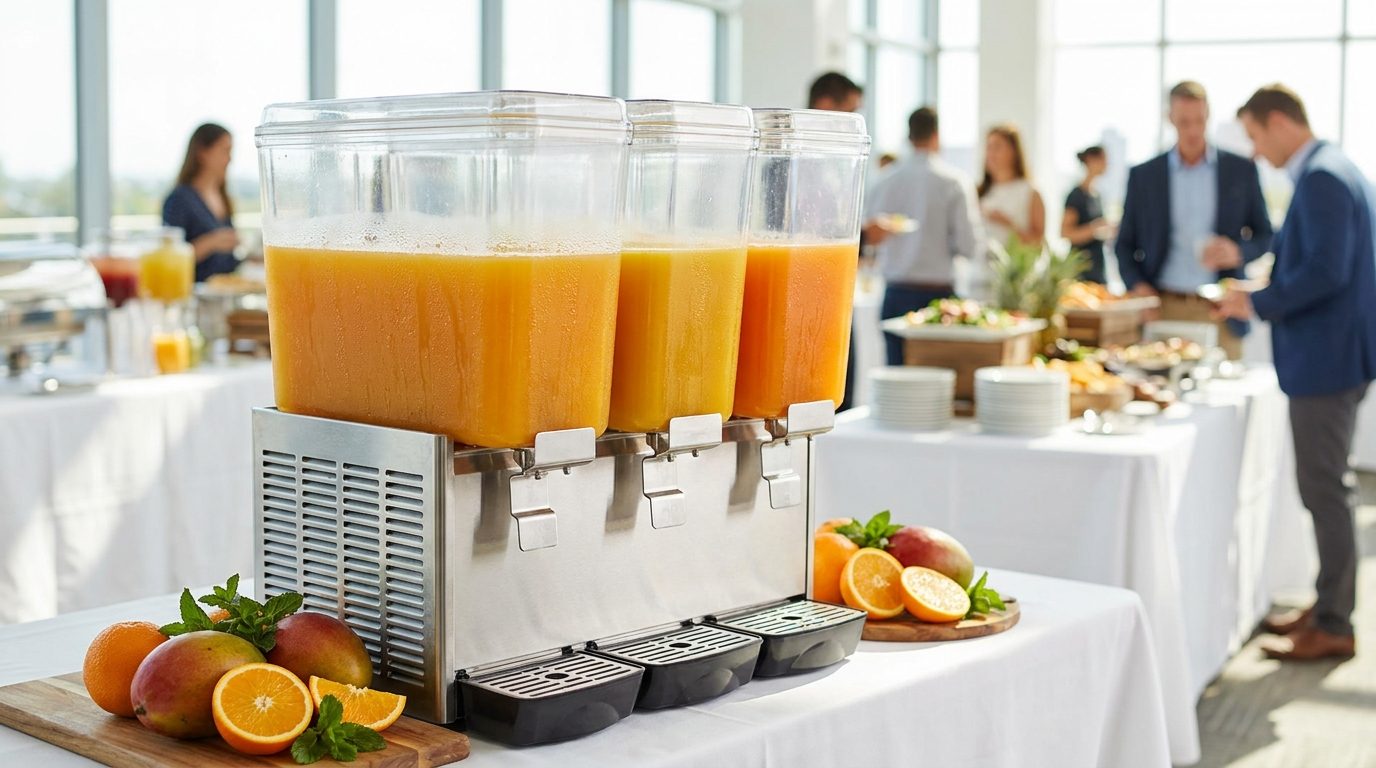
For events, choose a juice dispenser by three things: how many guests you have to serve in the busiest thirty minutes, how many drink varieties you want visible at once, and whether the venue gives you a power point at the drinks station. A multi-tank unit lets one server pour without touching a jug, keeps varieties separated, and shows guests what is on offer — which is why tank dispensers replaced jug service at almost every buffet line.
What a dispenser actually has to do at an event
A jug-and-glass setup fails at scale for practical reasons, not aesthetic ones. Every refill takes a staff member away from the line. Guests hesitate when they cannot see what is in the jug. Condensation and spills accumulate on the cloth. And the moment two people queue, the drinks station becomes the bottleneck for the whole buffet.
A dispenser fixes all four. The tank is transparent, so the drink sells itself. The tap is self-service, so the queue moves at the speed of guests rather than staff. Refills happen from the top, in one action, without dismantling the display. And a single stable base means far less mess on the table.
The trade-off is that you now have to size and position it properly. Get the tank capacity wrong and you spend the event refilling; get the tank count wrong and you spend it apologising for a variety that has run out.
Dispenser types compared
| Type | How it works | Best for | Watch out for |
|---|---|---|---|
| Single-tank gravity dispenser | One transparent tank, tap at the base | Small functions, one drink, staff canteens | No variety; empties fast at peak |
| Twin-tank dispenser | Two tanks on a shared base | Weddings, office events, hotel breakfast | Both tanks drain into the same footprint of space |
| Triple-tank dispenser | Three tanks side by side | Large buffets, banquet halls, all-day service | Needs a wider table run and more refill labour |
| Electric circulating dispenser | Powered unit that keeps the drink moving in the tank | Fruit juices and drinks that separate on standing | Needs a power point at the station |
| Glass jar dispenser with stand | Glass vessel on a display stand, tap at the base | Front-of-house presentation, infused water, mocktails | Glass is heavier and needs careful handling |
| Condiment and dry dispensers | Pump or hopper for sauces, cereal, dry goods | Breakfast buffets, quick-service counters | Not interchangeable with liquid drink tanks |
Trendy Zone Lanka's beverage dispenser range covers each of these formats. The Juice Dispenser 8L+8L, for example, puts two 8-litre tanks on one base, which is the point at which most caterers stop carrying jugs.
Sizing: how much drink an event actually gets through
Work in servings, not litres, then convert.
A standard buffet glass pour is roughly 200 ml, which means five servings per litre. Guests at a two-hour function typically take two to three drinks each, and the first thirty minutes is when most of them arrive at the table at once.
So the arithmetic is:
Peak-half-hour guests × 1 drink each × 0.2 L = litres you must have standing in the tank when the doors open.
For 150 guests arriving over half an hour, that is around 30 litres of cold drink available or within immediate reach — not 30 litres of tank, necessarily, but 30 litres between the tanks and the back-of-house top-up containers. A triple-tank unit such as the Industrial Juice Dispenser 16L Triple (A-Star) carries a large standing volume across three varieties, which is why it suits banquet and function work. For a café or a smaller function room, the Electric Juice Dispenser 10L Triple gives the same three-variety presentation in a narrower footprint.
Two sizing habits worth adopting:
- Never plan to run a tank to empty. A tank drawn below roughly a quarter looks unappealing and pours slowly. Plan your refill trigger at that point, not at the bottom.
- Count varieties before capacity. Three drinks at 10 litres each usually outperforms one drink at 30 litres, because guests take what they prefer rather than what is left.
Keeping drinks cold on a Sri Lankan buffet line
Ambient temperature is the constraint that catches out most first-time event caterers here. A dispenser is a holding vessel, not a refrigerator, unless it is specifically a cooling unit. Standard practice is to chill the drink fully before it goes into the tank and then to manage the standing time:
- Chill in the back-of-house cold room or chiller first — a commercial chiller or refrigerator doing the cooling is far more effective than trying to cool 16 litres on the buffet table.
- Top up with cold product rather than diluting with warm stock.
- Keep ice separate. Adding ice directly to a juice tank dilutes the drink as it melts and can clog the tap; a scoop of ice into the glass gives the guest a colder drink with no dilution of the tank. If ice supply is your limiting factor at events, the ice cube machine buying guide covers how much daily output a function schedule actually needs.
- Position the dispenser out of direct sun and away from the hot buffet run. Radiant heat from chafing dishes travels further than people expect.
For presentation-led events where the drinks station is part of the room's look, the Glass Juice Dispenser With Stand Triple puts the product at eye level on a stand, which works well for infused water, iced tea and mocktail service.
Beyond juice: the rest of the dispenser line
A buffet drinks station rarely stops at juice. Breakfast service in particular runs several dispenser types side by side, and it is worth planning the whole run at once rather than buying piecemeal:
- Hot beverage. The Industrial Coffee & Milk Dispenser 13L handles coffee or milk service in the same self-serve format as the juice tanks.
- Dry goods. The Industrial Cereal Dispenser 12L Double gives portion-controlled cereal service without open bowls on the line.
- Sauces. Pump-type condiment dispensers belong at the quick-service or grill end of the line rather than on the drinks station, but they are worth specifying at the same time so the counter run is consistent.
If you are equipping a full function room, look at the dispensers alongside the buffet sets and the wider hotel equipment range so that heights, finishes and table runs match. The hotel equipment guide for Sri Lanka sets out how the beverage station fits into the rest of the front-of-house build.
How to choose: a checklist before you buy
- [ ] Count your peak-half-hour guests, not total attendance, and convert to litres at five servings per litre.
- [ ] Decide how many varieties must be visible at once — this sets tank count before it sets capacity.
- [ ] Measure the table run in millimetres, including clearance for a glass under each tap and for lifting the lid to refill.
- [ ] Confirm whether there is a power point at the station. If not, rule out electric units for that venue.
- [ ] Check the tap height against the tallest glass you actually use.
- [ ] Plan who refills, and from where — a dispenser that can only be topped up by carrying it to the kitchen will not get topped up mid-service.
- [ ] Check the strip-down for washing: taps, seals and lids should come apart without tools if the unit is cleaned daily.
- [ ] For mobile catering, check the empty weight and base stability on the tables and vehicles you actually use.
Frequently asked questions
What size juice dispenser do I need for 100 guests? Assume 200 ml per pour and two to three drinks per guest over a two-hour function. For 100 guests that is 40 to 60 litres across the whole event, with roughly 20 litres needed in the first half hour. Two or three tanks of 8 to 16 litres each, refilled once or twice, handles that comfortably.
Is a single-tank or triple-tank dispenser better for catering? Multi-tank almost always wins for catering. Guests take drinks faster when they can see and choose between varieties, and one variety running dry does not shut the station down. Single tanks suit staff canteens, small meeting rooms and single-drink service where variety is not expected.
Can I put ice inside a juice dispenser tank? It is better not to. Melting ice dilutes the drink progressively through service, so the last guests get a weaker product than the first, and ice fragments can obstruct the tap. Chill the juice before filling and offer ice separately in the glass.
What is the difference between a juice dispenser and an electric one? A standard tank dispenser relies on gravity: you fill the tank and the tap releases the drink. An electric dispenser adds a powered function in the tank, typically keeping the drink circulating so fruit juices stay mixed rather than separating during a long service. Electric units need a power point at the station.
How do you clean a beverage dispenser between events? Empty and strip the unit the same day. Remove the tap assembly, lid and any seals, wash them separately, and pay particular attention to the tap interior where sugar residue collects. Rinse the tank thoroughly, dry it upside down, and reassemble only when dry to avoid trapped moisture.
Where to start
Fix your peak-half-hour number and your variety count first — those two figures decide almost everything else. Then compare tank counts and capacities across the beverage dispensers for events and catering at Trendy Zone Lanka, and plan the drinks station as part of the whole buffet run rather than as an afterthought at the end of the table.
Share:
Room service trolley types for hotels, and how to choose between them
Water boiler capacity for a restaurant: how to size it properly