
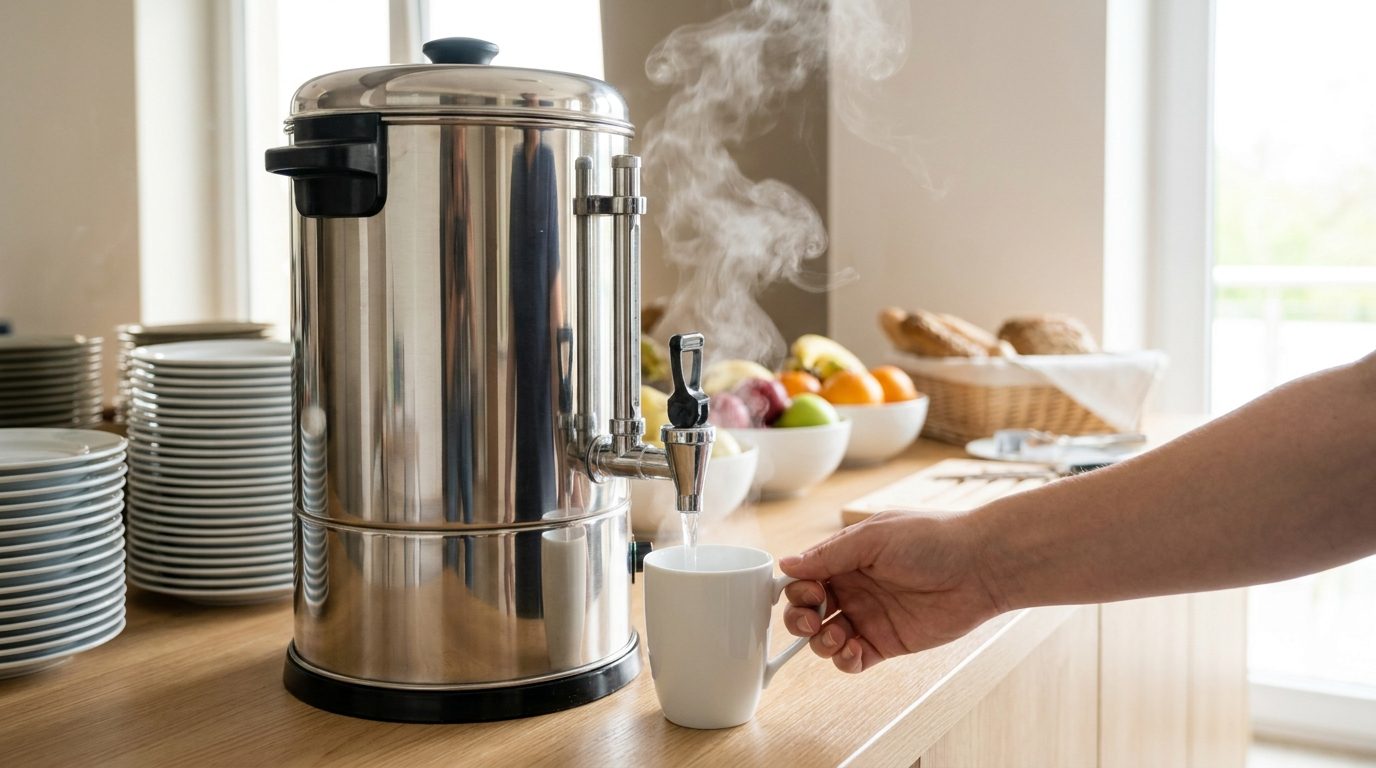
Size a commercial water boiler on peak-hour cups, not on daily volume. Count the hot drinks you serve in your busiest hour, allow roughly five to six cups per litre, and choose a tank that holds most of that hour's demand so the unit is topping up rather than starting from cold. A boiler that is one size too small does not just run out — it spends the whole service reheating, and the queue waits on the element rather than on your staff.
Why litres alone do not answer the question
Every commercial water boiler is sold on its tank capacity, and the number matters, but it describes storage rather than throughput. Two figures determine whether the unit copes:
- Standing volume — how much boiled water is ready the moment service starts.
- Recovery — how quickly the unit brings fresh cold water back up to temperature after a heavy draw-off.
A large tank with slow recovery is fine for a breakfast rush that ends after ninety minutes. A smaller tank with fast recovery suits a canteen with steady all-day demand. Problems appear when a small tank meets a sharp peak: the first twenty cups come out fine and the rest arrive lukewarm because the unit is refilling with cold water faster than it can heat it.
You will rarely be able to compare published recovery figures reliably across brands, so plan around standing volume — the number you can control — and give yourself headroom.
Cups per litre: the conversion that does the work
Hot drink servings in food service are typically 150 to 200 ml:
| Serving | Volume per cup | Cups per litre |
|---|---|---|
| Small tea cup, banquet service | ~150 ml | ~6.5 |
| Standard cup or mug of tea | ~180 ml | ~5.5 |
| Large mug, staff canteen | ~250 ml | ~4 |
| Americano-style long black (water portion only) | ~120 ml | ~8 |
Working at five cups per litre is a safe planning figure for mixed service — it builds in the water lost to warming pots, rinsing and the last inch you never actually pour.
So a breakfast service that pours 120 cups of tea in its busiest hour needs around 24 litres of hot water available across that hour. That does not mean a 24-litre tank is mandatory; it means that if you buy a 10-litre unit, it must refill and reheat more than twice inside that hour, and the queue will feel it.
A sizing ladder by venue type
| Venue and pattern | Typical peak-hour hot drinks | Capacity class that usually fits | Notes |
|---|---|---|---|
| Small office, meeting room, home use | Under 30 cups, intermittent | Around 8 litres | Bench-top, plug-in, no plumbing |
| Café or bakery counter | 30–60 cups in bursts | 10–15 litre class | Sits beside the coffee machine, not in the pass |
| Restaurant with tea and coffee service | 60–100 cups at peak | 20–23 litre class | Needs a dedicated counter position and drainage nearby |
| Hotel breakfast, banquet, canteen | 100–180 cups in a defined window | 30 litre class | Standing volume matters more than recovery here |
| Large staff canteen, event catering, institutional | Sustained demand across the day | 40 litre class and above | Consider two units in different service points |
Trendy Zone Lanka's commercial water boiler range follows this ladder closely. At the small end, the Russell Hobbs 8L Water Boiler covers offices and light counter use. The Industrial Electric Water Boiler 15L (Linkrich) High Quality is a typical café-counter size, while the Industrial Electric 23L Water Boilers sit in the restaurant band. For hotel breakfast and banquet work, the Industrial Electric Water Boiler 30L (Linkrich) High Quality and the Industrial Electric Water Boiler 40L (Linkrich) High Quality give the standing volume that a sharp, concentrated rush demands.
Two smaller boilers or one large one?
This is the question most operators get wrong, and the answer usually depends on geography rather than volume.
One large unit makes sense when all hot drink service happens at a single point — one buffet station, one counter, one canteen serving hatch. You get the biggest standing volume for the footprint and one thing to descale.
Two smaller units win when service is split across floors, function rooms or shifts. Carrying jugs of boiled water across a venue is slow, unpleasant and a burn risk. Two 15-litre units at two stations beat one 30-litre unit that is only convenient for half the room. Two units also give you redundancy: if one is down for descaling, breakfast still happens.
A useful test: if more than one person would have to walk more than about ten metres to reach the boiler during service, you probably want a second unit rather than a bigger one.
Placement, water supply and the practical details
Sizing is only half the decision. The details that decide whether staff actually like the unit:
- Tap height and clearance. Measure against the tallest vessel you fill — a teapot, a jug, a stock pot. A boiler that cannot fill your service teapot without tilting is a daily irritation.
- Drip management. Position the unit where spills go somewhere sensible. A boiler at the end of a wet counter run with drainage nearby is far easier to live with than one on a dry service table.
- Filling method. Manual-fill units need someone to lift water into them at intervals; the higher the capacity, the heavier that job becomes. Plan who does it and when.
- Scale. Hard water leaves deposits on elements and inside tanks, which slows heating over time. Regular descaling is basic maintenance for any boiling water unit — build it into the weekly or monthly cleaning schedule from day one rather than waiting for the unit to slow down.
- Electrical supply. High-capacity boilers draw meaningfully at start-up. Confirm the circuit at the intended position before you commit to a unit, particularly in older buildings where the counter run is already shared with other appliances.
Where the boiler sits alongside your coffee equipment
In cafés, the boiler and the espresso machine are often confused as alternatives. They are not. An espresso machine's hot water tap is designed for americanos and for rinsing, and drawing large volumes from it pulls the brew boiler down and hurts the next few shots. A separate water boiler protects espresso quality by keeping tea, instant drinks, jug filling and cleaning water off the machine entirely.
If you are building a café beverage station from scratch, plan the commercial coffee machines and the water boiler as two separate items on the counter layout, not one. The coffee machines buyer's guide for Sri Lanka covers the espresso side of that decision in detail.
For hotels, the boiler belongs on the breakfast-service equipment list alongside the buffet and beverage line — see the hotel equipment range and the hotel equipment guide for Sri Lanka for how the pieces fit together.
How to choose: a water boiler sizing checklist
- [ ] Count hot drinks served in your busiest hour, by service point, not per day.
- [ ] Convert at five cups per litre to get your peak-hour litre requirement.
- [ ] Decide whether that demand arrives as a sharp burst (favour standing volume) or a steady flow (a smaller tank can cope).
- [ ] Map where hot water is needed — one point or several. Distance decides one unit versus two.
- [ ] Measure the counter space and tap clearance against your tallest teapot or jug.
- [ ] Confirm the electrical circuit at the intended position.
- [ ] Decide who refills and who descales, and how often, before the unit arrives.
- [ ] Add headroom for functions and seasonal peaks — hot drink demand spikes with weather and events, and a boiler is not easily upsized later.
Frequently asked questions
What size water boiler do I need for a restaurant? Count hot drinks in your busiest hour and divide by five to get litres. A restaurant pouring 60 to 100 cups at peak generally suits a 20 to 23 litre class unit. Hotels with a concentrated breakfast rush usually need 30 litres or more, because standing volume matters more than recovery in a short, sharp window.
How many cups of tea does one litre make? Around five to six standard cups per litre at a 150 to 180 ml pour. Plan at five cups per litre, which allows for water used warming pots, rinsing and the residue you cannot practically pour out of the tank.
Is a commercial water boiler better than an electric kettle for a café? For anything beyond a handful of drinks, yes. A kettle boils from cold every time, so the queue waits on each cycle, and repeated boiling of small volumes is inefficient. A boiler holds a standing volume at temperature so the first cup and the fortieth are served at the same speed.
Can I use the hot water tap on my espresso machine instead? For occasional americanos, yes. For tea service, jug filling or cleaning water, no. Heavy draw-off from the machine's hot water tap pulls the boiler temperature down and affects the shots that follow. Keep bulk hot water on a separate unit.
How often should a commercial water boiler be descaled? It depends entirely on your local water, so judge it by behaviour rather than by a fixed calendar. Slower heating, visible deposits inside the tank or a change in the sound the unit makes at heat-up all indicate scale. Most busy sites make it a scheduled monthly task and adjust from there.
Where to start
Get the peak-hour cup count first — everything else follows from it. Then compare standing volumes across the commercial water boilers at Trendy Zone Lanka, and check the unit against your counter layout and service points before you settle on a capacity. If the boiler is part of a wider fit-out, plan it alongside the rest of your commercial kitchen equipment rather than adding it at the end.
Share:
How to choose a juice dispenser for events and catering
Types of juicers explained: centrifugal, masticating and commercial extractors