
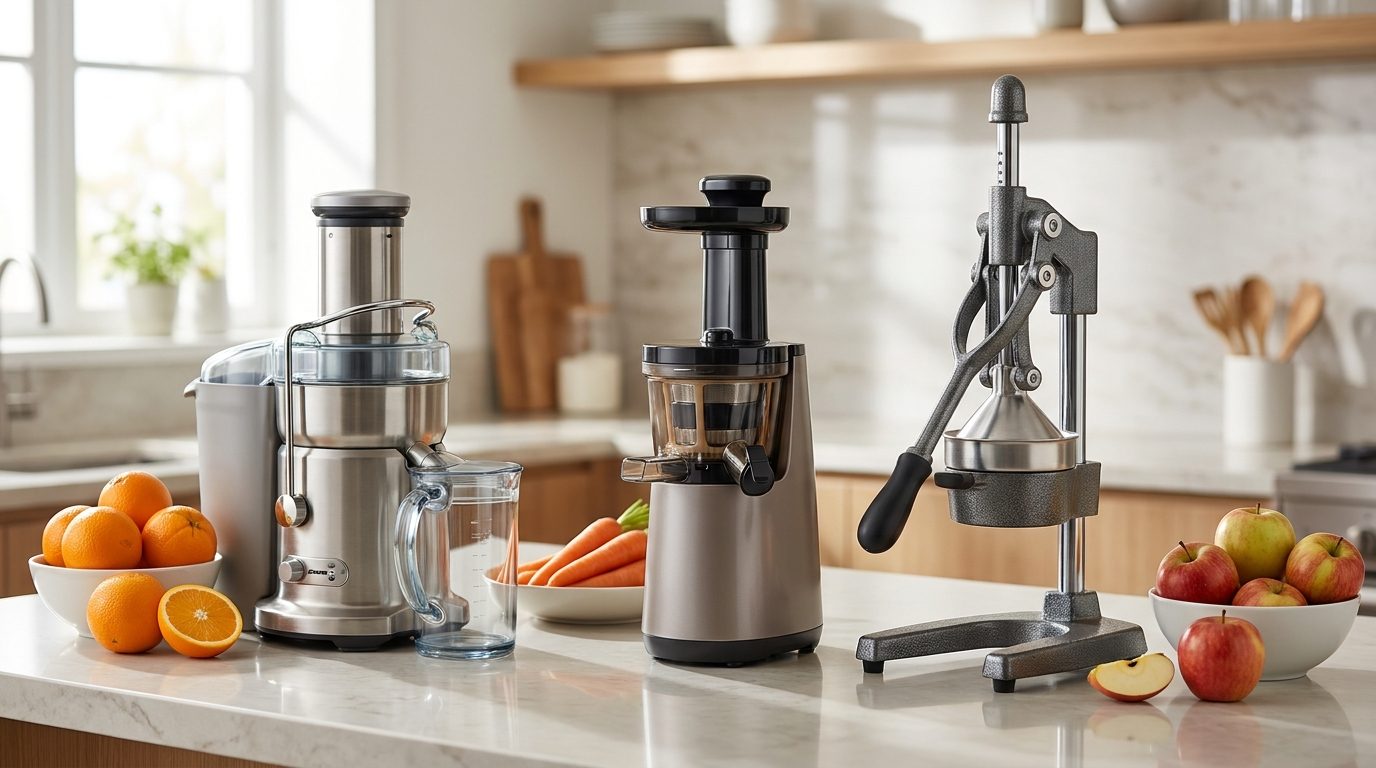
There are four juicer families worth knowing: centrifugal juicers, which shred fruit against a spinning screen and spin the juice out; masticating or slow juicers, which crush and press produce with an auger; citrus presses, which are built only for halved citrus; and commercial extractors, which are heavy-duty machines designed for continuous feeding through a service. The right one depends far more on what you juice and how long the machine runs than on any headline power figure.
How each type actually extracts juice
Understanding the mechanism explains every practical difference that follows.
A centrifugal juicer has a flat cutting disc spinning inside a mesh basket. Produce is pushed onto the disc, shredded, and the pulp is thrown outwards by centrifugal force. Juice passes through the mesh; pulp collects in a bin. It is fast, tolerant of whole fruit, and cheap to make — which is why it dominates domestic and light commercial use.
A masticating juicer turns a slow auger against a screen, crushing produce and squeezing juice out under pressure rather than throwing it out with speed. Lower speed means less air introduced and less heat from friction, which is why slow juicers are preferred for leafy greens and wheatgrass. It is also why they take longer per litre.
A citrus press does one job: it separates juice from a halved citrus fruit with a reamer or a lever press. It cannot handle hard produce and does not try to.
A commercial extractor is a scaled-up version of the centrifugal or press principle, built for duty cycle rather than for one-off use. The differences are in the bearings, motor cooling, feed chute size and pulp ejection — the things that decide whether a machine can run for two hours straight or needs to rest every few minutes.
Juicer types compared
| Type | Mechanism | Best produce | Speed per litre | Typical use |
|---|---|---|---|---|
| Centrifugal | High-speed disc and mesh basket | Apple, carrot, pineapple, beetroot, hard produce | Fast | Cafés, home kitchens, light juice counters |
| Masticating / slow | Low-speed auger crushing against a screen | Leafy greens, wheatgrass, soft fruit, celery | Slow | Health-focused juice bars, wellness menus |
| Twin-gear | Two interlocking gears grinding produce | Dense greens and fibrous produce | Slowest | Specialist juice programmes |
| Citrus press | Reamer or lever press on halved fruit | Orange, lime, lemon, grapefruit only | Very fast for citrus | Breakfast service, bar stations |
| Commercial auto-feed extractor | Continuous feed with automatic pulp ejection | Mixed hard produce at volume | Fast and sustained | Juice bars, hotel breakfast, event catering |
| Blender plus strainer | Blade blending, then strain through a fine sieve or bag | Soft fruit, tropical fruit, smoothie-style drinks | Moderate, labour-heavy | Kitchens already running a blender |
The one that matters most in Sri Lanka: pick by produce, not by trend
Slow juicers get most of the online attention, but the produce you actually work with should decide the machine.
If your menu is built around wood apple, mango, papaya, banana and other soft tropical fruit, a juicer is often the wrong tool entirely. These fruits are pulp, not juice; run them through a centrifugal machine and you throw most of the fruit into the pulp bin. They belong in a blender, either as a thick fresh juice or as a smoothie. That is why so many Sri Lankan juice bars run a heavy-duty blender as the primary machine and a juicer as the secondary one.
If your menu leans on carrot, beetroot, apple, pineapple and ginger, a centrifugal or commercial extractor is the efficient choice — hard produce is exactly what these machines are built for.
If you are selling wheatgrass shots or green juices at a wellness counter, only a masticating machine will do the job properly, and you should size the rest of the menu around the fact that it works slowly.
You will find both routes in Trendy Zone Lanka's juicers and extractors collection. The Smith & Nobel 600W Juicer Machine is a 600-watt-class juicer for hard produce at counter scale. Alongside it sit heavy-duty blending options for the pulp-heavy side of a tropical juice menu, including the Topmix 5L Industrial Blender for batch work and the Linkrich 2L Industrial Blender for single-order service.
Noise, duty cycle and the things that break
Three practical factors separate machines that survive commercial service from those that do not.
Duty cycle. Domestic juicers are designed for intermittent use — a few minutes at a time, then a rest. Push one through a two-hour breakfast service and the motor heats, the thermal cut-out trips, and you are down mid-service. If you juice continuously, buy for continuous running from the start.
Pulp handling. A machine with a small internal pulp chamber has to be stopped and cleaned regularly. One with automatic ejection into an external bin runs until the bin is full. At volume, this is the single biggest difference in labour.
Noise. A high-speed juicer or blender at a counter is loud enough to change the atmosphere of a small café. Sound-enclosed blending units such as the Topmix 1.5L Soundproof Industrial Blender exist because front-of-house noise is a genuine operational problem, not a luxury concern. If your machine sits within earshot of seated customers, treat noise as a selection criterion.
For counter-service juice programmes that batch drinks in advance, the juicer is only half the setup — the other half is holding and serving. Batch-prepared juices are usually held in a chilled tank and poured to order, which is where the beverage dispensers come in.
Yield, oxidation and how long fresh juice holds
Two things affect juice quality after extraction.
Oxidation. Juice begins to change as soon as it meets air. High-speed machines introduce more air and a little frictional heat, so their juice separates and dulls faster. Slow juicers produce juice that holds its appearance longer. In practice, if you serve to order, this rarely matters. If you batch for a buffet or bottle for later service, it matters a great deal — and it is a genuine reason to pay for a slow juicer.
Yield. Masticating machines generally extract more from leafy and fibrous produce, because pressing beats spinning for material that has little free liquid. On hard, juicy produce like apple and carrot, the gap narrows considerably. Judge the yield claim against your own produce mix rather than against a generic figure.
A simple test when you are comparing machines: run a kilogram of your most-used produce through each and weigh the pulp. Drier pulp means better extraction. It is a more honest comparison than any specification sheet.
How to choose: a juicer selection checklist
- [ ] List your top five juice menu items and identify whether each is hard produce, citrus, leafy or soft tropical pulp.
- [ ] If most are soft tropical fruit, check whether a heavy-duty blender serves the menu better than a juicer.
- [ ] Estimate litres per peak hour, not per day, and check whether the machine is rated for continuous running.
- [ ] Check the feed chute size against your prep style — a narrow chute means pre-cutting every piece.
- [ ] Confirm pulp ejection: internal chamber (stop to empty) or external bin (run continuously).
- [ ] Count the parts that need washing and how long a full strip-down takes. This is the daily cost of ownership.
- [ ] Assess noise if the machine sits in the customer's hearing.
- [ ] Check spare part availability locally for screens, baskets and augers — these are wear items on any juicer.
Frequently asked questions
What is the difference between a centrifugal and a masticating juicer? A centrifugal juicer shreds produce on a fast spinning disc and flings the juice through a mesh screen. A masticating juicer slowly crushes produce with an auger and presses the juice out. Centrifugal is faster and better for hard produce; masticating is slower, quieter and better for leafy greens and wheatgrass.
Which type of juicer is best for a commercial juice bar? It depends on the menu. Hard-produce menus built on carrot, apple, beetroot and pineapple are best served by a commercial centrifugal extractor with automatic pulp ejection. Green juice and wheatgrass menus need a masticating machine. Many juice bars in Sri Lanka run a heavy-duty blender as the main machine because tropical fruit is pulp-based.
Can I use a blender instead of a juicer? For soft, pulpy fruit, a blender is often the better tool — you keep the whole fruit rather than discarding it as pulp. For hard produce like carrot and beetroot, a blender plus straining is slow and messy compared with a juicer. Many operations need both machines for different parts of the menu.
Do slow juicers really give more juice? On leafy greens and fibrous produce, generally yes, because pressing extracts more than spinning from material with little free liquid. On juicy hard produce the difference is much smaller. The honest test is to run your own produce through both and weigh the leftover pulp — drier pulp means better extraction.
How long does fresh juice last after extraction? Serve to order wherever possible. Juice starts oxidising immediately, which changes colour, aroma and taste. Juice from slow juicers holds up longer than juice from high-speed machines. If you must batch, keep it chilled, covered and in the smallest practical container to limit contact with air.
Where to start
Decide first whether your menu is a juice menu or a pulp menu — that single answer eliminates most of the machines on the market. Then compare the options in Trendy Zone Lanka's juicers and extractors range, and look at the industrial blenders alongside them, including the A-Star Semi Automatic Juicer, if tropical fruit is the bulk of your menu. The commercial blender buying guide covers the blending side of that decision in more depth.
Share:
Water boiler capacity for a restaurant: how to size it properly
Choosing a milkshake machine for a shop or café