
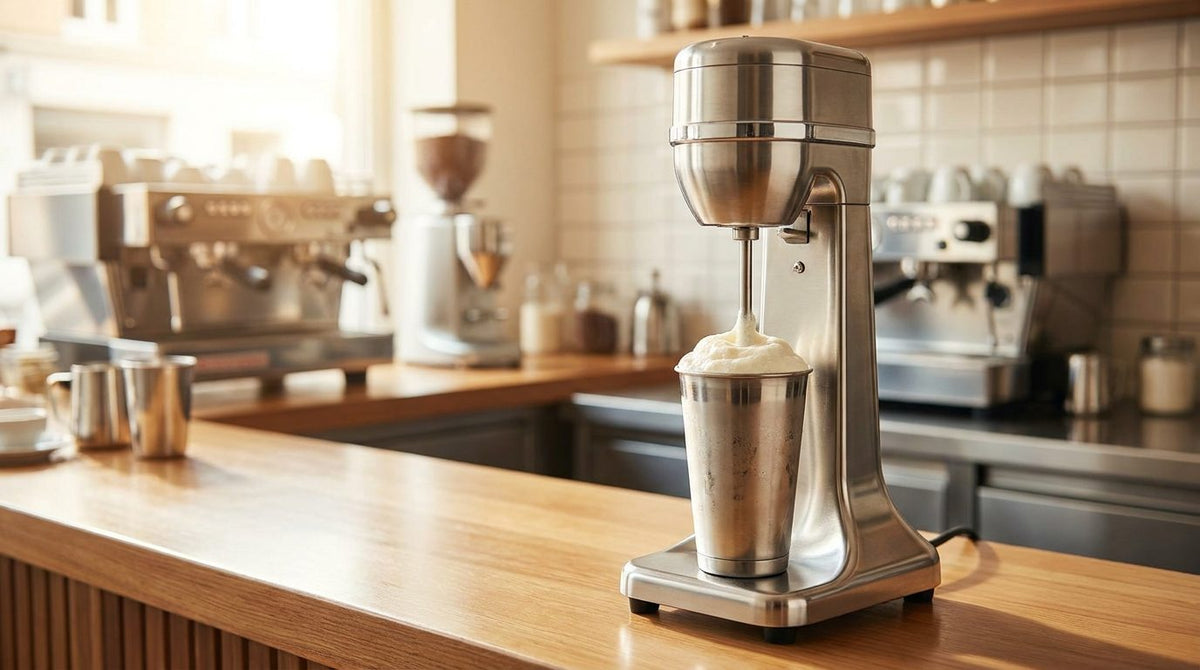
A milkshake machine for a shop is a spindle mixer: a fixed motor with a slim agitator that spins inside a stainless cup, aerating ice cream and milk into a smooth shake without shredding it the way a blender blade does. The choice comes down to three questions — how many shakes you sell in your busiest hour, whether your shakes are ice-cream-based or milk-and-syrup-based, and how many flavours you need running at the same time.
Spindle mixer, blender or soft-serve: three different drinks
These three routes produce genuinely different products, and choosing between them is the real decision.
A spindle mixer whips air into hardened ice cream and milk. The agitator is a small disc on a shaft; it lifts and folds rather than cuts. The result is the thick, aerated, spoon-resistant shake that most customers picture when they order one. Because the cup sits on a spindle and the operator's hands are free, one person can start a shake and go on making coffee while it runs.
A blender cuts. It handles ice, frozen fruit, biscuit, chocolate bars and syrups, and it produces a smoother, thinner, more homogeneous drink. That is the right machine for smoothies, frappes, fruit shakes and anything with solid inclusions — but a blender-made ice cream shake is generally thinner and warmer than a spindle-made one, because blade friction adds heat.
A soft-serve machine dispenses ice cream at serving temperature straight into the cup. Some shops build shakes from soft serve because it needs no tempering and mixes almost instantly, but the machine is a much larger commitment and is only worth it if you sell cones and sundaes too.
Comparison: which route suits which shop
| Route | Drink it makes best | Hands-free while running | Handles ice and solid inclusions | Best fit |
|---|---|---|---|---|
| Spindle milkshake mixer | Thick, aerated ice cream shakes | Yes | No | Dedicated shake counters, dessert shops, diners |
| Heavy-duty bar blender | Smoothies, frappes, fruit shakes, iced drinks | No | Yes | Cafés with a broad cold-drinks menu |
| Sound-enclosed blender | Same as above, front-of-house friendly | No | Yes | Small cafés where noise reaches seated guests |
| Soft-serve based shakes | Fast, consistent shakes from dispensed ice cream | Partly | No | Ice cream parlours already running soft serve |
| Hard ice cream plus spindle | Premium, dense shakes made to order | Yes | No | Gelato and premium dessert counters |
Trendy Zone Lanka's milkshake machine range is a focused one rather than a broad catalogue — it centres on the Industrial Milk Shake Machine as the commercial spindle option. If your menu is wider than shakes, plan the blender alongside it rather than instead of it.
Sizing: how many spindles do you actually need?
Shake orders arrive in clusters. Families order three at once; a group of four orders four. The relevant number is therefore not shakes per day but the largest simultaneous order you regularly take, plus the queue behind it.
A single-spindle machine makes one shake at a time. If your typical cluster is three shakes and each takes a minute or two on the spindle, the third customer waits several minutes on a machine constraint alone — and your barista is standing there instead of serving.
Practical guidance:
- Under about ten shakes an hour, one spindle is fine. The gaps between orders absorb the mixing time.
- Above that, or where group orders are common, you want either multiple spindles or a second machine. Two single-spindle machines have an advantage over one multi-spindle unit: you can run different flavours without cross-contamination, and you keep serving if one is down for cleaning.
- Count peak hour, not average. Milkshake demand is highly weather- and time-dependent, and the school-holiday afternoon peak is what decides whether the queue moves.
Flavour separation and the cleaning reality
The unglamorous part of shake service is washing. A spindle mixer leaves dairy residue on the agitator shaft and disc, and dairy at ambient temperature is unforgiving. Two operational rules make the difference:
- Rinse the agitator between drinks, wash it properly between flavour changes. Chocolate carried into a vanilla shake is a complaint, not a variation.
- Strip and wash the machine fully at the end of every trading day, including the splash areas around the spindle housing, where dairy dries into a film.
If you run more than two or three flavours through a busy service, the labour case for a second machine or a multi-spindle unit is often stronger than the throughput case.
Keeping a stock of clean, chilled stainless cups helps more than most operators expect. Cups coming straight from a chiller keep the shake colder through mixing, which means less melt and a thicker finished drink.
The supporting equipment a shake counter needs
A milkshake machine is one item on a cold-drinks station, and it rarely works alone.
- Ice cream storage and production. Thick shakes need properly hardened ice cream at a consistent temperature. If you make your own, the ice cream machines range covers both routes: the Gadali Industrial Hard Ice Cream Machine for hardened, scoopable product, and the Industrial Soft Ice Cream Machine (3 nozzle) if your shakes are built from soft serve alongside a cone menu.
- A blender for everything that is not a classic shake. Fruit shakes, frappes and smoothies need blades. The Sokany 5000W High Power Blender is a high-power option for a busy counter, while the Industrial Topmix Noise proof Blender addresses the noise problem in a small seated café. The commercial blender range covers both ends, and the commercial blender buying guide explains duty cycle and jug sizing in more detail.
- Ice supply. Blended cold drinks consume far more ice than most new shops budget for. The ice cube machine buying guide sets out how to size daily output against a cold-drinks menu.
How to choose: a milkshake machine checklist
- [ ] Define your shake style: thick ice-cream shake (spindle) or blended fruit shake (blender). If both, budget for both machines.
- [ ] Count your largest common simultaneous order — that number, not the daily total, sets your spindle count.
- [ ] Estimate peak-hour shakes on your busiest day of the week, in your busiest month.
- [ ] Decide how many flavours run concurrently, and how you will avoid carry-over between them.
- [ ] Check the counter footprint and height clearance — spindle machines need vertical space above the cup position.
- [ ] Confirm you have chilled cup storage near the machine.
- [ ] Assess noise relative to your seating layout.
- [ ] Plan the daily strip-down: who does it, how long it takes, and where parts dry.
- [ ] Confirm your ice cream holding temperature is consistent — inconsistent hardness is the most common cause of inconsistent shakes.
Frequently asked questions
What machine is used to make milkshakes in a shop? Most shops use a spindle milkshake mixer: a fixed motor with a slim agitator that spins inside a stainless cup, aerating ice cream and milk into a thick shake. Cafés with broader cold-drinks menus often run a heavy-duty blender instead or as well, because blenders handle ice, fruit and solid inclusions that a spindle cannot.
Can I use a blender instead of a milkshake machine? You can, and many cafés do. A blender is more versatile — it makes smoothies, frappes and fruit shakes as well. What it does not reproduce well is the thick, aerated texture of a classic ice cream shake, because the blades cut rather than fold and blade friction warms the mix.
How many milkshakes can one spindle make at a time? One. That is the key limitation. If you regularly take orders of three or four shakes at once, a single-spindle machine leaves the last customer waiting on the machine rather than on your staff. Multiple spindles or a second machine solves it and also lets you separate flavours.
Do I need a separate machine for different flavours? Not necessarily, but you do need a cleaning routine. Rinse the agitator between drinks and wash it fully between flavour changes, since carried-over chocolate in a vanilla shake reads as a mistake. Shops running many flavours at speed often find a second machine cheaper in labour than constant washing.
What ice cream works best in a milkshake machine? Hardened, scoopable ice cream at a consistent freezer temperature. Product that is too soft gives a thin shake; product that is too hard strains the spindle and mixes unevenly. Consistency of holding temperature matters more than the specific recipe — most shake inconsistency traces back to the freezer, not the machine.
Where to start
Decide whether you are selling thick ice cream shakes or blended cold drinks — that answer determines your machine before anything else does. If it is the former, start with the commercial milkshake machine option at Trendy Zone Lanka and plan your ice cream holding around it. If your menu is broader, look at the blender range in parallel, and size your ice supply before opening rather than after the first hot week.
Share:
Types of juicers explained: centrifugal, masticating and commercial extractors
What is a salamander grill, and what is it used for?