
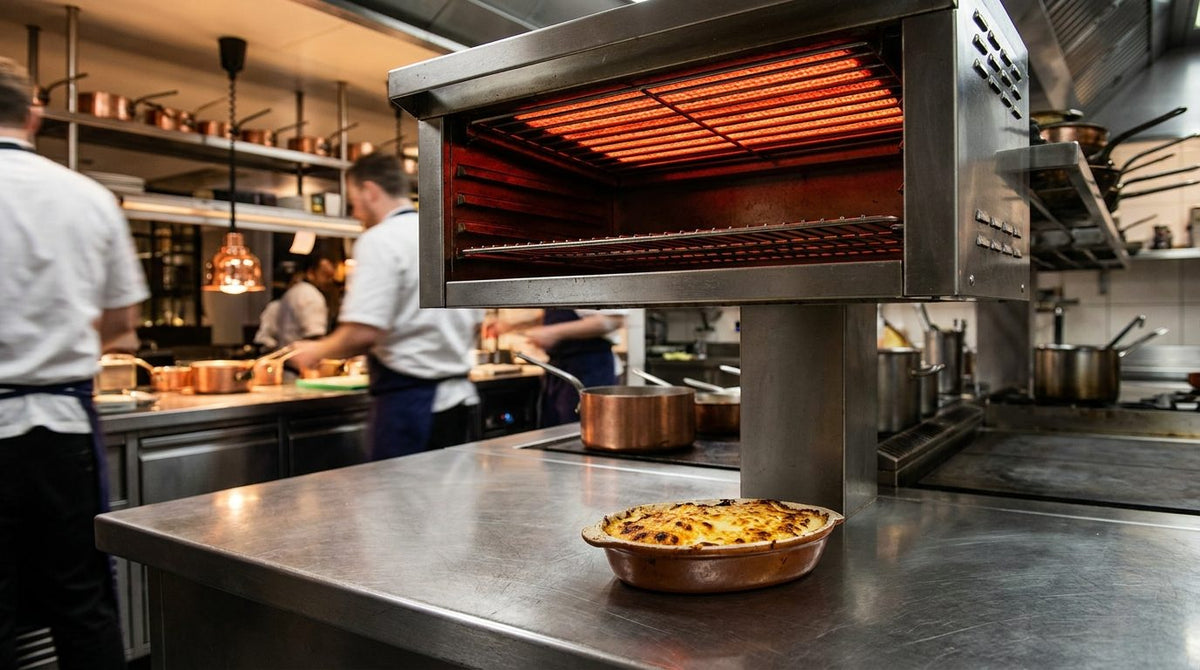
A salamander grill is a commercial overhead grill: the heat source sits above the food, radiating downwards onto a shelf or tray. It is used for finishing rather than cooking through — melting and browning cheese, glazing and gratinating, colouring the top of a dish, toasting bread at volume, and holding plated food briefly before it leaves the pass. Because the heat comes from above and reaches working temperature quickly, a salamander does in thirty seconds what an oven would take several minutes to do.
How a salamander differs from the grills next to it
Kitchens often own three or four things that all get called "the grill". They are not interchangeable.
| Equipment | Heat direction | Primary job | What it is not good at |
|---|---|---|---|
| Salamander grill | From above | Browning, glazing, melting, finishing, toasting | Cooking raw protein through from cold |
| Griddle plate | From below, through a solid plate | Searing, eggs, kottu, continuous flat-top cooking | Browning the top surface of a dish |
| Panini grill | From above and below, contact plates | Pressed sandwiches, contact marking | Anything in a tray or gratin dish |
| Chargrill or char-broiler | From below, open flame or elements | Bar-marked meat, direct grilling | Delicate gratins and cheese work |
| Conveyor toaster | From above and below, timed belt | High-volume identical toast | Anything that is not a flat, repeatable item |
| Oven | Enclosed, all around | Baking and roasting through | Fast surface colour on a finished plate |
The distinction that matters operationally: a griddle cooks the side touching it, a salamander colours the side facing up. Almost every kitchen that adds a salamander does so because a dish leaves the pass looking pale, not because it leaves undercooked.
What kitchens actually use a salamander for
- Melting and browning cheese — gratins, lasagne portions, cheese toast, baked pasta, chicken and cheese dishes finished to order.
- Glazing and gratinating — a breadcrumb or cheese crust on fish, vegetables or a bake, developed in seconds without further cooking the interior.
- Finishing grilled meat — bringing colour to a steak or chop surface after it has cooked, or reheating the surface of a rested piece before plating.
- Toasting at volume — many hotel breakfast lines run toast and open sandwiches under a salamander or, where the item is identical every time, through a conveyor toaster.
- Short-term holding — holding plated components warm at the pass for the minute or two before service, at low setting.
That last use is often the deciding one in a hotel kitchen: a salamander over the pass turns a single-plate handover into a section that can build several covers at once.
Gas or electric?
Both are common, and neither is universally better.
Electric salamanders heat elements directly. They typically reach usable heat quickly, offer finer control at low settings, and can be zoned so that half the width runs hot while the other half holds. They need a suitable electrical supply at the intended position, which is the constraint most kitchens hit. Trendy Zone Lanka's electric options include the Industrial Electric Salamander Double for narrower stations and the Industrial Electric Salamander Triple where a wider working area is needed.
Gas salamanders use overhead burners. They suit kitchens already piped for gas, and where the surrounding cook line is gas anyway there is a simplicity argument for keeping the whole line on one fuel. Burner count is the practical sizing figure: the Industrial Gas Salamander 04 Burners covers a standard station, while the Industrial Gas Salamander 06 Burner gives a wider heated area for a busier pass.
The honest way to choose is to start from what your kitchen already has. If gas is piped to the cook line and your electrical board is close to its limit, gas is the lower-friction choice. If your section is electric and the salamander will be used for delicate glazing work where low-setting control matters, electric usually wins.
Fixed, lift-type or hanging: the mounting decision
This is the choice most buyers overlook, and it affects daily use more than fuel does.
Fixed shelf units have a grill shelf that slides in and out at set positions. Simple, robust, and adequate when your items are of similar height.
Lift-type salamanders let you raise or lower the heat body relative to the food. That matters when you work with items of very different heights — a flat cheese toast and a deep gratin dish need different distances from the element to colour without burning. The Industrial Electric Lift Type Salamander is designed around this adjustment.
Hanging or wall-mounted units free the counter entirely. In a tight kitchen, a Commercial Stainless steel Electric Hanging Salamander recovers the bench space a bench-top unit would occupy, and puts the grill at the pass where the food is plated. The trade-off is that the wall must take the mounting and the position is permanent.
If your kitchen produces a large volume of one identical toasted item, a conveyor toaster is a more efficient answer than a salamander — the belt gives identical results without an operator standing over it, and it frees the salamander for finishing work.
Placement, heat and extraction
A salamander radiates heat downwards and forwards, into the space where a chef stands. Three placement rules follow:
- Put it where it is used, not where it fits. A salamander at the far end of the kitchen from the pass will not get used for finishing; the food will go out pale anyway.
- Keep clearance above and around it. Radiant heat needs somewhere to go, and adjacent surfaces and stored items should not be in its path.
- Bring it under the extraction canopy. It is a radiant heat and grease-generating appliance. Kitchens that mount a salamander outside the canopy line usually regret it within a month.
Cleaning follows the same physics. Fat drips downwards from food and upwards spatter reaches the element or burner area. A daily routine of removing and washing the tray and shelf, and wiping down the reflective surfaces once cool, keeps performance consistent — a salamander with a build-up of carbonised fat loses radiant efficiency and starts to smoke on start-up.
How to choose: a salamander selection checklist
- [ ] Define the job: finishing and glazing, high-volume toasting, or pass holding. If it is only identical toast, consider a conveyor toaster instead.
- [ ] Count the plates or trays you need under it at once at peak — this sets the width, not the fuel type.
- [ ] Check your available fuel at the intended position: piped gas, or spare electrical capacity.
- [ ] Decide whether you need height adjustment. Mixed item heights point to a lift-type unit.
- [ ] Choose bench-top or wall-mounted based on how much counter space you can afford to lose.
- [ ] Confirm the unit sits under the extraction canopy in your layout drawing, not beside it.
- [ ] Measure clearance above and behind the intended position.
- [ ] Check how the tray and shelf come out for washing — daily cleaning ease is the difference between a grill that stays efficient and one that does not.
- [ ] Plan the pass workflow: who stands where, and whether the salamander blocks a movement line when the shelf is pulled out.
Frequently asked questions
What is a salamander grill used for in a commercial kitchen? It is used for finishing rather than cooking through. Typical jobs are melting and browning cheese, glazing and gratinating, adding colour to the top of a plated dish, toasting bread at volume, and briefly holding plated food warm at the pass. The heat comes from above, so it works on the surface facing up.
What is the difference between a salamander and a grill? A salamander is a specific type of grill with the heat source above the food and an adjustable or fixed shelf beneath it. A chargrill or char-broiler heats from below, which is what most people mean by "grill". Because a salamander heats downwards, it browns the top surface without turning the food.
Is a salamander grill the same as a broiler? Broadly yes — "broiler" is the American term for the same overhead radiant heating principle, and salamander is the term more common in British and Commonwealth kitchens. Both describe a unit that applies intense heat from above for browning and finishing rather than cooking through from raw.
Should I buy a gas or electric salamander? Start from your existing services. If your cook line is already piped for gas, a gas salamander keeps the line consistent. If you are on electric and need fine control at low settings for delicate glazing, an electric unit is easier to work with. Neither fuel is inherently better for the cooking result.
Do I need a salamander if I already have an oven and a griddle? If food is leaving your pass pale on top, yes. An oven cannot add surface colour in seconds without over-cooking the interior, and a griddle only heats the side touching the plate. The salamander fills the specific gap of fast top-surface browning on food that is already cooked.
Does a salamander grill need extraction? Treat it as a cooking appliance that produces radiant heat and grease-laden vapour, and plan it under the kitchen canopy alongside the rest of the cook line. Placing it outside the extraction run pushes heat and smoke into the working area.
Where to start
Work out first whether you need finishing capability, toasting volume, or both — that decides the machine type before fuel or size. Then compare widths, mounting styles and fuels across the commercial salamander grills at Trendy Zone Lanka, and check how the unit sits with the rest of the cook line, including the panini grills and griddle plates and commercial burners. If you are planning a full build, the commercial kitchen equipment guide for Sri Lanka and the hotel equipment guide cover how the pass section fits into the whole kitchen.
Share:
Choosing a milkshake machine for a shop or café
Panini Press vs Griddle Plate: Choosing the Right Cooking Surface