
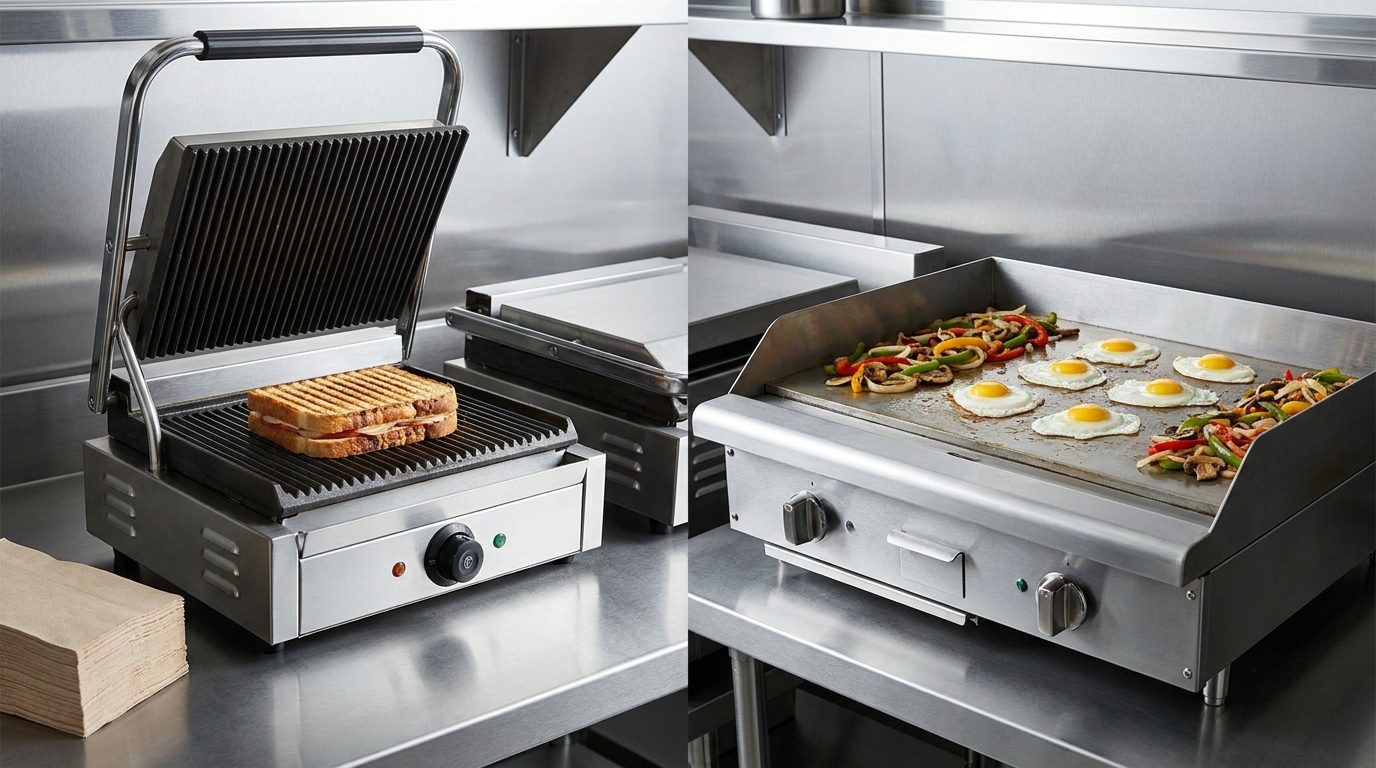
A panini press cooks from both sides at once between two hinged plates, so a filled sandwich heats through and marks in one closed cycle without being turned. A griddle plate is a single open heated surface you cook on from above, which lets you hold many items at different stages at the same time. If your menu is built on pressed sandwiches and wraps, you want a press; if it is built on eggs, burgers, kottu, onions, bacon and anything that needs turning or holding, you want a griddle.
Most working kitchens end up owning both, because they solve different problems. The question is which one carries your service, and which one is the support act.
How a panini press works
The press is a contact appliance. Two plates, both heated, close on the product. Cooking time drops because heat enters from above and below simultaneously, and the weight of the top plate flattens the sandwich so the interior conducts heat instead of trapping air. That is why a pressed sandwich reheats a cold filling reliably while a griddle-toasted one often does not.
The consequences for service are practical:
- Output is per-cycle, not per-square-metre. A press is busy or free; there is no in-between.
- Cooking is largely hands-off once closed, which suits a single-operator counter.
- The closed plate is a covered environment, so cheese melt and internal temperature are far more consistent than open cooking.
- Cleaning is a scrape-and-wipe of two surfaces plus a grease channel, done between rushes.
A single unit like the Industrial Panini Grill 425mm covers a cafe running sandwiches as a side line to coffee. Once pressed items become a named menu section and orders arrive in twos and threes, a twin-plate unit such as the Industrial Panini Grill Double removes the queue, because you can load the second plate while the first is closed.
How a griddle plate works
A griddle is a thick heated steel or chrome plate over gas burners or electric elements, open on top. Its value is surface area and zoning. You can run one end hot for searing and the other cooler for holding, work several items at different stages, and press, flip, chop or scrape as the dish needs. Kottu, fried rice, egg hoppers-adjacent breakfast items, burger patties, sausages, onions and stir-cooked toppings all belong here.
Griddles are one-sided, so everything is turned at least once, and the operator is present throughout. In exchange you get parallel cooking that no press can match. The plate also stores heat: a heavy plate recovers temperature quickly when cold product lands on it, which is the single most important quality during a rush.
Trendy Zone's griddles are described by plate width, which is the number that matters when you plan your line. A Industrial Gas Griddle 550MM (Full Flat) suits a small counter or a breakfast station. The Industrial Gas Griddle 790MM (full Flat) gives room for two operators' worth of product or one operator handling several dishes at once. For a dedicated station, a 1200mm plate such as the stand-mounted Industrial Gas Griddle with Stand - 1200mm (Half Grooved) becomes the centre of the hot line rather than an accessory to it.
Panini press vs griddle plate compared
| Factor | Panini press | Griddle plate |
|---|---|---|
| Heat contact | Both sides, plates closed | One side, open surface |
| Best for | Pressed sandwiches, wraps, toasties, paninis | Eggs, burgers, kottu, fried rice, onions, bacon, seafood |
| Operator attention | Load, close, walk away | Continuous presence and turning |
| Throughput model | Per cycle, limited by plate count | Per square metre of surface |
| Product consistency | Very high, closed environment | Depends on operator skill and zoning |
| Menu flexibility | Narrow, sandwich-focused | Wide, most short-order items |
| Footprint | Compact bench appliance | Bench or stand, needs real line space |
| Multi-stage cooking | Not possible | Standard practice with heat zoning |
Read the table as a menu question rather than an equipment question. Count the items on your menu that must be pressed and the items that must be turned. Whichever list is longer decides which machine you buy first.
Flat, half-grooved and full-grooved surfaces
Griddle plates come in three surface patterns, and this choice is harder to reverse than size because it is fixed in the plate.
Full flat is the general-purpose choice. Maximum usable contact, easy scraping, and the only sensible surface for eggs, rice, chopped roti and anything liquid or fine. If you are buying one griddle for a mixed menu, buy flat.
Full grooved produces the raised sear lines associated with steaks, chops and chicken fillets, and lets fat drain away from the product. It is poor at eggs and impossible for rice or kottu.
Half grooved splits the plate: flat on one side, grooved on the other. Options such as the Industrial Gas Griddle 730MM (Half Grooved) suit kitchens that want sear marks on protein without giving up a flat working area. The trade-off is that you have roughly half the plate for each job, so a half-grooved 550mm plate is effectively two small stations.
Where a griddle is a secondary station supporting fried items, a combined fryer-and-griddle unit puts a fryer tank and a flat plate on one footprint, which is often the right answer for a small kitchen where line metres cost more than equipment.
Where BBQ grills fit, and where they do not
BBQ grills are a separate category with a separate job, and they are frequently confused with griddles because both are called "grills" in everyday speech. A BBQ grill cooks over open bars or radiant heat with the product exposed, producing smoke contact and char - it is built for outdoor service, buffet stations, poolside and event catering. It is not a substitute for a flat plate, and it will not cook eggs, rice or a pressed sandwich.
If open-flame char is what you actually want, look at BBQ grills as a distinct purchase. If you want a controlled indoor cooking surface for daily short-order production, stay with panini grills and griddle plates. Similarly, if your real need is finishing and top-browning - melting cheese on an open sandwich, glazing, reheating a plated dish - that is a salamander grill, not a press.
How to choose: decision checklist
Work through these in order before you commit to a purchase.
- List your pressed items. Fewer than five sandwich lines and low volume: a single-plate press is enough. A named toastie or panini section: go double-plate.
- List your turned items. If eggs, burgers, kottu or fried rice appear, a griddle is not optional regardless of what press you buy.
- Measure the line, not the appliance. Add clearance for the operator's turning arm and for landing plates on both sides. A 1200mm plate needs more than 1200mm of bench.
- Choose the surface pattern by your widest-selling item, not by the item you find most impressive.
- Decide gas or electric by the utility you already have. Gas plates suit kitchens with an existing LPG line and extraction; electric suits front-of-house counters and small cafes with no gas run.
- Decide bench-top or stand. A stand-mounted griddle frees bench space and gives under-storage, but fixes the station's position.
- Plan extraction and cleaning access. Open griddles produce grease-laden vapour; the plate must be scraped hot and the grease tray emptied daily.
- Confirm peak-hour throughput. Count the items that must leave the pass in your busiest 15 minutes and check that one plate cycle or one plate area can carry it.
Frequently asked questions
Can I use a panini press as a griddle?
Only for small quantities. With the top plate lifted, a press becomes a very small single-sided cooking surface - usable for a couple of eggs or a burger patty, but the plate area is a fraction of a griddle's and there is no room to hold or stage items. It is a stopgap, not a station.
Is a grooved plate better than a flat plate?
Neither is better; they do different jobs. Grooved plates mark and drain fat from thick protein cuts. Flat plates give full contact and handle liquid, fine and chopped products. Kitchens with a mixed menu almost always get more use from flat, which is why half-grooved plates exist as a compromise.
What size griddle do I need for a cafe?
Size by simultaneous items at peak, not by covers per day. A breakfast counter cooking eggs and toast for a handful of orders at a time works on a 550mm plate. A kitchen running burgers, onions and a second dish together needs 730mm or more. A dedicated hot station handling multiple cooks needs 1200mm.
Do I need a griddle if I already have a BBQ grill?
Yes, if you cook anything that a bar grate cannot hold. BBQ grills serve outdoor and event cooking with open flame; griddles serve daily indoor short-order production. They are complementary, not interchangeable, and most operations that run both use them in different service periods.
Gas or electric for a griddle plate?
Gas gives fast recovery and independence from power supply issues, but needs an LPG connection and proper extraction. Electric is simpler to install, cleaner in a customer-facing position, and easier to control precisely. Choose based on your site's existing services and where the machine will physically sit.
Where to start
Match the appliance to the item you sell most. If that item is a pressed sandwich, buy the press first and add a plate later; if it is anything turned, chopped or held, the plate comes first. Both live in the panini grills and griddle plates range, and if you are specifying a full hot line rather than a single appliance, the commercial kitchen equipment guide and the commercial fryer buying guide cover the stations either side of it.
Share:
What is a salamander grill, and what is it used for?
Waffle Business Guide: Bubble, Belgian, Cone and Stick Machines