
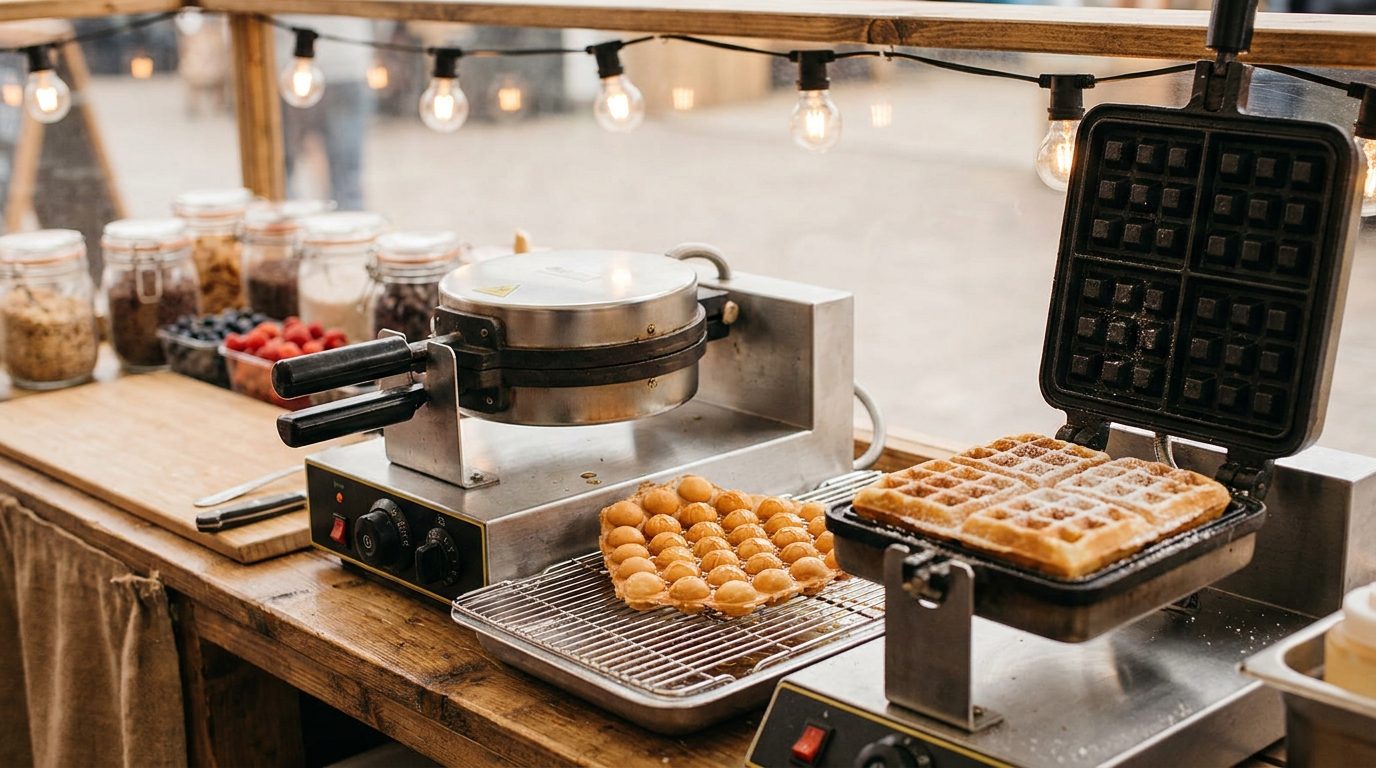
A bubble waffle machine business works because one inexpensive batter, one machine and one operator can produce a high-margin dessert that customers watch being made. The equipment decision comes down to format: bubble (egg) waffles for hand-held street dessert, Belgian and square irons for plated cafe service, cone irons for ice cream sales, and stick or novelty irons for events and kiosks. Each format sets your menu, your price positioning and your serving speed before you sell anything.
This guide covers what each machine type actually produces, how plate count controls your queue, and how to match a format to the site you are trading from.
Why waffles suit small food businesses
Waffle formats have three commercial properties that matter more than the recipe. Ingredient cost per portion is low and stable, since flour, egg, sugar and milk are the bulk of it. The product is made to order in a few minutes, so there is no waste from unsold stock at close. And the machine is theatre - a bubble waffle lifting off the plate holds attention in a way a pre-made cabinet item does not.
The constraints are equally clear. Waffles are batch-cooked with a fixed cycle, so your maximum sales per hour are set by plate count and cook time, not by demand. Batter needs rest time and cold holding. And each format needs its own plate; you cannot make a Belgian waffle in a bubble plate.
Bubble and egg waffle machines
The bubble waffle - Hong Kong egg waffle - is a sheet of connected spheres cooked in a hinged, rotating plate. It is served flat, folded, or rolled into a cone and filled with ice cream, fruit and sauce. This is the format driving most new dessert counters, because the filled cone version sells at dessert prices while costing little more than the plain sheet.
Single-plate units are the entry point for testing the format at a kiosk or as an add-on to an existing cafe. When bubble waffles become the reason people visit, a dual-plate machine like the Industrial Non-Stick Electric Dual Bubble Waffle Maker doubles output on the same counter length and lets one operator stagger two cycles - pour the second plate while the first cooks. If your plan is specifically the filled cone, the Industrial Non-Stick Single Bubble Waffle Cone Maker forms the shape directly.
Non-stick plates matter more here than in any other format, because the bubble geometry has deep pockets and a sticking sheet tears on release, which costs you both the portion and the next two minutes of cleaning.
Belgian, square and round waffle irons
Square and round irons produce the plated waffle: thicker, crisp outside, served with syrup, fruit, cream or savoury toppings. This is cafe and hotel breakfast territory rather than street dessert, and it commands a plate price with a knife and fork.
The practical decision is single versus double plate. A single square iron is right for a cafe adding waffles to an existing menu, where two or three orders arrive in a sitting. The Industrial Double Square Waffle Maker is the buffet and brunch answer, where several waffles must land together and a single plate would leave half the table waiting.
Rotary irons - such as the Industrial Rotary Waffle Maker - Double - flip the plate assembly after pouring so batter spreads evenly across the whole cavity before it sets. That is why hotel breakfast lines favour them: the result is a fully formed, evenly risen waffle without an operator judging the pour. Heart-shaped and round novelty irons serve seasonal and event trade where presentation is the selling point.
Cone and stick formats
Cone irons press and roll a thin batter into an edible cone, which turns a waffle machine into an ice cream margin engine: you stop buying bought-in cones and start selling a freshly made one. An Industrial Electric Double Ice Cone Waffle Maker pairs naturally with a scooping or soft-serve counter, and links your dessert offer to the ice cream machines range rather than standing alone.
Stick and hand-held formats - the Tree-Lolli Industrial Stick Waffle Maker and cone-dog style irons - are built for walking trade: events, night markets, mall kiosks and school-run locations. The product is eaten one-handed with no plate, no cutlery and no seating, which is exactly what a stall without a dining area needs.
Waffle machine formats compared
| Format | Product sold | Typical site | Service style | Plate consideration |
|---|---|---|---|---|
| Bubble / egg waffle | Sheet or filled cone dessert | Kiosk, dessert counter, mall | Made to order, watched | Deep pockets need true non-stick |
| Square / Belgian | Plated waffle with toppings | Cafe, hotel breakfast, restaurant | Table service or buffet | Single for add-on, double for volume |
| Rotary | Even, fully formed round waffle | Hotel buffet, high-volume brunch | Batch, repeatable | Rotation gives even spread |
| Ice cream cone | Fresh waffle cone | Ice cream counter, parlour | Paired with scooping | Needs rolling form and timing |
| Stick / novelty | Hand-held waffle on a stick | Event stall, night market, kiosk | Walking trade, no seating | Shape is the product |
| Crepe plate | Thin crepe, sweet or savoury | Dessert bar, cafe, catering | Made to order, open plate | Flat plate, different skill set |
Crepes belong in this conversation because they share the counter and the customer. A double gas crepe plate alongside a waffle iron gives a dessert counter two formats from one batter station and roughly one operator's attention, and both sit in the same waffle and crepe maker range.
Matching output to your queue
Output is arithmetic, not marketing. One plate produces one product per cook cycle plus the pour and release time. Two plates on the same machine roughly double that, because the operator's dead time on plate one becomes productive time on plate two. Three consecutive customers ordering from a single-plate machine will wait through three full cycles - which is where kiosks lose sales.
Plan for the peak, not the average. A mall kiosk sees its whole day in two or three short surges; a hotel breakfast sees one 90-minute wave. In both cases the correct question is how many waffles must leave the counter in the busiest 15 minutes, and whether your plate count and batter holding can supply it. Batter is the second constraint: mixed and rested in advance, held cold, and portioned with a consistent ladle or jug so every waffle uses the same volume.
How to choose a waffle machine for your business
- Decide the product first. Filled bubble cone, plated Belgian, fresh ice cream cone or stick novelty - each is a different customer and a different price point.
- Match the format to the site. No seating means hand-held formats. A hotel buffet means rotary or double square. A cafe adding a dessert line means a single plate to start.
- Count peak-quarter-hour demand and divide by your cycle time to see whether one plate is honestly enough.
- Check counter length and power position. Waffle irons are shallow but need clearance for the handle swing and a landing area for finished product.
- Confirm plate coating and release behaviour - non-stick performance decides both waste and cleaning time.
- Plan batter production and cold holding before you buy the iron. A machine that outruns your batter supply is wasted capacity.
- Think about the pairing. Cones need an ice cream counter; bubble waffles need toppings and sauces; Belgian waffles need a plate wash cycle.
- Allow for cleaning access. Plates are cleaned hot with a brush and cloth; anything with a rotating assembly needs the frame wiped as well as the plates.
Frequently asked questions
Is a bubble waffle business profitable in Sri Lanka?
The format has low ingredient cost per portion and a made-to-order dessert price, which is a favourable margin structure. Whether it is profitable in your case depends on footfall, site cost and how many portions you can actually produce at peak. Model the peak-hour output of your machine before you commit to a location.
What is the difference between a bubble waffle and a Belgian waffle?
A bubble waffle is a thin sheet of connected spheres, flexible enough to roll into a cone and eaten by hand. A Belgian or square waffle is thicker, denser and rigid, served on a plate with toppings. They use different batters, different plates and appeal to different service styles.
Do I need a double-plate waffle maker to start?
Not usually. A single plate is the correct way to test demand at a new site or as an added menu line. Move to a double when customers routinely wait through more than one cook cycle, since that queue is lost revenue rather than a comfort issue.
Can one machine make several waffle shapes?
Generally no. Waffle plates are fixed to the format - bubble, square, round, cone or stick - so the shape you buy is the shape you sell. Operators wanting two formats normally run two machines, which also protects output when one is being cleaned.
What else do I need besides the waffle iron?
A batter mixing and cold-holding setup, consistent portioning jugs, a topping station, and somewhere to land and finish the product. Dessert counters usually add ice cream or sauces; cafes usually already have the mixing capacity in place.
Where to start
Choose the format your site can serve, then size the plate count to your peak quarter-hour. The full waffle maker range covers bubble, square, rotary, cone and stick formats, and if this is part of a wider dessert or bakery build, the commercial bakery machines range and the bakery equipment setup guide cover the mixing and baking side that feeds it.
Share:
Panini Press vs Griddle Plate: Choosing the Right Cooking Surface
Popcorn Machine for Business: What to Look for Before You Buy