
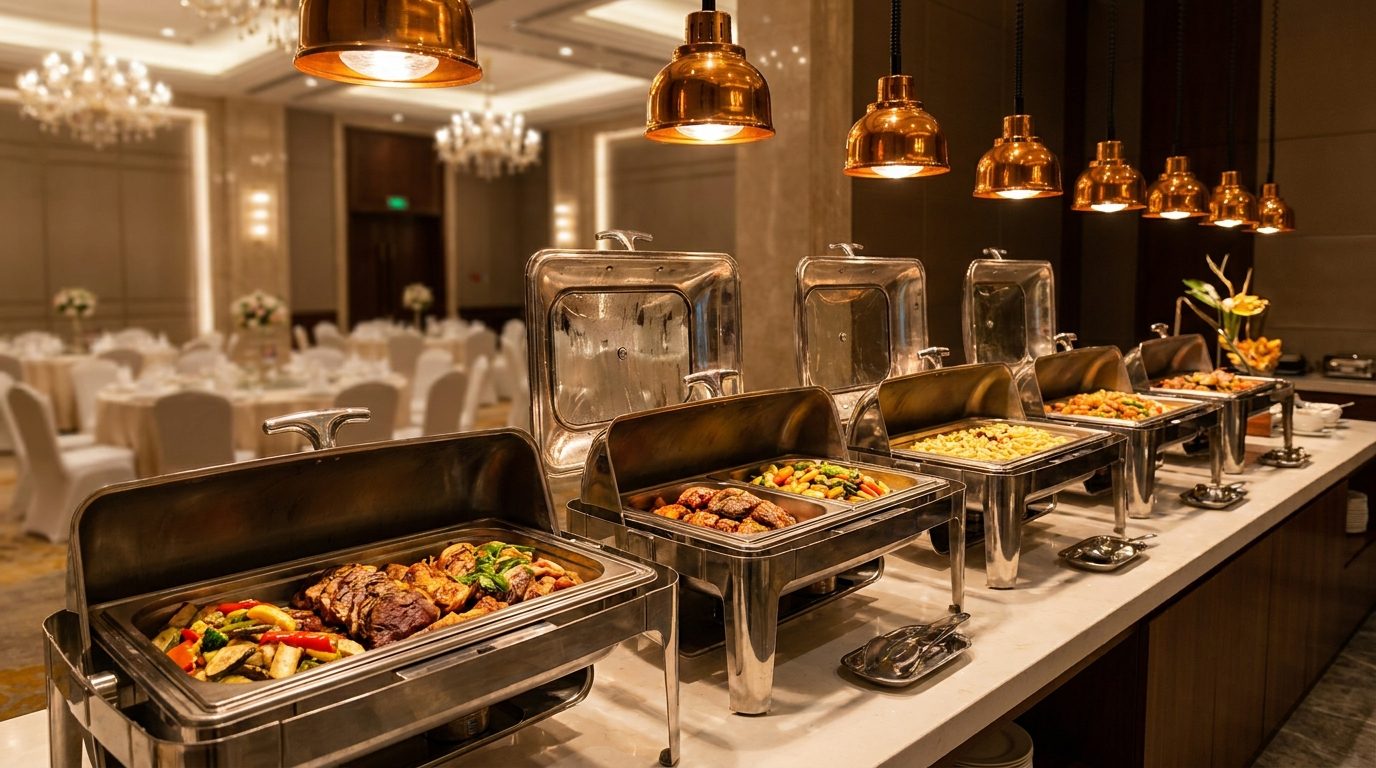
Gastronorm (GN) is an international dimensional standard for food pans, built on one base module — GN 1/1, measuring 530 × 325 mm — with every other size a defined fraction or multiple of it. Because the standard is dimensional rather than brand-specific, a GN pan, a chafing dish frame, a bain marie well and a GN trolley from different makers all interlock, which is exactly why buffet operations standardise on it. This guide gives the size chart, explains what pan depth actually changes, and shows how to build a buffet line around it.
If you take one thing from this article: choose the pan layout first, then choose the chafing dishes that accept it. Doing it in the other order is how kitchens end up decanting food between vessels on the way to the buffet.
The GN pan sizes chart
The standard defines each fraction against the GN 1/1 module. Nominal dimensions are listed below; individual pans vary slightly at the rim depending on flange design, which is normal and does not affect interchangeability within the standard.
| GN size | Nominal dimensions (mm) | Fraction of GN 1/1 | Typical buffet use |
|---|---|---|---|
| GN 2/1 | 650 × 530 | Double | Large bulk items on wide counters and back-of-house holding |
| GN 1/1 | 530 × 325 | Base module | Main courses, rice, curries — the default buffet pan |
| GN 2/3 | 354 × 325 | Two thirds | Secondary mains on a narrower counter |
| GN 1/2 | 325 × 265 | Half | Vegetables, sides, medium-volume items |
| GN 1/3 | 325 × 176 | One third | Sides, sauces, sambols, condiments |
| GN 1/4 | 265 × 162 | Quarter | Garnishes, small accompaniments |
| GN 1/6 | 176 × 162 | One sixth | Condiments, toppings, salad-bar components |
| GN 1/9 | 176 × 108 | One ninth | Small condiments and garnish inserts |
Standard depths run 20, 40, 65, 100, 150 and 200 mm across most sizes. Depth is the variable most people ignore, and it is the one that changes service quality most.
What pan depth actually changes
Depth determines three things at once: how much food you hold, how long the last portion sits, and how the food looks when the pan is half empty.
Deep pans (100 mm and above) hold volume but the base of the food sits under sustained heat for the whole service window. For items that tolerate long holding — rice, dhal, thick curries, braised meats — that is fine. For anything with a delicate texture, a deep pan means the bottom third is overcooked by the time it is served.
Shallow pans (65 mm and below) present better and turn over faster, but they need more frequent replenishment. The practical answer for a busy buffet is shallow pans with a disciplined replenishment cycle from the kitchen, rather than deep pans left to run down. That, in turn, means you need holding capacity behind the line — which is what a bain marie is for.
A useful rule when planning: match pan depth to the item's holding tolerance, not to the number of covers. Cover count should be handled by replenishment frequency and back-of-house holding, not by piling more food into a deeper pan.
Chafing dish types and what each is good at
A chafing dish is a frame, a water pan, a food pan and a heat source. The differences between formats come down to how the heat is supplied and how the lid behaves.
Fuel-heated chafers use a chafing-fuel burner under the water pan. They need no power at the table, which makes them the practical choice for outdoor functions, marquee events and venues where the buffet position changes. Frames such as the Chafing dish Without Heaters are specified where the operator already runs a fuel or induction heating system and only needs the vessel.
Electric chafers hold temperature far more steadily because the element is thermostatically controlled rather than dependent on a burning fuel. Units such as the Electric Chafing Dish (with heaters) suit fixed indoor buffet lines and long breakfast services where a fuel change mid-service is disruptive. Where staff need to see and set the holding temperature rather than judge it, an Electric Chafing Dish with Digital Display panel removes the guesswork.
Lid design is a real service decision, not a cosmetic one. A hinged roll-top opens with one hand and stays open, which speeds a queue. A window lid such as the Chafing Dish With Window lets guests see the dish without lifting anything, which reduces the number of times the chamber is opened and heat is lost — useful on a long breakfast line where the same pans sit for hours.
For small service points, a compartment buffet server such as the TODO 400W Buffet Server Electric 2L Serving Pot X3 Adjustable Thermostat covers three items in one footprint with a single thermostat — the right format for a boardroom lunch or a small function where a full chafer line would overwhelm the table.
Compare formats across the buffet and chafing dish sets range when you are matching frames to the pan layout you have decided on.
Building the buffet line: pan layout, holding and transport
A buffet line is three zones, and GN sizing runs through all of them.
The line itself. Plan each station in GN modules. A typical main-course station is one GN 1/1 per main plus GN 1/3 pans for accompaniments, with condiments in GN 1/6. Work out how many modules your counter takes before you buy chafers, because a counter that fits four GN 1/1 frames will not take five no matter how the food is arranged.
Back-of-house holding. Food waiting to go out needs to be at temperature in the same pans it will be served in. This is where bain marie units earn their place — a multi-pan wet-heat unit holds the next round of GN pans so replenishment is a pan swap rather than a re-cook. For fixed breakfast and all-day counters, heated food warmers and displays do the same job as a permanent installation rather than a portable one.
Transport. The pans have to get from kitchen to counter. A GN-format rack such as the GN Tray Trolley 15 Layers moves a full replenishment load in one trip, and because the rack is built to the same module, pans slide in without adapters. Browse the full service and tray trolley range if your function rooms are any distance from the kitchen.
How to choose: buffet setup checklist
- Count your counter length in GN modules, not in metres, before specifying any frames.
- Decide the pan layout per station — mains in GN 1/1, sides in GN 1/2 or 1/3, condiments in GN 1/6 — then buy frames that accept it.
- Choose depth by holding tolerance: deep for rice, dhal and braises; shallow for anything with texture to lose.
- Pick fuel-heated chafers if the buffet position moves or power is unreliable at the service point; pick electric if the line is fixed and the service window is long.
- Specify back-of-house holding capacity at roughly one replenishment round per station, so the line never runs down while food is being re-cooked.
- Add a GN-format trolley if the kitchen-to-function-room route is longer than a short carry.
- Standardise on one pan module across kitchen, holding and buffet so nothing is decanted in transit.
- Buy spare pans in the sizes you use most; pans are the consumable part of a buffet system, frames are not.
Frequently asked questions
What size is a GN 1/1 pan?
GN 1/1 measures 530 × 325 mm and is the base module of the Gastronorm standard. Every other GN size is a defined fraction or multiple of it, which is what allows pans, chafing dish frames, bain marie wells and GN trolleys to interchange across manufacturers.
What GN pan sizes should a buffet use?
Most buffet lines run GN 1/1 for main courses, GN 1/2 or GN 1/3 for vegetables and sides, and GN 1/6 for condiments and garnishes. Standardising on these four sizes keeps replenishment simple and lets one trolley carry a full service round.
Which is better for a buffet, an electric or fuel-heated chafing dish?
Electric chafers hold temperature more consistently and suit fixed indoor buffet lines with long service windows. Fuel-heated chafers need no power at the table, which makes them the practical option for outdoor functions, marquee events and any buffet whose position changes between events.
How deep should a buffet pan be?
Match depth to how well the item tolerates holding. Deep pans of 100 mm and above suit rice, dhal and braised dishes. Shallow pans of 65 mm and below present better and turn over faster, but they require a disciplined replenishment cycle from back-of-house holding.
Can chafing dish pans and bain marie pans be the same?
Yes, provided both are built to the Gastronorm standard. That is the main operational reason to standardise on GN — food is cooked, held in a bain marie, transported on a GN rack and served from a chafer in the same pan, with no decanting and no extra washing.
Setting up your buffet line
Decide the pan layout and depth first, then match frames and holding equipment to it. The buffet and chafing dish sets range covers fuel-heated, electric and window-lid formats for both fixed hotel lines and mobile catering, and pairs with the bain marie and trolley ranges linked above. For wider context on equipping a property's F&B operation, see the hotel equipment guide.
Share:
Hotel food and beverage equipment list, department by department
Bain marie vs food warmer: what the difference actually means for your food