
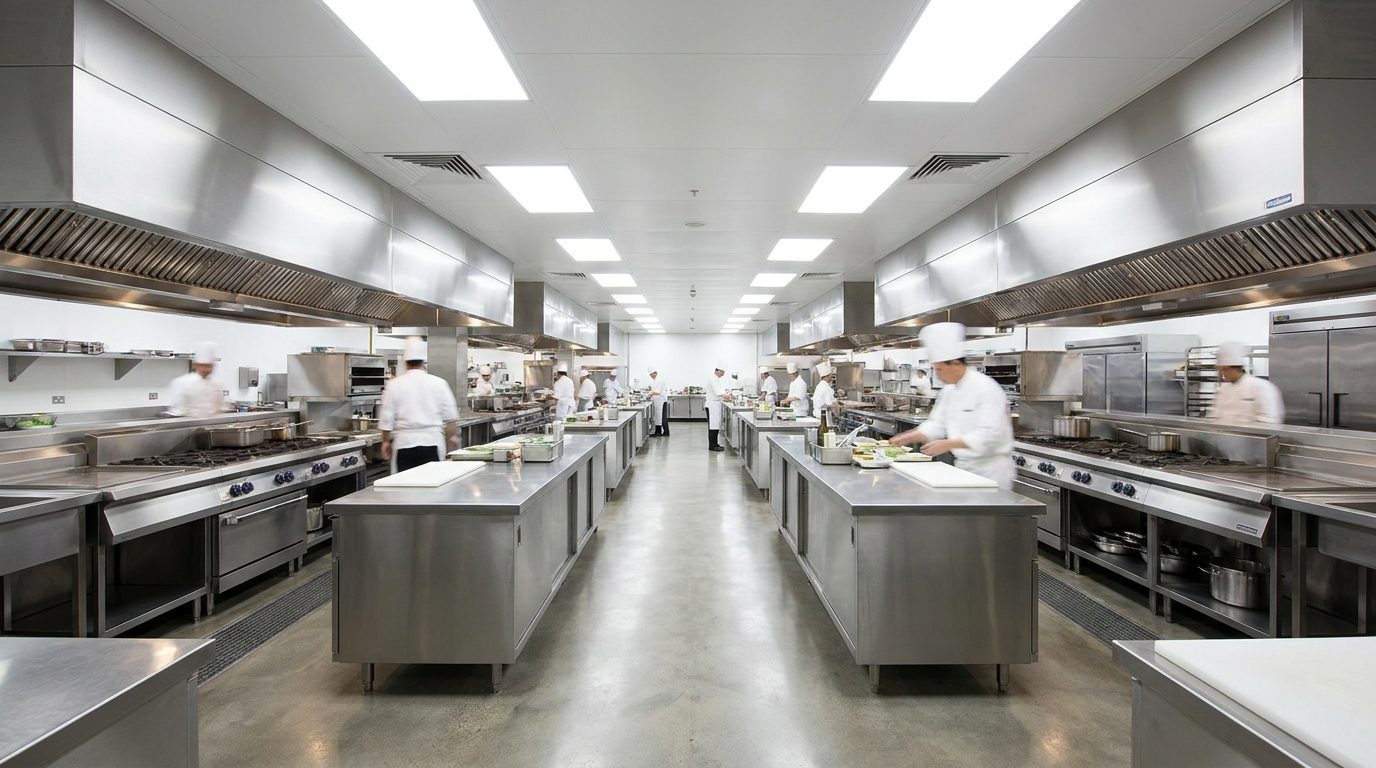
A hotel food and beverage equipment list is only useful when it is grouped the way the property actually operates: the production kitchen that cooks, the service outlets that sell, the banquet operation that scales up and down, and the back-of-house support that keeps both running. Buying department by department stops the two failures that cost hotels the most — duplicating capacity in two kitchens, and commissioning an outlet with no holding or transport equipment behind it. This guide walks through each department, what belongs in it, and what determines the size you should specify.
The list below is a planning framework, not a fixed shopping order. Sequence your purchase around the department that opens first and the one that carries your highest covers.
How to structure the list before you price anything
Start from three numbers you already know: total keys, restaurant covers at peak service, and the largest function you intend to accept. Everything downstream is derived from those. Room count drives breakfast volume and in-room beverage service. Restaurant covers drive cooking line capacity. Banquet ambition drives holding, transport and buffet equipment — which is usually where under-specified hotels get caught.
Then split the equipment into four departments. Every item should be assigned to exactly one of them and justified against that department's peak, not the hotel's average. Average demand never breaks a kitchen; simultaneous peaks do.
The companion overview at hotel equipment in Sri Lanka covers the general buying context; this article goes a level deeper into how the departments differ.
Department 1 — Main production kitchen
The production kitchen is the department with the longest lead time to change, so specify it generously in footprint and conservatively in count. It carries the cooking line, the primary ovens, bulk staple cookery and the heavy prep machinery.
The cooking line is built from burners and griddles. Multi-burner ranges are the backbone: a unit such as the Industrial 06 Burner Stove With Stand (Linkrich) gives a brigade six independent hobs on a single stand, which matters more than raw burner power when several sections are working the same service. Wok-style burners are specified separately where the property runs an Asian section, because wok cookery needs concentrated high heat rather than an even flame spread.
Oven capacity is planned in trays, not in ovens. A single-deck two-tray unit such as the Industrial Gas Oven 1 Deck 2 Tray suits a hotel that bakes and roasts in rotation; properties with a dedicated pastry section usually separate that load entirely so bread and savoury roasting are not competing for the same chamber.
Bulk staple cookery deserves its own line item. Rice and steamed items in a Sri Lankan hotel are volume production, not à la carte, and running them on the main line steals burners you need for orders. A tray-based steamer such as the Industrial Electric Rice Steamer 12 Trays moves that entire load off the cooking line.
Frying is the last major block. Cabinet-mounted fryers such as the Industrial Gas Fryer with Cabinet - 48L suit continuous banquet and outlet frying, where the constraint is oil volume and recovery between drops rather than the number of baskets.
Browse the full production range in the hotel kitchen equipment collection, and if you are scoping a kitchen from scratch, the commercial kitchen equipment guide covers layout and workflow decisions that should be settled before equipment is fixed in place.
Department 2 — F&B service and beverage outlets
Service departments are judged on speed and consistency, not output volume. The equipment list here is shorter but far more visible to the guest.
Coffee is the anchor. A lobby café, a restaurant and a banquet foyer have genuinely different requirements, and specifying one machine for all three is the most common outlet mistake. Group-head count and steam capacity should be matched to each outlet's peak, not to the hotel's total.
Hot water and juice service run in parallel. Bulk water boilers cover tea service, breakfast and function foyers without tying up a barista. Chilled beverage service runs off juice dispensers, sized by the number of simultaneous service points rather than by total litres — two smaller dispensers on separate tables clear a queue faster than one large one.
Ice belongs to this department even though it is produced in the back. Specify it against the peak hour of the busiest bar or banquet service, and remember that ice demand in a Sri Lankan property is a year-round constant rather than a seasonal spike.
Department 3 — Banquet, buffet and outside catering
Banquet is where a hotel wins or loses margin, and it is almost entirely a holding-and-transport problem rather than a cooking problem. Food is produced in Department 1 and must arrive at the function in condition.
Three equipment families cover it. Chafing dishes and buffet servers hold and present food at the table — the buffet and chafing dish sets range covers both fuel-heated and electric formats. Wet holding in the kitchen, before food goes out, is handled by bain marie units, which keep multiple pans at service temperature over a long banquet window. Fixed service counters use food warmers and heated displays, which suit permanent breakfast and buffet lines better than portable chafers.
Transport is the fourth, and it is the one most often left out of the budget. Tray and serving trolleys are what actually move plated covers, GN pans and cleared crockery between kitchen, function room and wash-up. A banquet operation with no trolley plan runs on staff carrying trays, which caps how fast you can turn a room.
Department 4 — Back-of-house support and housekeeping-adjacent service
This department has no guest-facing glamour and is the first thing cut from a budget. It should not be.
Warewashing sets the ceiling on how many covers you can serve. Sinks, pot-wash stations and dish machines are specified against peak crockery return. A property that can cook 300 covers but only wash 150 will serve 150.
Cold storage sits alongside it. Under-counter and upright chillers and freezers should be split between line-side holding in the kitchen and bulk storage — one large store room chiller does not substitute for cold space at the section.
Housekeeping-adjacent F&B service is the last piece: in-room kettles, minibar-adjacent cooling and the small-appliance stock that supports guest rooms. These are specified per key, so build the quantity from room count and a replacement allowance rather than buying once and forgetting them.
Department comparison: what drives the sizing decision
| Department | Core equipment families | What determines the size | Common specification error |
|---|---|---|---|
| Production kitchen | Burner ranges, ovens, steamers, fryers, prep machinery | Peak simultaneous covers across all outlets | Sizing to average covers rather than peak overlap |
| F&B service and beverage | Coffee machines, water boilers, juice dispensers, ice | Service points and queue speed at peak hour | One shared machine specified for outlets with different peaks |
| Banquet and buffet | Chafing dishes, bain marie, heated displays, trolleys | Largest function accepted, plus distance from kitchen | Holding equipment bought, transport equipment forgotten |
| Back-of-house support | Sinks, dish machines, chillers, freezers | Peak crockery return and delivery/storage cycle | Warewashing capacity below cooking capacity |
How to choose: a departmental commissioning checklist
Work through this before committing to any department's list.
- Write down peak covers per outlet and the largest banquet you will accept. Every size decision references these two numbers.
- Assign each equipment item to exactly one department. If an item is being counted twice, one department is under-equipped.
- Check that Department 4 capacity matches Department 1 capacity. Cooking output above warewashing output is wasted spend.
- Confirm the banquet route: how far food travels from kitchen to function room, and on what. Specify trolleys before chafers if the route is long.
- Separate bulk staple cookery from the à la carte line so rice, steaming and stock production do not consume service burners.
- Match power and gas provision to the department's combined connected load, and confirm the utility layout before equipment positions are fixed.
- Standardise pan sizes across banquet, holding and transport so the same pan moves from kitchen to buffet without decanting.
- Plan replacement and spares for the high-cycle items — fryers, dish machines and coffee equipment fail from duty, not age.
Frequently asked questions
What equipment does a hotel food and beverage department need?
At minimum: a production kitchen with burner ranges, ovens and bulk staple cookery; service equipment for coffee, hot water and chilled beverages; banquet holding and transport equipment such as chafing dishes, bain marie units and trolleys; and back-of-house warewashing and refrigeration sized to match kitchen output.
How do I decide equipment capacity for a new hotel kitchen?
Size against peak simultaneous covers across all outlets, not the daily total. Add the largest banquet you intend to accept, because banquet production usually runs through the same kitchen at the same time as normal restaurant service.
Should banquet equipment be separate from the main kitchen?
The cooking usually is not separate, but the holding and transport equipment should be. Banquet food is produced on the main line and then held and moved, so chafing dishes, bain marie units and trolleys are dedicated banquet assets even when the kitchen is shared.
What is the difference between a bain marie and a chafing dish in hotel service?
A bain marie is back-of-house wet holding equipment that keeps multiple pans at service temperature in the kitchen. A chafing dish is front-of-house presentation equipment that holds a smaller quantity at the buffet table. Most banquet operations need both.
Which department should a hotel equip first?
Whichever opens first, but never at the expense of back-of-house support. A restaurant that opens without adequate warewashing and cold storage will hit a service ceiling within its first busy week.
Where to start
Pick the department that opens first, size it against its own peak, and check it against Department 4 before you commit. The hotel equipment range covers the production and service categories described above; the banquet-specific ranges are linked in the relevant sections.
Share:
How to Use a Commercial Meat Slicer Safely
GN pan sizes chart and how to set up a buffet line