
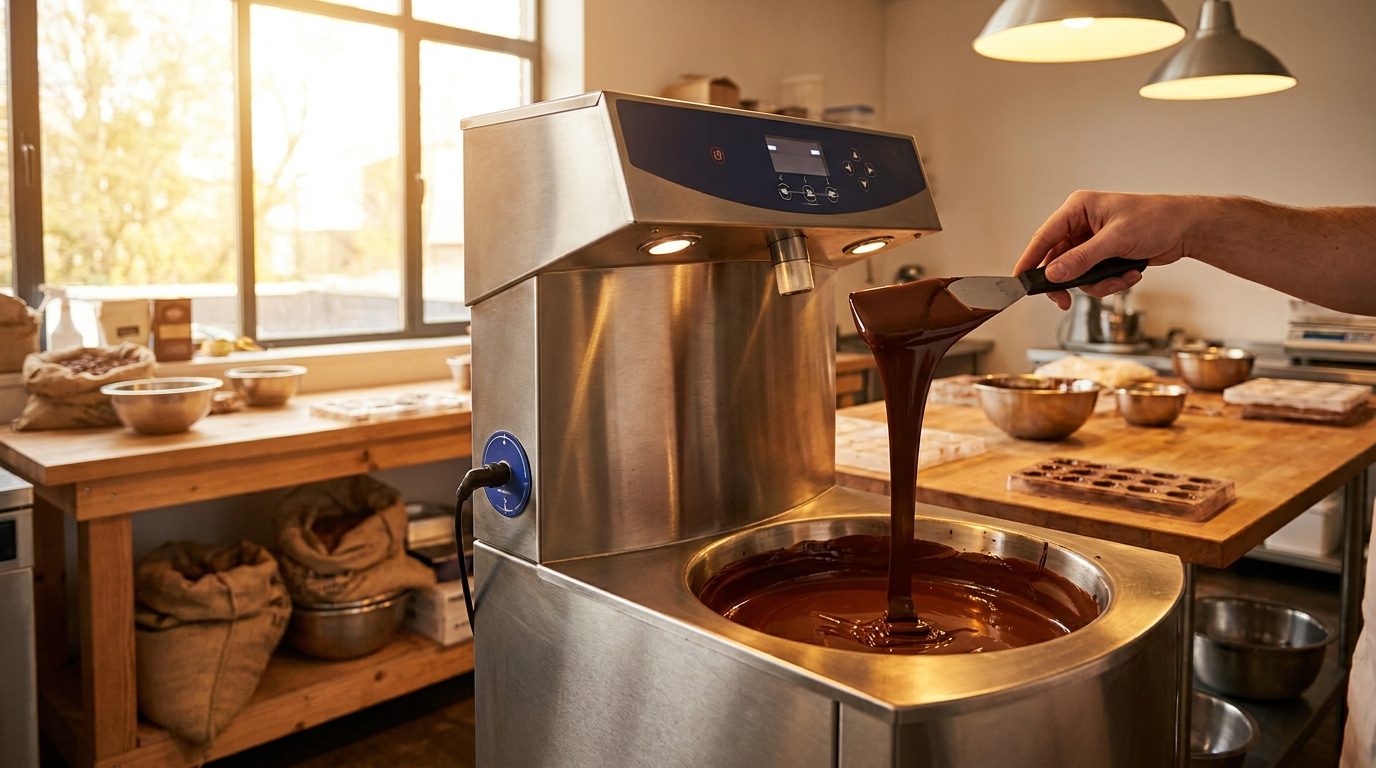
A chocolate melting machine holds chocolate liquid at a controlled, gentle temperature in a water-jacketed or indirectly heated pan, so it never scorches, seizes or thickens the way it does over direct heat. That controlled hold is what makes tempering repeatable, and tempering is what gives finished chocolate its snap, gloss and clean release from a mould. For any bakery or chocolatier working with real couverture, the machine is not a convenience - it is the difference between saleable product and dull, streaked chocolate.
This guide explains how tempering actually works, how melters, stoves and fountains differ, and how to size a machine to a working day rather than to a single recipe.
Why chocolate needs controlled heat
Chocolate is cocoa solids and sugar suspended in cocoa butter, a fat that can set into several different crystal forms. Only one of them produces the finished qualities you want: firm snap, shiny surface, contraction on cooling so the piece releases from its mould, and stability at room temperature.
Direct heat causes two failures. Overheating burns the milk solids and sugar and thickens the mass irreversibly. And even a trace of water - steam, a wet spatula, condensation off a lid - makes chocolate seize into a grainy paste that cannot be recovered for coating work. A purpose-built melter avoids both by heating gently and holding a stable temperature for hours rather than minutes.
Tempering in plain terms
Tempering is controlled crystallisation, and in general confectionery practice it follows three stages regardless of the equipment used.
- Melt fully. Bring the chocolate up until all existing crystal structure is gone. In standard confectionery practice this sits in the mid-to-high 40s Celsius for dark chocolate, and a few degrees lower for milk and white, which contain more milk solids and are more heat-sensitive.
- Cool to form crystals. Bring the temperature down - by seeding with unmelted chocolate, by tabling on a marble slab, or by controlled cooling - until stable crystals form, generally in the high 20s Celsius.
- Warm slightly and hold for working. Raise it a little to melt off the unstable crystals while keeping the stable ones, and hold there while you dip, mould or coat. Dark chocolate is usually worked in the low 30s Celsius, with milk and white a degree or two lower.
These are general ranges taught in confectionery work, not settings for any specific machine; always follow the temperature guidance for the couverture you are actually using, since recipes vary by cocoa butter content. What the equipment contributes is stability - holding the working temperature steady while you work through a batch, instead of drifting and forcing you to re-temper.
Melters, stoves, cookers and fountains compared
| Machine type | What it does | Best for | Watch out for |
|---|---|---|---|
| Chocolate melting machine (pan type) | Gently melts and holds chocolate at a set temperature | Dipping, moulding, enrobing, daily production | Sized by pan count - plan for parallel colours |
| Chocolate stove | Multi-pan heated base for melting and holding | Bakeries running several fillings, glazes or colours | Working temperature is managed by the operator |
| Chocolate cooker | Heating vessel for larger melting and cooking work | Ganache, fillings and volume melting | Not a display or service unit |
| Chocolate fountain | Circulates tempered chocolate over tiers | Events, buffets, hotel dessert stations | Needs correctly fluid chocolate to run cleanly |
The distinction that trips up new buyers is between a melter and a fountain. A melter is production equipment: it prepares chocolate you will turn into a product. A fountain is service equipment: it displays and dispenses chocolate a guest dips into. They are not substitutes for each other, and a fountain is not a practical way to prepare chocolate for moulding.
Sizing by pan count and workflow
Pan count, not litres, is the practical sizing unit for this category, because chocolate work is rarely one chocolate at a time.
A single-pan machine like the Industrial Chocolate Melting Machine - Single Pan suits a cafe or small bakery doing one job at a time - melting coating chocolate for a cake line, or holding one chocolate for dipping.
Two pans change the workflow completely. The Industrial Chocolate Melting Machine - Double Pans lets you hold dark and milk simultaneously, or hold one chocolate for dipping while a second pan carries a coloured or flavoured batch. The Industrial Chocolate Melting Machine - 02 Pans (High Quality) serves the same two-stream workflow for operations where the machine runs every day and build quality earns its place.
Three and four-pan stoves such as the Industrial Chocolate Stove 04 Pans are for producers running several streams at once: dark, milk, white and a coloured or compound line, or chocolate plus a warm glaze or caramel. Dedicated chocolate cookers sit alongside them in the chocolate melting machine range for the bulk melting stage that feeds those pans.
The rule of thumb is simple: count the distinct chocolates and coatings that must be liquid at the same moment on your busiest production day. That number is your minimum pan count. Buying below it means constant emptying, cleaning and re-melting between colours, which wastes both product and the working temper.
Chocolate fountains as service equipment
A fountain is a hospitality product, not a production one. It belongs on a buffet, at a wedding, in a hotel dessert station or at a mall promotion, where the visual of flowing chocolate is the offer.
Two things determine whether a fountain runs well. The chocolate must be fluid enough to sheet evenly down the tiers, which usually means a couverture with sufficient cocoa butter or a fountain-formulated chocolate rather than standard baking chocolate. And the tier size must suit the room: a Industrial Chocolate Fountain 400MM suits a cafe counter or a small function, while a Industrial Chocolate Fountain 600MM is a banquet-scale centrepiece with the visual presence a large room needs.
Position matters too. Fountains do not like draughts or air conditioning blowing across them, because a cooled curtain of chocolate thickens and breaks into an uneven flow.
A working day around the machine
For a bakery or chocolatier, the machine sets the rhythm of the day. Chocolate is loaded and brought to full melt first thing, because melting from solid is the slowest step and is best done while other prep runs. Tempering follows, and the pan then holds the working temperature, so dipping, moulding and enrobing run in blocks rather than being restarted each time.
Practical points that protect a batch:
- Keep every tool bone dry. A single drop of water seizes a pan.
- Cover pans when unattended to stop condensation dripping back in.
- Top up with solid chocolate in small amounts, not large cold additions that knock the temperature down.
- Keep the moulding and cooling area cooler than the melting area, and away from oven exhaust, or set chocolate will bloom.
- Clean pans fully between different chocolates; residual milk chocolate in a dark pan changes both flavour and set behaviour.
This is why chocolate work sits so naturally alongside the rest of a bakery build - the melter feeds the same production line as your mixers, ovens and cooling racks in the wider bakery equipment range.
How to choose: decision checklist
- Count parallel chocolates. The number of chocolates that must be liquid at once is your minimum pan count.
- Separate production from service. Melters and stoves make product; fountains display it. Buy for the job you actually have.
- Match capacity to your longest run, so you are not stopping mid-batch to melt more from solid.
- Check bench space and heat neighbours. Chocolate equipment should not sit next to ovens, fryers or a hot pass.
- Plan the cooling side. Moulded and dipped work needs a cool, still, dry area to set properly.
- Confirm the operator's method. Seeding, tabling and machine-assisted tempering all work; choose equipment your staff can run consistently.
- Budget cleaning time between colours - it is the hidden cost of running too few pans.
- Think about the whole line. Melting is one step; mixing, baking and finishing sit either side of it in commercial bakery machines.
Frequently asked questions
What does a chocolate melting machine do that a double boiler cannot?
It holds a stable temperature for hours without steam, so chocolate stays in working condition through a whole production run. A double boiler introduces water vapour, drifts in temperature and needs constant attention, which makes consistent tempering and clean release from moulds much harder to achieve.
Do I need a tempering machine or is a melter enough?
A melter plus a disciplined seeding or tabling method is enough for most bakeries and small chocolatiers, because the melter provides the stable holding temperature that tempering depends on. Dedicated automatic tempering becomes worthwhile at volumes where manual crystallisation costs too much operator time.
Why does my chocolate turn dull and streaky after setting?
That is bloom, and it means the chocolate was out of temper or set in the wrong conditions. Common causes are overheating, unstable crystals never being melted off, a workspace that is too warm, or the finished pieces cooling too slowly or near moisture.
How many pans do I need for a small bakery?
Count the chocolates and coatings you use in one production session. One chocolate means a single pan is fine. Dark plus milk, or chocolate plus a coloured coating, means two. Three or more streams point to a multi-pan stove so you are not cleaning and re-melting mid-shift.
Can I use a chocolate fountain to prepare chocolate for moulding?
No. A fountain is designed to circulate and display fluid chocolate for dipping by guests. It is not a controlled preparation vessel, and the chocolate formulated to flow well in a fountain is not necessarily what you want for moulded work with a firm snap.
Where to start
Size the machine by the number of chocolates you must hold liquid at once, and keep production equipment and service equipment separate in your plan. The chocolate melting machines range covers single and multi-pan melters, stoves, cookers and fountains. If you are building or expanding a bakery around it, the bakery equipment setup guide and the stand mixer vs dough mixer comparison cover the production steps that feed the chocolate bench.
Share:
Popcorn Machine for Business: What to Look for Before You Buy
Food Dehydrator for Business: A Guide for Sri Lankan Producers