
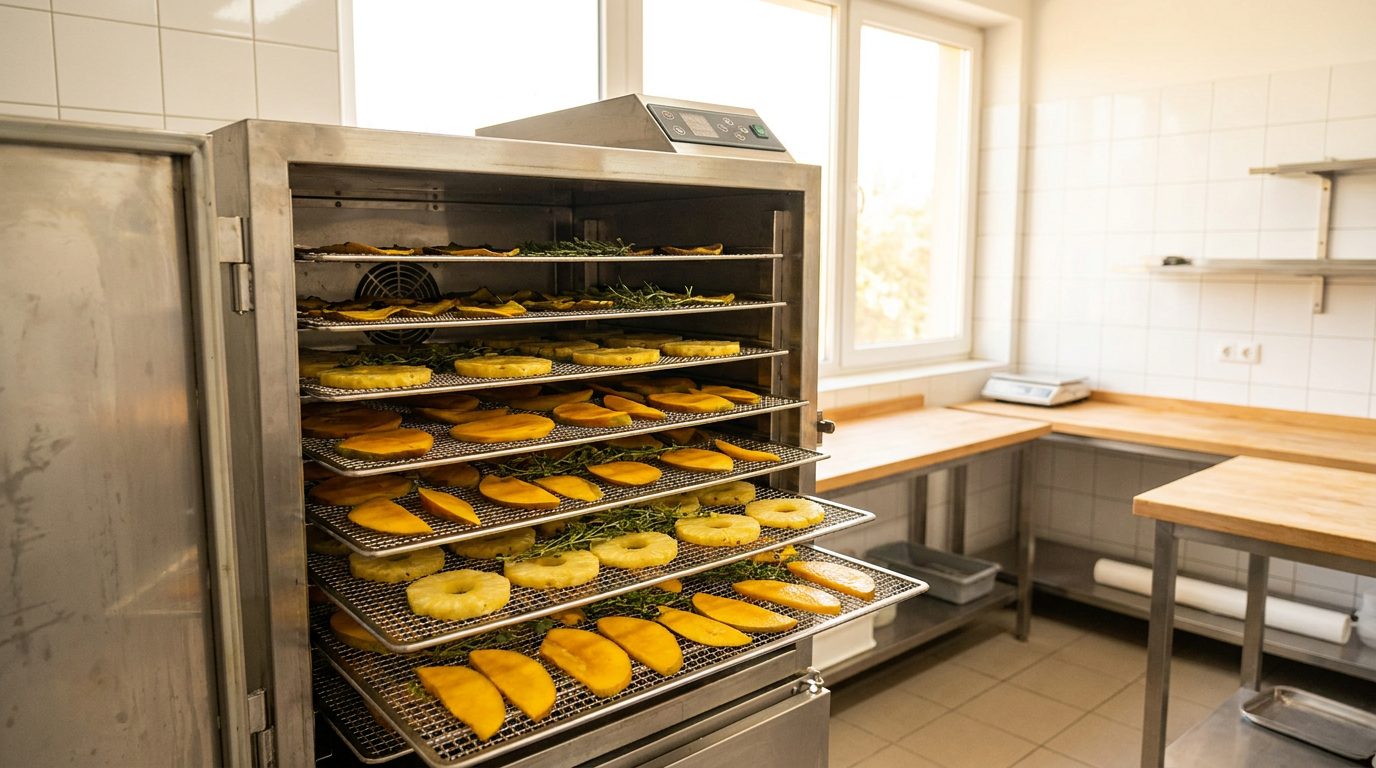
A commercial food dehydrator removes moisture from food using warm, moving air across stacked trays, which extends shelf life without freezing or chemical preservation. For a Sri Lankan producer, the machine you need is defined by two numbers: how many trays you can fill in one batch, and how much tray area each layer gives you. Everything else - airflow design, temperature control, construction - determines how evenly those trays dry.
Dehydration is one of the few value-adding processes a small producer can start without a cold chain. Fruit that is unsaleable fresh after two days becomes a packaged product with months of shelf stability, sold at a higher price per kilogram than the raw crop.
What drying actually does to food
Spoilage organisms need available water. Drying reduces water activity to the point where bacteria, yeast and mould cannot grow, which is a different thing from simply making food feel dry to the touch. That is why the finish matters: a batch that looks dry but retains moisture in the thickest pieces will mould inside a sealed pack weeks later.
Three practical rules follow from this:
- Uniform pieces dry uniformly. Inconsistent slice thickness is the main cause of a failed batch, not the machine.
- Low and slow beats hot and fast. Excessive heat case-hardens the surface, sealing moisture inside the piece.
- The last stage is the slowest. Removing the final portion of moisture takes disproportionately longer than the first, and skipping it is what causes shelf-life failures.
Different products also want different treatment: leafy herbs and curry leaves dry at gentle temperatures to hold their colour and aroma, fruit sits in the middle, and meat or fish products need higher, food-safety-driven handling. Follow the established guidance for each product category rather than running everything at one setting.
Sri Lankan products that suit dehydration
The domestic and export opportunity here is real and specific:
- Fruit - jackfruit, banana, mango, pineapple, papaya, wood apple and ambarella, sold as snack packs or as inputs to bakery and cereal products.
- Spices and aromatics - chilli, ginger, turmeric, garlic, pandan and curry leaves, either as a finished product or as pre-drying for grinding into powder.
- Herbs and wellness lines - moringa, gotukola and tea-adjacent botanicals, where colour retention drives the price.
- Vegetables - onion, tomato and mushroom for food-service and ready-meal supply.
- Coconut and protein products - desiccated and chip formats, dried fish and jerky-style lines under appropriate food-safety controls.
Drying is frequently the first step rather than the last. Producers making chilli powder, turmeric powder or spice blends dry first and then mill, which is why a dehydrator and the equipment in the food grinders range are usually specified together.
Reading tray counts and tray sizes
Manufacturers describe these machines by layers or trays, and the honest way to compare them is total tray area, not layer count alone. A machine with more layers but smaller trays may not hold more product than one with fewer, larger trays.
| Machine class | Typical use | Batch character | Planning note |
|---|---|---|---|
| 5-layer compact | Home producer, recipe development, sampling | Small single-product batches | Good for proving a product before scaling |
| 10-tray compact (195 x 280mm trays) | Cottage industry, small market seller | Modest batch, low bench footprint | Tray area is small - check against your slice volume |
| 10-tray standard (380 x 280mm trays) | Small commercial producer | Meaningful batch on one machine | Larger trays give substantially more area per layer |
| 16-layer industrial | Established producer, regular supply orders | Full production batches | Load and unload time becomes a labour factor |
| 30-layer industrial | Volume production, contract supply | Continuous production planning | Needs dedicated space, power and a prep team |
In practice: the Food De-Hydrator 05 Layers is the machine for testing a product and building a recipe before you commit to volume. The Compact Food Dehydrator 10 Tray 195 × 280mm and the Industrial Food Dehydrator 10 Tray 380 × 280mm share a layer count but not a working area - the 380 x 280mm trays hold considerably more per layer, which is the difference between a market-stall batch and a small supply order.
Once you are drying to a schedule, the Industrial Food De-Hydrator 16 Layers covers regular production runs, and the Industrial Food De-Hydrator 30 Layers is a production-line machine for producers with contracted volumes and staff to load it.
Airflow, temperature control and batch uniformity
Two machines with the same tray count can produce very different results, and the difference is airflow.
Air must move across every tray, not just the ones nearest the fan. When it does not, trays closest to the heat source finish early and scorch while the far trays remain moist - and the operator compensates by over-drying the whole batch. Good practice with any multi-tray machine is to rotate tray positions during the run and to check the thickest pieces on the least-favoured tray as your reference for doneness, not the pieces on the best tray.
Temperature control matters just as much. A stable, adjustable set point lets you run herbs gently and fruit warmer; a machine that only has "on" forces every product through the same conditions. Loading density is the third variable within your control: trays crowded edge to edge block airflow, and a single layer with visible gaps between pieces dries faster and more evenly than a packed tray, even though it feels less efficient.
After drying: packing and storage
A perfectly dried batch can still fail on the shelf. Dried product is hygroscopic - it pulls moisture back out of humid air, and Sri Lankan ambient humidity is exactly the condition that undoes your work.
Cool the batch fully before packing, because warm product packed immediately releases vapour into the bag and condenses. Then pack with as little air as possible. This is where a vacuum sealer earns its place: units in the vacuum sealer machines range, such as the Industrial Vacuum Sealer Machine DZ400T, remove headspace air so colour, aroma and crispness hold through the distribution period rather than degrading in the first fortnight.
Store the packed stock away from light and heat, and keep a retained sample from each batch so you can check how your product actually ages. That record is what turns a home-scale line into a supplier a retailer will list.
How to choose: decision checklist
- Name the product and its slice format before choosing a machine - thickness and piece size drive both tray area and run time.
- Calculate your weekly kilograms of raw input, then divide by the batches you can realistically run per week to find your required batch size.
- Compare tray area, not layer count. Multiply length by width by number of trays to compare machines honestly.
- Check that temperature is adjustable if you plan to dry more than one product category.
- Allow for the shrink ratio. Fresh fruit and vegetables lose the great majority of their weight, so raw handling capacity always exceeds finished output by a wide margin.
- Plan the prep bench. Washing, peeling, slicing and loading take longer than the drying itself in labour terms.
- Confirm space, ventilation and power position. Dehydrators run for many hours and exhaust warm, moist air that needs somewhere to go.
- Specify packing at the same time. Sealing capacity that lags behind drying capacity leaves finished product exposed to humidity.
Frequently asked questions
What size food dehydrator do I need for a small business?
Work from raw input. Weigh a typical week's produce, decide how many batches you can run and staff per week, and divide. Producers testing a product usually start at 5 layers; regular market or retail supply generally needs a 10-tray machine with full-size trays or a 16-layer unit.
How long does it take to dehydrate fruit?
It varies widely with the fruit, slice thickness, load density and set temperature, so treat published times as indicative only. The reliable method is to test the thickest pieces on the least-favoured tray and continue until they are consistently dry, rather than running a fixed clock.
Can I dry chillies and spices in the same machine as fruit?
Yes, but not in the same batch. Strong aromatics transfer flavour, so run them separately and clean trays thoroughly between products. Many producers dedicate specific trays to spices for exactly this reason, and dry pale fruit early in the cleaning cycle.
Is a food dehydrator better than sun drying?
For a commercial product, generally yes. A dehydrator gives controlled temperature and airflow, protects the batch from dust, insects, rain and overnight rehumidification, and produces a consistent result you can repeat and stand behind with a buyer. Sun drying costs less but is far harder to standardise.
What do I need besides the dehydrator?
A wash and prep area, a slicer or consistent cutting method, cooling space, weighing scales, and a sealing and packing setup. If your product will be milled into a powder, add grinding capacity; if it will be retailed, add sealed packaging that resists humidity.
Where to start
Choose by tray area and adjustable temperature rather than by headline layer count, and plan your packing step at the same time as your drying step. The food dehydrator range runs from compact 5-layer units to 30-layer industrial machines. If drying is one step in a larger production build, the commercial kitchen equipment guide covers the prep and processing stations that surround it.
Share:
Chocolate Melting Machine Guide: Tempering, Capacity and Workflow
How to Choose a Vacuum Sealer for a Restaurant Kitchen