
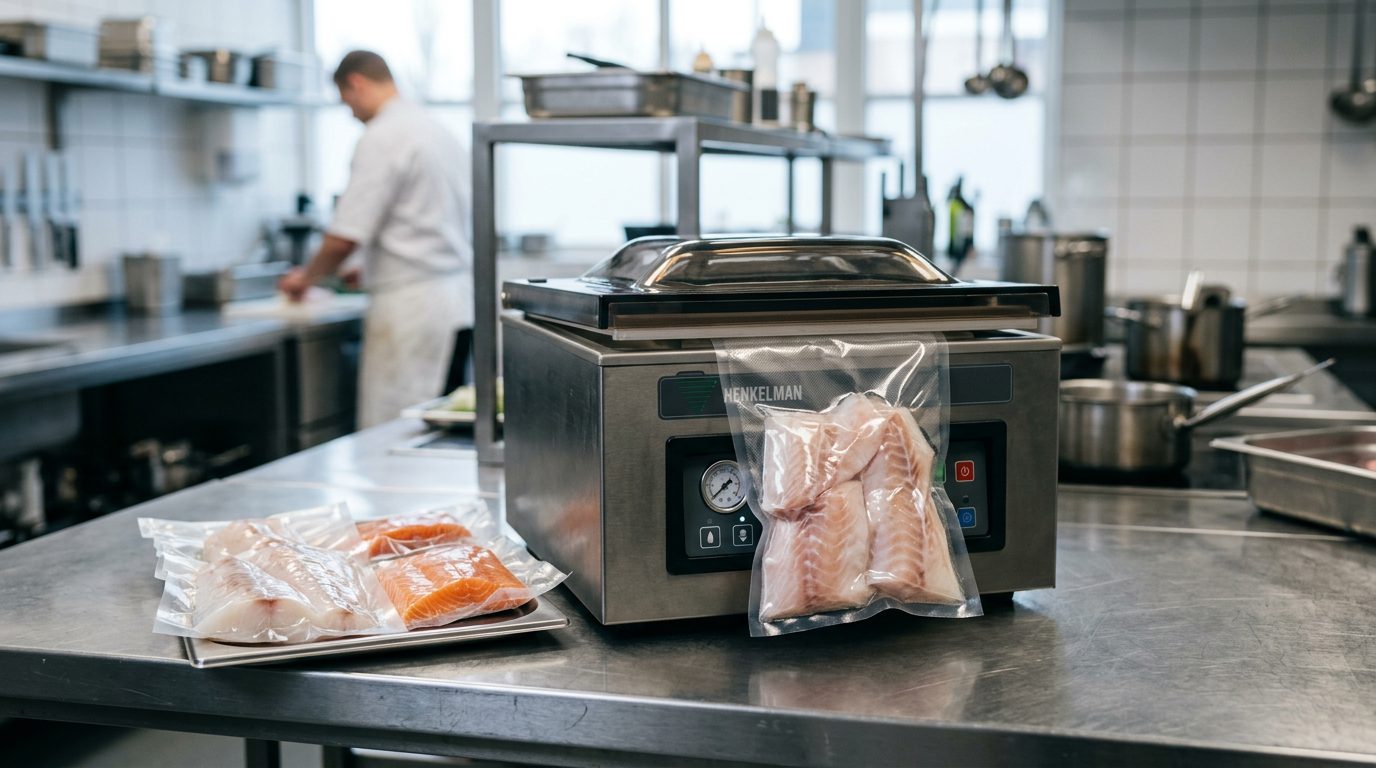
A vacuum sealer for restaurant use is not the same tool as a home food saver. Professional kitchens need a machine that will seal wet products — marinated meat, stocks, curry bases, brined vegetables — cycle after cycle through a service prep session, which in practice means a chamber machine rather than a suction-nozzle unit. The decision comes down to what you seal, how wet it is, how many bags a day you run, and how much bench space you can give up.
What a vacuum sealer actually changes in a working kitchen
Three things, in order of how much money they usually save.
Portion control. Sealing pre-weighed portions turns a subjective job into a measured one. A chef portioning chicken by eye across a week loses margin invisibly; sealed portions make yield a number you can check.
Shelf life on prepped items. Removing air slows oxidation and the growth of aerobic spoilage organisms. In Sri Lanka's heat and humidity, an open tray of prepped protein degrades fast even under refrigeration; a sealed bag buys you usable working time. It does not make food safe indefinitely — chilling discipline still does the heavy lifting, and anaerobic pathogens are exactly the ones vacuum packing does not suppress. Treat sealing as a quality and waste tool, not a substitute for temperature control.
Freezer protection. Freezer burn is dehydration at the surface. A tight seal against the product almost eliminates it, which matters if you buy protein in bulk and hold it in a commercial chiller or freezer.
Kitchens running sous vide need a sealer as a precondition, not an accessory. So do producers who dry fruit, chilli or curry leaf in a food dehydrator and then need to hold the dried product without it picking up moisture back out of the air.
Chamber vs external vacuum sealers
This is the fork in the road. Everything else is detail.
| Chamber machine | External (suction) sealer | |
|---|---|---|
| How it works | Bag sits inside a sealed chamber; air is evacuated from the whole chamber, then the bar seals | Bag mouth clamps into the machine; a pump sucks air out through the opening |
| Liquids | Handles wet product, marinades and light liquids well, because pressure equalises inside and outside the bag | Struggles — liquid gets drawn towards the pump and stops the seal |
| Bags | Plain smooth pouches, generally the cheaper consumable per unit | Requires embossed or channelled bags |
| Cycle speed | Fast and repeatable once set; suits batch prep | Slower per bag under sustained use |
| Footprint | Heavier, needs dedicated bench space | Compact, can live in a drawer |
| Typical fit | Restaurants, hotels, butchery, sous vide, central kitchens | Home use, very light café prep, small retail packs |
If you plan to seal anything with sauce, stock or marinade in it, a chamber machine is the answer. Trendy Zone lists two industrial units in the vacuum sealer machines range — the Industrial Vacuum Sealer Machine DZ400T and the Industrial Vacuum Sealer Machine DZ260T. Before committing to either, take your largest intended pouch and check it against the machine's stated chamber and seal bar dimensions, because bag width is the constraint that people discover too late.
For a home kitchen, a small operator testing an idea, or a front-of-house pack-down job with dry goods only, the Russell Hobbs Seal Fresh Vacuum Sealer is the domestic-class alternative. It is a different tool for a different duty cycle — do not put it on a production line.
Sealing jobs that are not vacuum sealing
A common purchasing mistake is buying a vacuum sealer to solve a problem that is actually a container-sealing problem.
If you sell bubble tea, fresh juice, faluda or takeaway beverages, what you need is a cup sealer — the Industrial Manual Cup Sealer applies a film lid to a filled cup so it survives a delivery rider's route. If you pack sauces, chutneys, ready-meals or preserved product into tins, that is the job of the Industrial Semi Automatic Can Sealer. Neither removes air from a pouch; both solve packaging problems that a vacuum sealer cannot.
Work out which of the three jobs you actually have before you shop. Some kitchens need two of them.
Sizing the machine to your prep volume
There is no honest bag-per-hour figure that applies across products, so size on the following instead.
- Bags per prep session at peak. Count your busiest realistic day, not your average. A machine that comfortably clears your peak session in one prep block is correctly sized.
- Largest single item. Whole fish, a full rack, a bulk 5 kg protein pack. Your biggest item sets the minimum seal bar length and chamber depth.
- Wet-to-dry ratio. If more than a small fraction of your sealing is wet, chamber is mandatory, not preferred.
- Duty pattern. Continuous back-to-back cycles heat the seal bar and load the pump. Batch prep in blocks with brief rests is gentler than a two-hour unbroken run.
- Bench and power access. Chamber machines are heavy and want a dedicated, level surface near a socket, ideally close to the cold store so sealed product goes straight into chill.
How to choose: a decision checklist
Work through these in order. If you cannot answer one, you are not ready to buy.
- What am I sealing? List the five items by volume. If any is wet, choose chamber.
- What is the largest pouch? Measure it. Compare against the machine's chamber and seal bar dimensions.
- How many bags per peak session? Choose a machine that clears that in one block.
- Where does it live? Confirm bench space, a level surface, socket access and a short walk to refrigeration.
- Who operates it? Chamber machines need a two-minute briefing on bag placement and cycle settings; nominate the person and write the procedure on the wall.
- What is the consumable plan? Confirm you can consistently source the correct bag type and gauge for that machine, in the sizes you measured.
- Does this change my food-safety plan? Vacuum packing changes storage assumptions. Review your chilling, labelling and use-by discipline, and confirm what your local authority requires for packed and date-marked food.
- What is the cleaning routine? Decide now who wipes the chamber, checks the seal gasket and inspects the seal bar tape, and how often.
Keeping a sealer running
Chamber machines are simple but unforgiving of neglect. The gasket around the chamber lid is the part that fails first — it takes a beating from lid closures and from stray salt and marinade. Wipe it after every session and inspect it for compression damage.
The seal bar's cover tape is a consumable; when seals start coming out uneven or bubbled, that tape is usually the reason, not the pump. Keep spares. Chamber machines generally use an oil-lubricated rotary vane pump, and pump oil in a humid climate absorbs moisture — follow the manufacturer's documentation for the oil-change interval and never run the machine hot with contaminated oil.
Finally, never seal steaming-hot product. Vapour condenses in the bag and contaminates the seal line, and hot product going into vacuum has its own food-safety problems. Chill first, seal second.
Frequently asked questions
Can a vacuum sealer seal liquids like stock or curry? A chamber machine can, because it evacuates air from the whole chamber, so there is no pressure difference pulling liquid towards a nozzle. External suction sealers cannot — liquid gets drawn into the machine and ruins the seal. Chilling the liquid thoroughly first makes chamber sealing cleaner and more reliable.
Is a vacuum sealer worth it for a small restaurant? It usually pays back through portion control and reduced waste rather than through any single dramatic saving. If you portion protein by hand, buy in bulk, or run sous vide, the case is strong. If you cook everything to order from daily deliveries, it is a lower priority than refrigeration.
What bags do commercial vacuum sealers use? Chamber machines use plain smooth pouches. External suction machines require embossed or channelled bags so air has a path to the pump. The two are not interchangeable, and using a smooth bag in a suction machine is the most common reason a new owner thinks their machine is faulty.
How long does vacuum-sealed food last? Longer than the same food in open storage, but there is no universal figure — it depends on the product, its initial quality and your storage temperature. Vacuum packing slows oxidation and aerobic spoilage; it does not stop anaerobic organisms. Keep your existing chilled and frozen storage rules and date-mark every bag.
Do I need a vacuum sealer for sous vide? Effectively yes for consistent results. Water needs full contact with the product for even heat transfer, and a loose bag insulates. A chamber machine is the practical choice because most sous vide preparations involve marinade or fat in the bag.
Where to start
Decide chamber or external first, measure your largest pouch second, then compare the units in the vacuum sealer machines collection. If sealing is part of a wider prep upgrade, read the commercial kitchen equipment guide for Sri Lanka for how prep, cold storage and packing fit together, or the hotel equipment guide if you are specifying for a property with multiple outlets. Kitchens buying protein in bulk should also look at meat mincers, slicers and processing machines, since breaking down and sealing are usually the same workflow.
Share:
Food Dehydrator for Business: A Guide for Sri Lankan Producers
Soup Kettle Commercial Use: Holding, Sizing and Service