
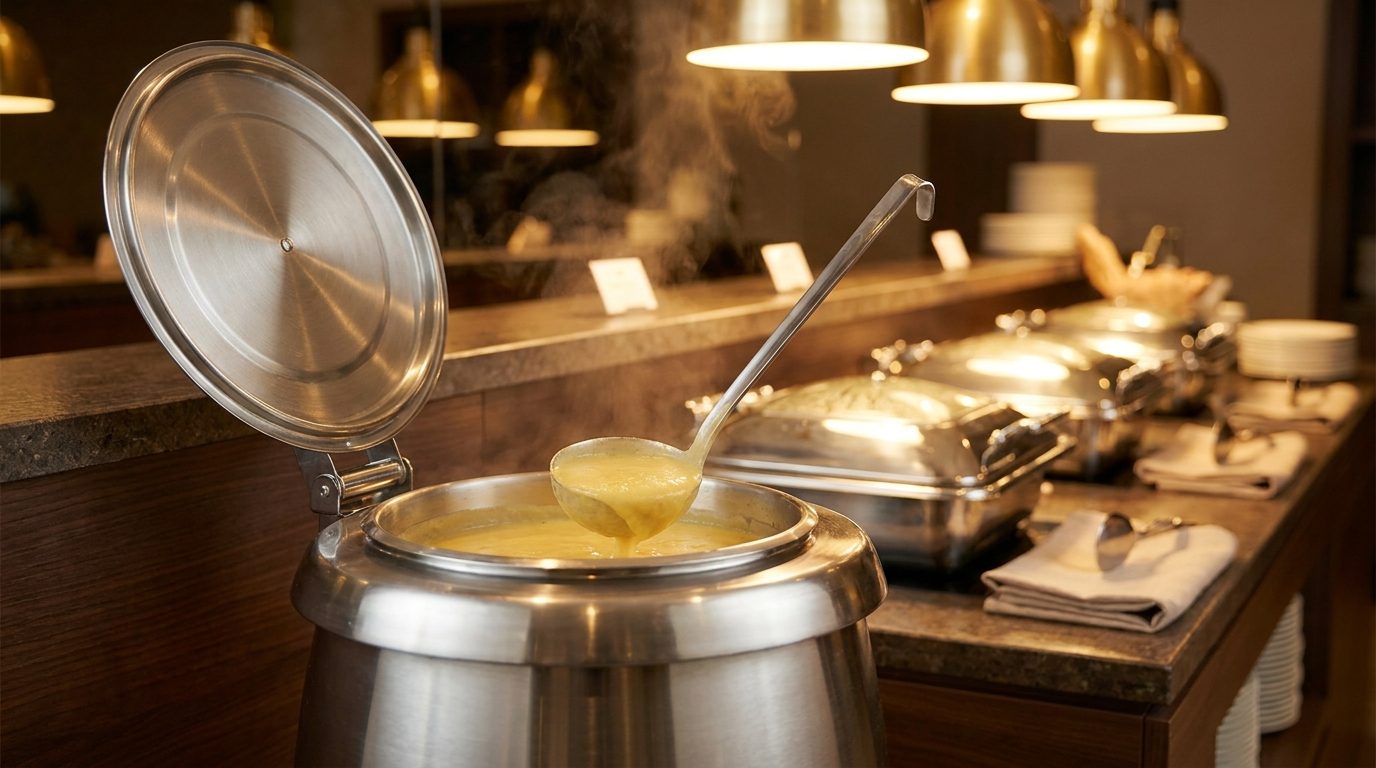
A commercial soup kettle is a holding appliance, not a cooking appliance. It keeps an already-hot product at a safe, consistent serving temperature for the length of a service — soup, dhal, kanji, gravy, curry base or a hot beverage — using a gentle heating element under a stainless insert. It will not bring cold product up to temperature quickly, and asking it to is the single most common reason kitchens are disappointed by one.
What a soup kettle is for
Picture a buffet line at 7 a.m. Kanji and a soup went into the kettles at 6:30, already at full temperature from the range. For the next three hours the kettle's job is to hold that product in the safe zone, keep it visually appetising, and let a server ladle from it without dragging a pot back and forth from the kitchen.
That is the whole brief, and it is a narrow one. A kettle is right when:
- the product is liquid or semi-liquid and stirs easily;
- it will be served over an extended window rather than plated to order;
- the serving point is in front of guests, or at a counter separated from the cook line;
- the volume per service is modest — one kettle serves a station, not a banquet.
It is the wrong tool when you need to reheat from chilled, when the product is thick enough to catch on the base, or when you need to hold six different components at once. For those, look at a bain marie or a heated food warmer or display unit.
Soup kettle vs bain marie vs chafing dish
These three get confused constantly, and buying the wrong one wastes both money and counter space.
| Soup kettle | Bain marie | Chafing dish | |
|---|---|---|---|
| Heat source | Electric element under a single round or oval insert | Electric element heating a water bath under multiple GN pans | Fuel gel or electric heater under a water pan |
| Products | One liquid product per unit — soup, gravy, kanji, dhal, hot drinks | Several dishes at once, wet or dry | Buffet dishes, usually plated food |
| Portion control | Ladle from a deep insert; easy to serve consistent volumes | Serving spoon per pan | Serving spoon per pan |
| Best location | Counter, buffet end, café front | Service pass or buffet back-line | Banquet, outdoor and off-site catering |
| Power | Mains socket | Mains socket | Fuel gel or mains, so it travels |
| Weakness | One product only | Bulkier, needs water management | Least temperature control |
If your service is a hotel breakfast or a buffet with several hot components, a kettle usually sits alongside a bain marie rather than replacing it. If you cater off-site where power is unreliable, chafing dishes and buffet sets are the more portable answer.
Sizing: how many litres, how many units
Capacity is the decision most operators get wrong, in both directions. Under-size and staff top up mid-service, which means product at mixed temperatures and a queue waiting. Over-size and you hold a half-empty insert all morning, which scorches the sides and dulls the product.
Work backwards from service:
- Portion size. Decide the ladle size you actually serve — a cup portion and a bowl portion are very different demands on the same kettle.
- Covers in the window. How many portions across the whole holding window, not the whole day.
- Top-up rhythm. Aim to refill once mid-service with freshly cooked product rather than either running dry or filling to the brim at open. Product held for the full window loses quality regardless of the equipment.
- Number of products. Each product needs its own kettle. Two soups means two units, full stop.
In practice, a café serving one soup at lunch is served by a single unit such as the Industrial Soup Kettle 10L (Unique) or the Industrial 10l soup kettle. A hotel breakfast line running kanji plus a soup, or a busy food court counter, is better matched to the larger 13-litre class — the Industrial Soup Kettle 13L – Stainless Steel Finish is the workhorse specification. Compare the full range of commercial soup kettles against your portion maths rather than buying the biggest unit available.
Finish matters more than you would expect
A soup kettle is almost always visible to the guest, which makes its finish a service decision rather than a cosmetic one. A stainless body reads as clinical and professional and disappears into a stainless counter. A darker unit like the Industrial Soup Kettle 13L – Black Finish sits better on a wooden or painted counter in a café. A copper-look body such as the Industrial Soup Kettle 13L Copper Body (Unique) suits a heritage or fine-dining buffet where the equipment is part of the presentation.
Whatever the outside, check the insert: it should lift out cleanly for washing, and the lid should be easy to hold open one-handed while a server ladles.
Holding temperature and product quality
Hot holding has two masters. Food safety requires product to stay above the hot-holding threshold your local authority applies — the widely used commercial benchmark is around 63°C — and quality requires it not to sit far above that for hours. Confirm the specific requirement and record-keeping expected in your area before you write your procedure.
Practical rules that hold across products:
- Load hot. Bring product to full temperature on the range, then transfer. Never use the kettle to heat from cold.
- Stir on a schedule. Every 20 to 30 minutes, from the bottom. This evens temperature and stops a skin forming.
- Lid on between services. An open kettle loses heat and moisture fast, and thickens the product.
- Check with a probe, not by eye. The dial on the front is a control, not a measurement.
- Set a discard time. Decide the maximum holding window in advance and stick to it, whatever the kettle can technically do.
- Watch thick products. Dhal, thick gravies and anything starchy will catch on the base. If a product needs constant attention, it belongs in a water-bath unit instead.
How to choose: decision checklist
- How many separate hot liquid products do I serve at once? (One kettle each.)
- What is my portion size and how many portions across the holding window?
- Is the unit guest-facing, and does the finish match that counter?
- Is there a dedicated socket at the serving point, on a circuit that is not already loaded?
- Does the insert lift out for washing, and where does it get washed?
- Who probes and logs the temperature, and how often?
- Does the product I intend to hold behave in a dry-heat kettle, or does it need a water bath?
- What is my top-up plan, and who cooks the refill batch?
Cleaning and upkeep
Empty and strip the kettle daily. The insert washes like any pot; the body should be wiped, never submerged, and the element area kept dry. Sri Lanka's hard water leaves scale in units where staff add water for a wet-heat setup, so descale on a routine, not when someone notices.
Two failure patterns account for most dead kettles: running dry with the element on, and liquid getting into the control housing during cleaning. Both are avoidable with a written closing procedure taped inside the counter.
Frequently asked questions
Can a soup kettle heat cold soup? It should not be used that way. The element is sized to hold temperature, not to raise it, so cold product spends hours in the temperature range where bacteria multiply. Heat to full temperature on the range or in a stock pot, then transfer to the kettle for holding.
How long can soup be held in a soup kettle? Long enough for a normal service window, provided it stays above your local hot-holding threshold and is stirred regularly. Quality is usually the limiting factor before safety is. Set a fixed discard time for your operation, log the temperature through service, and do not carry product over to the next day.
Do I need water in a commercial soup kettle? It depends on the model. Some are designed for direct dry heat under the insert, others expect a shallow water bath which gives gentler, more even heat and suits thicker products. Follow the unit's own documentation — running a wet-heat design dry is a common way to damage the element.
What size soup kettle do I need for a small café? Base it on portions rather than seats. A single 10-litre-class unit typically covers a café serving one soup over a lunch window, with one mid-service top-up from a fresh batch. Add a second unit rather than a bigger one if you want to offer two soups.
Is a soup kettle better than a bain marie for a buffet? They do different jobs. A kettle holds one liquid product, serves cleanly from a deep insert and looks presentable in front of guests; a bain marie holds several dishes at once in GN pans and is better suited to the back-line. Most hotel buffets end up running both, with kettles at the guest-facing soup and kanji station.
Where to start
Count your portions, decide how many products you hold at once, then compare finishes and capacities across the soup kettle range. If you are specifying a full breakfast or buffet line, the hotel equipment guide for Sri Lanka covers how holding equipment fits with the rest of the service line, and the commercial rice cooker and steamer guide covers the bulk-cooking side that feeds it.
Share:
How to Choose a Vacuum Sealer for a Restaurant Kitchen
Commercial Kitchen Layout Plan: Designing for Workflow